
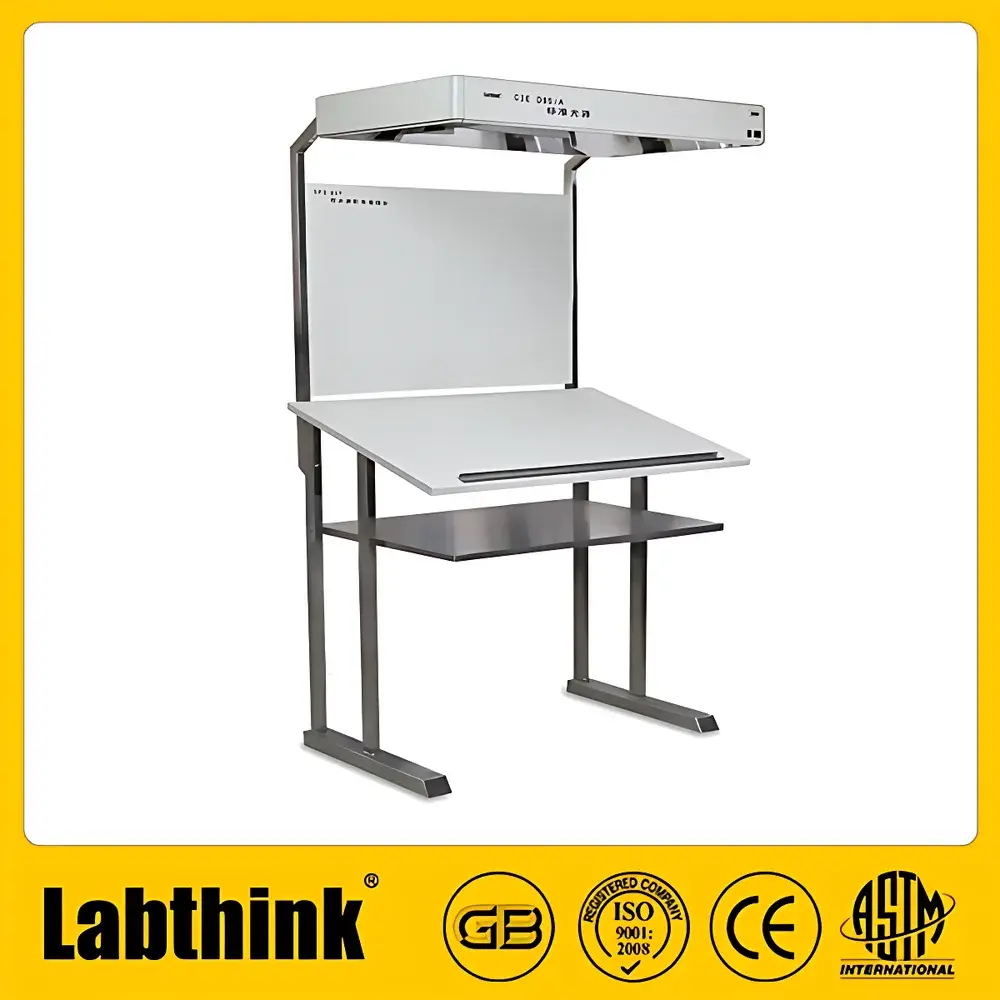
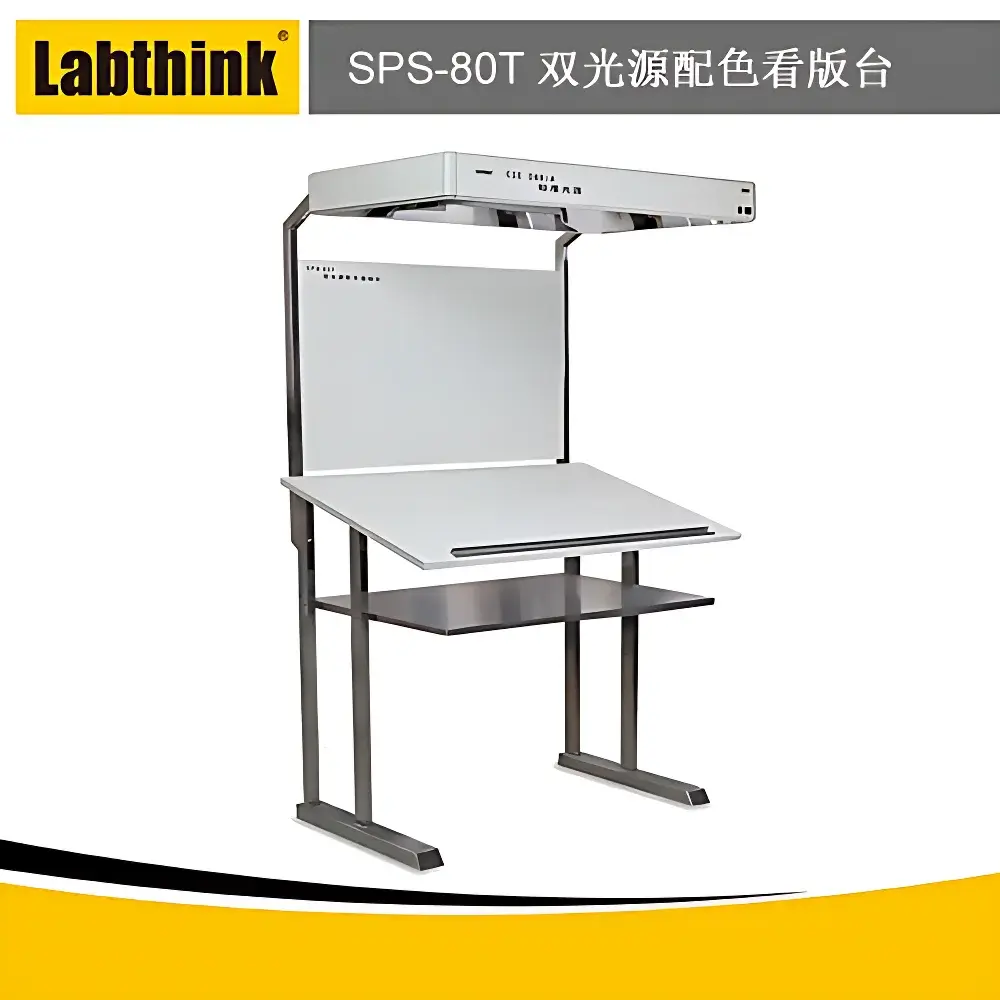
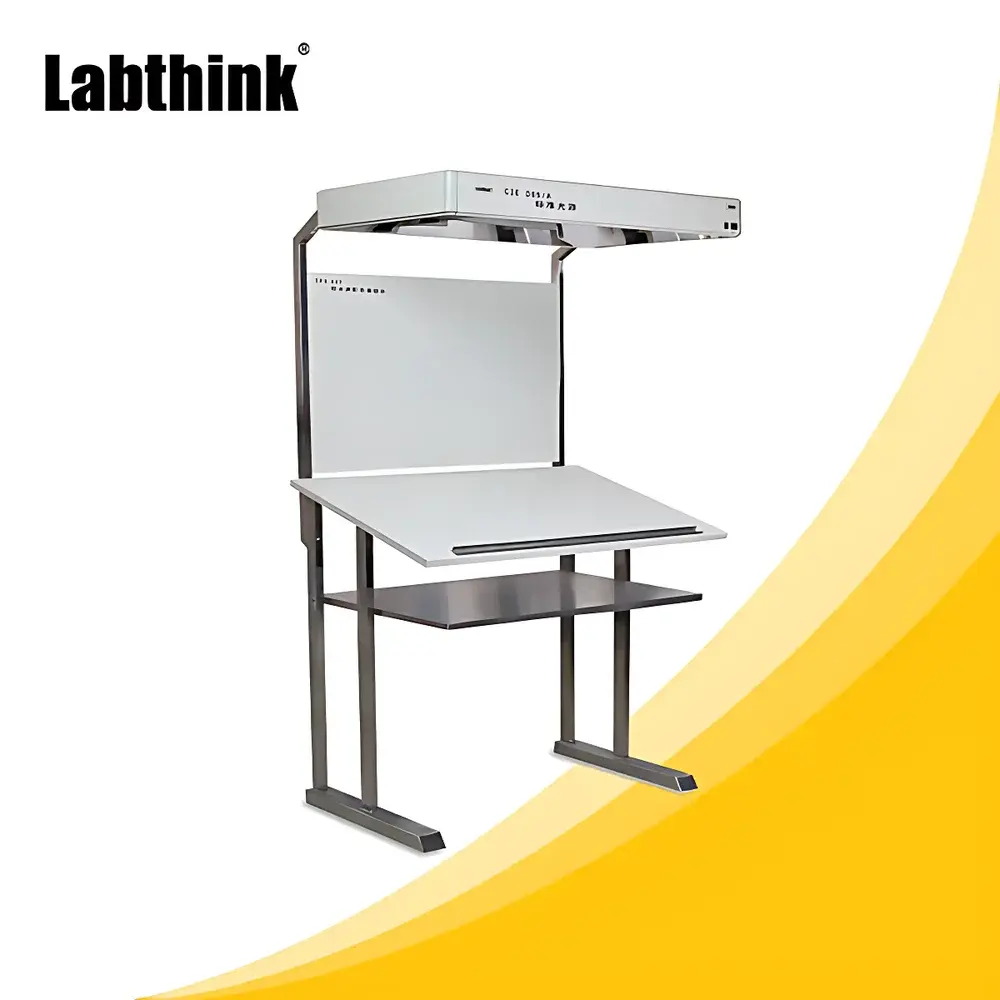
Labthink SPS-80T Dual-Source Standard Light Booth (D65 & Illuminant A)
| Brand | Labthink |
|---|---|
| Model | SPS-80T Dual-Source |
| Light Sources | CIE D65 (6500 K, Ra > 90) & Illuminant A (2900 K, Ra = 100) |
| Viewing Surface | 1050 mm × 700 mm |
| Overall Dimensions | 1050 mm (L) × 800 mm (W) × 2100 mm (H) |
| Net Weight | 40 kg |
| Power Supply | 220 VAC 50 Hz / 120 VAC 60 Hz |
| Compliance | CIE No. 51, ISO 3664:2009, CY/T 3–91, ASTM D1729, ASTM E308 |
Overview
The Labthink SPS-80T Dual-Source Standard Light Booth is an engineered optical evaluation system designed to replicate standardized illumination environments essential for color-critical visual assessment in industrial quality control and R&D workflows. It implements the CIE-defined spectral power distributions of two fundamental illuminants—D65 (representing average daylight, 6500 K) and Illuminant A (representing incandescent tungsten lighting, 2900 K)—within a single, ergonomically optimized vertical viewing cabinet. The device operates on the principle that human color perception is inherently illuminant-dependent; therefore, reliable color matching, tolerance verification, and metamerism detection require controlled, spectrally stable, and photometrically uniform lighting conditions. Unlike generic light boxes, the SPS-80T integrates precision-engineered optical components—including high-CRI D65 fluorescent tubes (Ra > 90), calibrated tungsten-halogen A-source lamps (Ra = 100), and a rigorously diffused anti-glare viewing chamber—to ensure compliance with ISO 3664:2009 (Graphic technology — Viewing conditions), CIE Publication No. 51 (Technical Report on Colorimetry), and China’s CY/T 3–91 standard for color evaluation in printing and packaging.
Key Features
- Dual independent light source switching with tactile toggle controls and status indicators for seamless D65/A transitions without recalibration or warm-up delay
- Neutral gray interior surface (Munsell N8 matte finish) minimizing chromatic contamination and enhancing contrast sensitivity during side-by-side sample comparison
- Optimized optical geometry: downward-tilted reflective hood and adjustable specimen platform ensure uniform illuminance (±5% deviation across viewing area) and eliminate specular highlights
- Integrated lamp-hour counter with non-volatile memory, enabling traceable maintenance scheduling and regulatory audit readiness
- Compliant viewing geometry: 45°/0° observation angle alignment per ISO 3664, supporting both transmission and reflection mode assessments
- Robust steel frame construction with powder-coated finish, vibration-damped base, and cable management system for laboratory-grade durability and long-term photometric stability
Sample Compatibility & Compliance
The SPS-80T accommodates flat, rigid, and semi-flexible specimens up to 1050 mm × 700 mm in dimension—including printed sheets, coated films, textile swatches, painted panels, plastic injection-molded parts, and automotive trim samples. Its viewing chamber meets the spatial and photometric requirements specified in ISO 3664:2009 for critical color evaluation in graphic arts, packaging, and coatings industries. The system supports full implementation of ASTM D1729 (Standard Practice for Visual Appraisal of Colors and Color Differences of Objects) and ASTM E308 (Standard Practice for Computing the Colors of Objects by Using the CIE System), facilitating consistent pass/fail decisions against master standards. For regulated environments—including pharmaceutical packaging color verification under USP <661> or automotive OEM color release protocols—the booth’s documented illuminant fidelity and operational traceability align with GLP/GMP documentation expectations and support 21 CFR Part 11-compliant data review workflows when paired with validated digital logging tools.
Software & Data Management
While the SPS-80T operates as a hardware-only visual assessment station, its design incorporates interfaces compatible with third-party spectral imaging systems (e.g., Konica Minolta CM-700d, X-Rite eXact) and color management software suites (e.g., X-Rite Color iMatch, Datacolor Match Pigment). Optional USB-connected ambient light sensors and programmable relay modules enable integration into automated QC reporting pipelines. All lamp operating hours are stored locally with timestamped reset logs, providing auditable evidence for internal calibration intervals and supplier qualification audits. No proprietary firmware or cloud dependency is required—ensuring deterministic behavior, data sovereignty, and uninterrupted operation in air-gapped production labs.
Applications
- Pre-press and print proof verification under D65 illumination to simulate daylight viewing conditions for final customer approval
- Metamerism screening: simultaneous evaluation of sample/standard pairs under D65 and Illuminant A to detect spectral mismatch prior to mass production
- Color formulation validation in paint, ink, and plastic compounding laboratories where batch-to-batch consistency must be verified across multiple lighting environments
- Textile dye lot inspection for apparel and home furnishing manufacturers requiring conformance to retailer-specific color standards (e.g., Walmart, IKEA, H&M)
- Automotive interior trim color matching under both daylight-simulating (D65) and interior cabin lighting (A) conditions
- Educational use in color science curricula for demonstrating CIE color space principles, illuminant metameric failure, and observer variability
FAQ
What is the purpose of including Illuminant A alongside D65 in this booth?
Illuminant A simulates tungsten-filament lighting commonly found in retail stores, homes, and automotive interiors. Its inclusion enables detection of metamerism—the phenomenon where two colors match under one illuminant but diverge under another—critical for preventing field complaints and returns.
Does the SPS-80T meet ISO 3664:2009 requirements for critical color viewing?
Yes. It satisfies all mandatory criteria: D65 spectral distribution (CIE 15:2018), minimum illuminance (2000 lux ± 500 lux at viewing plane), uniformity (≥80% across central 80% of viewing area), and neutral surround (Munsell N8).
Can I replace the D65 tubes with newer LED-based equivalents?
No. LED retrofitting is not supported. The system’s photometric validation is based exclusively on the original high-CRI fluorescent D65 tubes and tungsten-halogen A lamps specified in the type certification report.
Is the viewing chamber suitable for evaluating transparent or backlit materials?
Yes. The optional translucent acrylic base plate (sold separately) enables transmission-mode assessment of films, labels, and packaging overlays under D65 illumination.
How often should the lamps be replaced to maintain compliance?
D65 tubes require replacement after 2,000 hours of cumulative operation; Illuminant A lamps after 1,000 hours. The built-in hour meter tracks usage per channel independently.




