
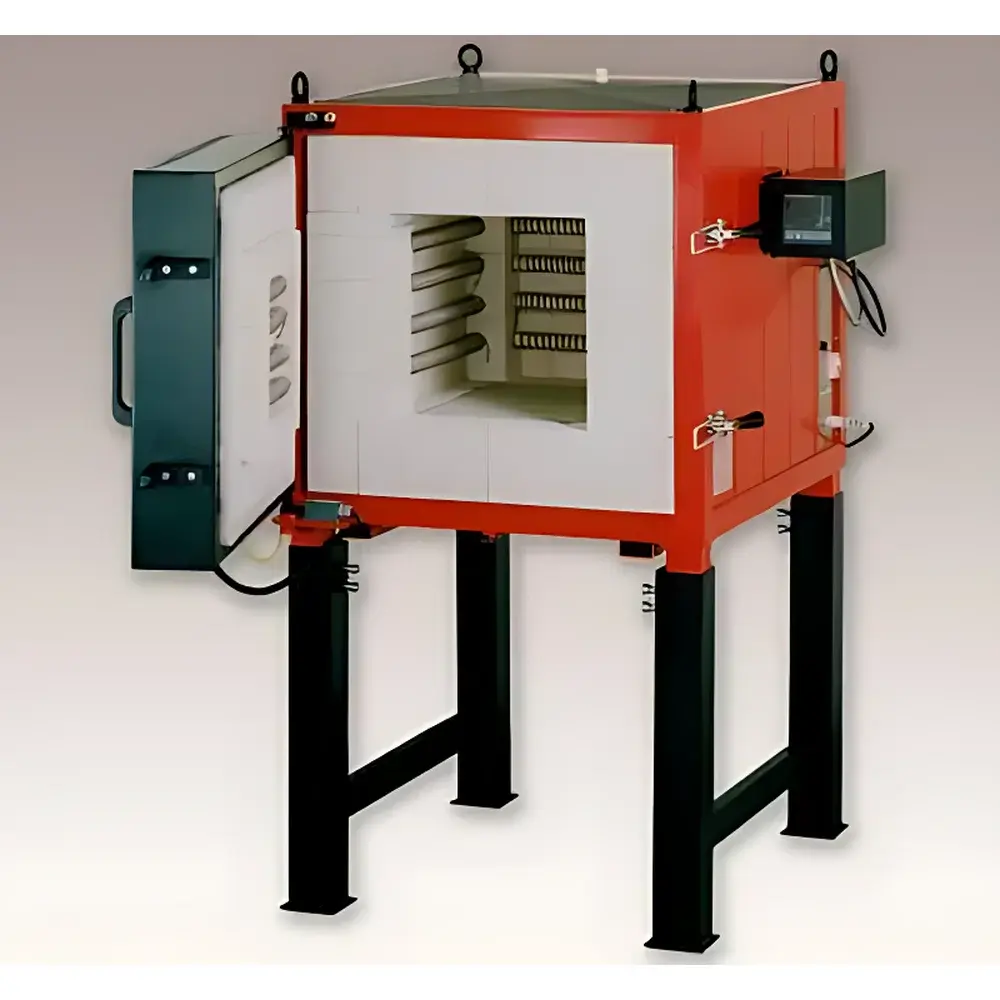
LAC KC Series Rapid-Heating Box-Type Muffle Furnace
| Brand | LAC (Czech Republic) |
|---|---|
| Model | KC Series |
| Type | Box-Type Muffle Furnace |
| Max Temp | 1300 °C / 1400 °C |
| Chamber Volume | 20–120 L |
| Power | 8–18 kW |
| Voltage | 380 V AC, 3-phase |
| External Dimensions (W×H×D) | 760×1250×850 mm to 1080×1480×1120 mm |
| Internal Dimensions (W×H×D) | 270×270×270 mm to 500×500×500 mm |
| Insulation Thickness | 30–40 mm mineral fiber + firebrick lining |
| Heating Element | Kanthal A1 wire wound on ceramic tubes, mounted on refractory brick supports, distributed across five surfaces (four walls + floor) |
| Temperature Sensor | Type S thermocouple |
| Controller | CERAMIC programmable controller (20 programs × 15 segments), real-time clock, SSR output |
| Safety | Door-mounted interlock switch, overpressure relief valve (optional), independent thermal cut-off unit |
| Compliance | Designed for GLP-compliant thermal processing |
Overview
The LAC KC Series Rapid-Heating Box-Type Muffle Furnace is an industrial-grade laboratory furnace engineered for high-precision thermal treatment of ceramics, glasses, metallurgical samples, and advanced functional materials. Operating on the principle of resistive heating via high-stability Kanthal A1 alloy wire elements, the furnace achieves rapid, repeatable ramp rates up to 30 °C/min while maintaining exceptional temperature uniformity (±3 °C at 1300 °C, ±5 °C at 1400 °C) across its five-sided heated chamber — including the floor — a configuration critical for eliminating thermal stratification during sintering, ashing, or heat-treatment protocols. Constructed with structural L-section steel framing and a corrosion-resistant stainless-steel outer casing, the KC series integrates dual-layer thermal insulation: a dense firebrick inner lining backed by 30–40 mm thick mineral wool, minimizing surface temperatures (40% compared to conventional single-layer muffle designs. Its 380 V three-phase supply ensures stable operation under continuous load, supporting uninterrupted thermal cycles required in QC laboratories and R&D facilities conducting ASTM C20, ISO 10545-9, or USP residue-on-ignition testing.
Key Features
- Five-surface heating architecture (four vertical walls + floor) enables superior axial and radial temperature homogeneity, verified per EN 15380 calibration procedures.
- Refractory chamber lined with high-purity alumina-silica firebricks (Al₂O₃ ≥ 60%) and mineral fiber insulation, rated for continuous operation at 1300 °C or 1400 °C depending on model variant.
- CERAMIC digital controller with non-volatile memory storing up to 20 independent thermal profiles, each comprising 15 programmable segments (ramp/soak/halt); integrated real-time clock allows scheduled autonomous start-up.
- Type S platinum-rhodium thermocouple (IEC 60584-2 Class 1) coupled with solid-state relay (SSR) output ensures low-noise, zero-crossing switching, eliminating electromagnetic interference with adjacent instrumentation.
- Mechanically interlocked left-hinged door with ergonomic right-side handle and safety cutoff switch compliant with EN 61000-6-2 immunity standards.
- Silicon carbide (SiC) hearth plate (standard) provides mechanical stability, chemical inertness against alkali fluxes, and resistance to thermal shock during rapid cooling cycles.
- Modular design supports factory-installed options including right-side door mounting, automated pneumatic lid actuation, and INDUSTRY controller with RS-485 Modbus RTU interface for SCADA integration.
Sample Compatibility & Compliance
The KC furnace accommodates crucibles (alumina, zirconia, graphite), ceramic setters, metal alloys, geological specimens, and pharmaceutical excipients without cross-contamination risk, owing to its fully enclosed muffle chamber and absence of combustion byproducts. It meets essential regulatory prerequisites for laboratories operating under Good Laboratory Practice (GLP) and ISO/IEC 17025 accreditation frameworks. The CERAMIC controller’s audit-trail-capable logging (when paired with optional INDUSTRY firmware and PC software) satisfies FDA 21 CFR Part 11 electronic record requirements for thermal validation documentation. All models are CE-marked per Machinery Directive 2006/42/EC and EMC Directive 2014/30/EU, with thermal performance validated against ISO 8573-1 purity class 4 for particulate-free heating environments.
Software & Data Management
While the standard CERAMIC controller provides local profile execution and basic data logging (max 1000 points), the optional INDUSTRY controller extends functionality with full traceability: time-stamped temperature curves, user-access-level permissions, password-protected parameter modification, and exportable CSV reports compliant with Annex 11 validation guidelines. When connected via RS-232 or RS-485, the furnace integrates into centralized lab information management systems (LIMS) or MES platforms using standard Modbus RTU protocol. Optional temperature monitoring software delivers real-time visualization, alarm thresholds, deviation alerts, and automated PDF certificate generation for IQ/OQ/PQ documentation.
Applications
- Ceramic sintering and densification (e.g., ZrO₂, Al₂O₃, Si₃N₄) under controlled atmospheres (air, N₂, Ar).
- Residue-on-ignition assays per USP , EP 2.4.15, and pharmacopoeial monographs.
- Thermal gravimetric analysis (TGA) sample pre-conditioning and ash content determination (ASTM D3174, ISO 1171).
- Glass annealing, devitrification studies, and frit melting behavior evaluation.
- Heat treatment of metallic powders, catalyst supports, and battery electrode materials (LiCoO₂, NMC).
- Calibration of thermocouples and reference materials in metrology labs (ISO/IEC 17025 Clause 6.4.10).
FAQ
What is the maximum recommended continuous operating temperature for the KC 80/14 model?
The KC 80/14 is rated for continuous operation at 1400 °C, with thermal stability maintained for ≥100 hours per cycle under nominal load conditions.
Can the furnace be operated in inert or reducing atmospheres?
Yes — the sealed muffle design supports nitrogen, argon, or forming gas (5% H₂/95% N₂) purging via optional inlet/outlet ports; however, hydrogen service requires additional safety certification and venting compliance.
Is the CERAMIC controller compliant with FDA 21 CFR Part 11?
The base CERAMIC unit does not support electronic signature or audit trail functions; full Part 11 compliance requires the INDUSTRY controller with enabled software license and configured Windows-based host system.
How is temperature uniformity verified and documented?
Uniformity mapping is performed using a 9-point thermocouple array per ASTM E2203, with certificates issued upon request showing deviation limits at specified setpoints (e.g., ±3 °C at 1200 °C).
What maintenance intervals are recommended for heating elements and insulation?
Kanthal A1 elements typically exceed 3000 hours of service life at 1300 °C; annual visual inspection of firebrick integrity and mineral fiber compression is advised, with replacement recommended after 5 years of daily use or visible cracking/delamination.



