
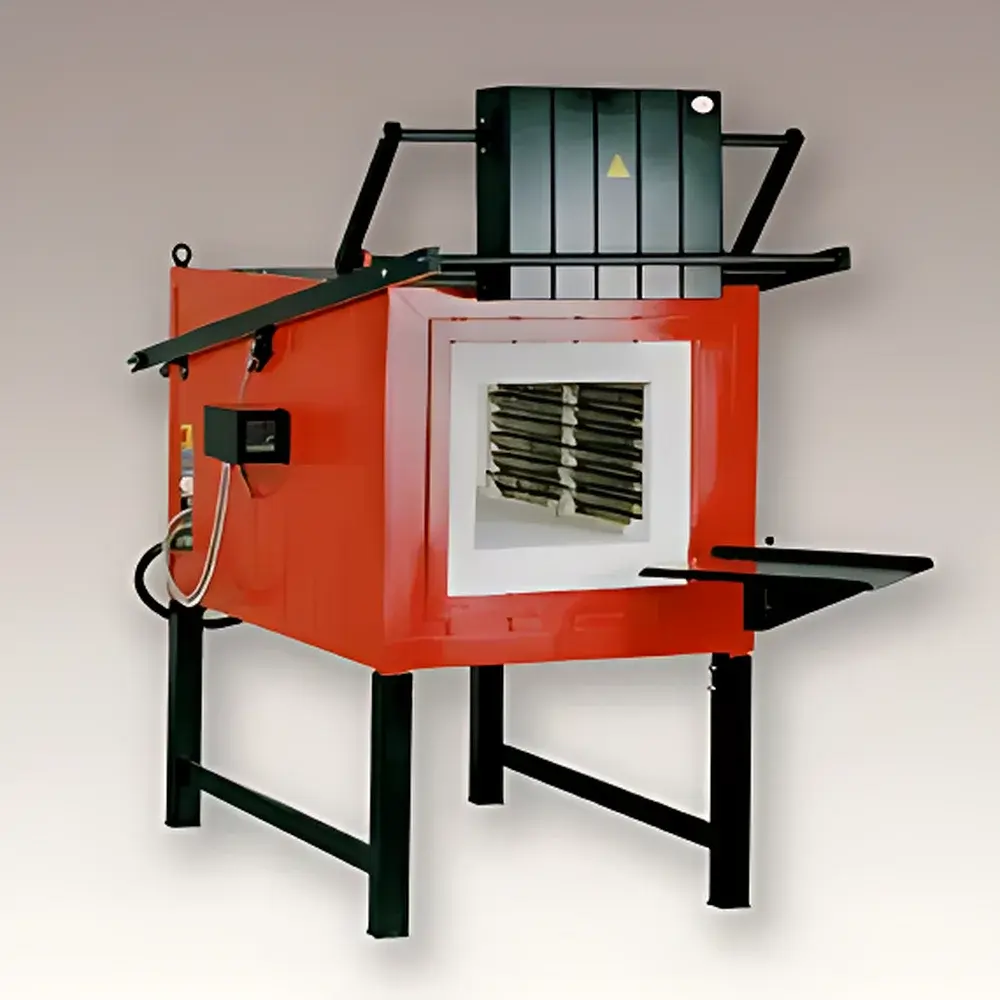
LAC PK Series Laboratory Quenching Furnace
| Brand | LAC |
|---|---|
| Origin | Czech Republic |
| Model | PK Series |
| Max Temperature | 1280 °C |
| Chamber Volume | 10–40 L |
| External Dimensions (W×H×D) | 700×700×790 mm to 1100×1440×1900 mm |
| Internal Dimensions (W×H×D) | 230×200×350 mm to 290×250×550 mm |
| Power Input | 3–11 kW |
| Weight | 60–320 kg |
| Voltage | 230 V or 400 V (3-phase) |
| Heating Configuration | Dual-zone (side + bottom) |
| Temperature Uniformity | Compliant with DIN 17052-1 Class A |
| Control System | INDUSTRY PID Controller with 30 programmable profiles (15 steps each), real-time clock, non-contact semiconductor relay |
| Thermocouple | Type S (Platinum/Rhodium) |
| Insulation | Lightweight refractory brick |
| Structural Frame | Low-carbon steel |
| Door | Manually operated, safety interlock switch |
| Optional Atmosphere | Semi-sealed design compatible with protective gas kits |
Overview
The LAC PK Series Laboratory Quenching Furnace is a precision-engineered thermal processing system designed for controlled heating, annealing, preheating, and quenching operations in oxidizing atmospheres. Built to meet the stringent demands of materials research laboratories, metallurgical QA/QC facilities, and glass manufacturing R&D centers, this furnace operates on the principle of resistive heating via embedded Kanthal A1 or similar high-stability resistance wire wound on ceramic mandrels—distributed across both lateral walls and the furnace floor. Its dual-zone heating architecture ensures uniform thermal distribution throughout the chamber, validated to DIN 17052-1 Class A specifications for temperature homogeneity (±5 °C at maximum operating temperature). The semi-sealed configuration allows integration of inert or reducing gas environments (e.g., N₂, Ar, or forming gas) when equipped with optional protective atmosphere kits—enabling applications such as stress-relief annealing of tool steels or preheating of glass molds without surface oxidation.
Key Features
- Dual-position heating elements: Ceramic-sheathed resistance wires mounted on side walls and recessed into the furnace base—optimized for vertical and horizontal heat convection symmetry.
- High-integrity thermal insulation: Lightweight refractory brick lining minimizes thermal mass while maintaining structural stability up to 1280 °C.
- Robust mechanical construction: Low-carbon steel frame reinforced with fire-resistant concrete door assembly and SiC protective plates shielding bottom heating elements from mechanical abrasion and thermal shock.
- Advanced process control: INDUSTRY-series PID controller with non-contact solid-state relays, 30 stored programs (each with up to 15 ramp/soak segments), real-time scheduling capability, and password-protected parameter access.
- Safety-certified operation: Integrated door-mounted safety interlock switch compliant with EN 60204-1; CEE-form 3-phase power inlet (230 V or 400 V) located on rear panel for standardized lab integration.
- Modular expandability: Standard manual lift/drop door configuration supports field-upgradable actuation options—including pneumatic, foot-pedal, or solenoid-valve-driven mechanisms.
Sample Compatibility & Compliance
The PK Series accommodates a broad range of sample geometries and material classes—including metallic alloys (tool steels, stainless grades, titanium), ceramic substrates, refractory components, and glass molds—within its 10–40 L working chambers. Internal dimensions are optimized for batch processing of crucibles, graphite fixtures, and custom jigs. All models conform to CE marking requirements under the EU Machinery Directive 2006/42/EC and Electromagnetic Compatibility Directive 2014/30/EU. Temperature calibration traceability aligns with ISO/IEC 17025-accredited practices when used with certified Type S thermocouples. For regulated environments (e.g., aerospace or medical device manufacturing), the furnace supports GLP-compliant data logging when paired with optional graphical temperature recorders or PC-connected controllers—enabling full audit trails per FDA 21 CFR Part 11 where electronic records are implemented.
Software & Data Management
While the standard INDUSTRY controller operates independently via front-panel interface, optional RS485 or USB communication modules enable bidirectional integration with laboratory information management systems (LIMS) or SCADA platforms. Process data—including setpoint history, actual temperature curves, hold durations, and alarm events—can be exported in CSV format for post-run analysis. Firmware updates are performed via secure SD card interface, ensuring long-term maintainability without hardware replacement. The controller’s internal memory retains all 30 programs even during power loss, and time-stamped execution logs support root-cause analysis during process deviation investigations.
Applications
- Quench hardening of small-diameter alloy steel samples prior to microstructural evaluation (ASTM E384, ISO 6507).
- Preheating of borosilicate glass molds to minimize thermal shock during casting cycles.
- Stress-relief annealing of welded assemblies in nuclear-grade stainless components (ASME Section IX).
- Calibration reference heating for thermocouple verification labs (per ASTM E230/E230M).
- Heat treatment qualification testing for additive-manufactured Ti-6Al-4V parts (AMS 2750E pyrometry compliance achievable with external sensor validation).
- Controlled oxidation studies of Ni-based superalloys under ambient air or diluted O₂ atmospheres.
FAQ
What is the maximum continuous operating temperature of the PK Series furnaces?
The PK Series is rated for continuous operation at 1280 °C, with thermal stability maintained across the full chamber volume per DIN 17052-1 Class A tolerance limits.
Can the furnace be used under inert or reducing atmospheres?
Yes—when fitted with the optional protective atmosphere kit (including gas inlet/outlet ports, pressure relief valve, and sealed door gasket), the semi-sealed design supports N₂, Ar, H₂/N₂ mixtures, or vacuum-assisted purging protocols.
Is the INDUSTRY controller compatible with third-party data acquisition software?
Standard RS485 Modbus RTU or optional USB-to-serial interfaces allow integration with LabVIEW, MATLAB, or custom Python-based DAQ platforms using open protocol documentation.
How is temperature uniformity verified and documented?
Uniformity mapping is conducted per AMS 2750E Zone Certification procedures using a 9-point sensor array; factory test reports include deviation charts referenced to the geometric center point.
Are spare parts and technical support available outside the EU?
LAC maintains authorized service partners in North America, APAC, and EMEA regions; critical spares—including heating elements, SiC shields, and INDUSTRY controller modules—are stocked globally with ≤5-business-day lead time.



