
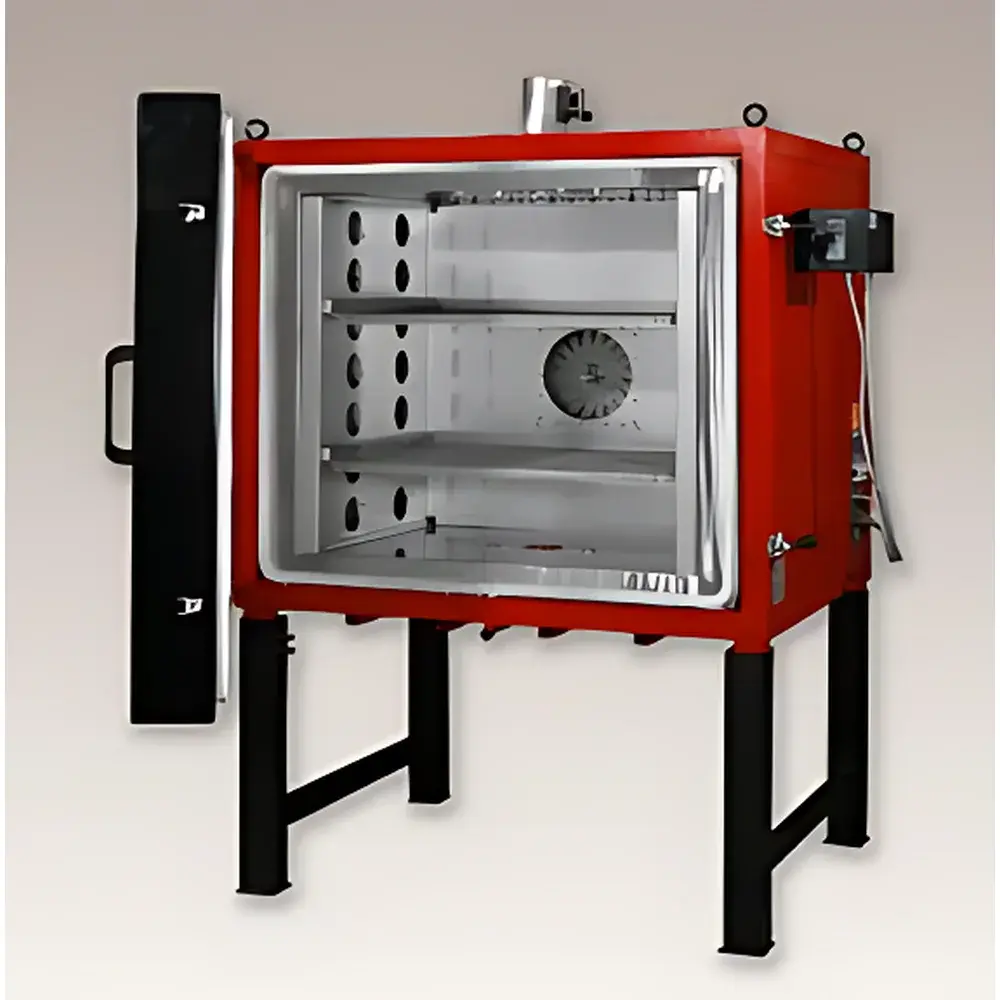
LAC S-Series Laboratory Oven and Drying Chamber
| Brand | LAC |
|---|---|
| Origin | Czech Republic |
| Model | S-Series |
| Max Temperature | 200 °C / 300 °C (selectable by variant) |
| Chamber Volume | 60–380 L |
| External Dimensions (W×H×D) | 1050×1350×950 mm to 1400×1750×1200 mm |
| Internal Dimensions (W×H×D) | 450×300×450 mm to 800×800×600 mm |
| Power Input | 2–6 kW |
| Voltage | 230 V or 380 V (3-phase) |
| Weight | 60–350 kg |
| Air Circulation | Horizontal forced convection via side-mounted axial fan (S60/S100) or central radial fan (S250/S400) |
| Temperature Control | INDUSTRY PID programmable controller with 30 stored profiles (15 steps each), real-time clock, RS485/RS232 interface option |
| Safety | Door-mounted safety switch, K-type thermocouple, semiconductor non-contact SSR relay, independent current-limiting unit |
| Construction | Mild steel frame & outer casing |
| Ventilation | Manually adjustable damper with bottom exhaust |
| Compliance | Designed to meet DIN 17052-1 Class A uniformity requirements for laboratory ovens |
Overview
The LAC S-Series Laboratory Oven and Drying Chamber is a precision-engineered, horizontally ventilated convection oven designed for controlled thermal processing in research, quality control, and industrial R&D laboratories. Based on the proven LAC platform developed in the Czech Republic, this series operates on the principle of horizontal forced-air circulation—achieved via side-mounted axial fans (models S60 and S100) or centrally located radial fans (S250 and S400)—to ensure uniform temperature distribution across the entire working chamber. It complies with DIN 17052-1 Class A specifications for temperature uniformity, making it suitable for applications demanding high spatial repeatability, such as polymer curing, elastomer vulcanization, electronic component aging, ceramic pre-firing, glass annealing, and moisture removal from hygroscopic materials. The oven supports two maximum operating temperatures—200 °C and 300 °C—depending on configuration, and integrates robust thermal management architecture including dual-zone heating elements mounted on both lateral walls, redundant overtemperature protection, and fail-safe door interlock circuitry.
Key Features
- Horizontal forced-air convection system engineered for DIN 17052-1 Class A temperature uniformity (±1.5 °C at setpoint across full chamber volume)
- Stainless steel (AISI 304) inner chamber and baffle plates for corrosion resistance, cleanability, and long-term dimensional stability
- Mild steel structural frame with powder-coated exterior finish for mechanical durability and chemical resistance
- Manually adjustable ventilation damper with bottom-mounted exhaust port for precise control of atmospheric exchange rate
- INDUSTRY-series PID temperature controller with real-time clock, capable of storing up to 30 multi-step programs (15 segments per program), each programmable with ramp rates, soak times, and hold conditions
- Integrated safety architecture: K-type thermocouple input, semiconductor solid-state relay (SSR) for contactless switching, independent current-limiting unit, and door-activated safety cut-off switch
- High-efficiency thermal insulation using low-conductivity refractory materials to minimize standby energy consumption and reduce surface temperatures
- Left-hinged door secured by stainless steel latches and sealed with high-temperature silicone rubber gasket and ceramic fiber rope
Sample Compatibility & Compliance
The S-Series accommodates a broad range of sample types and geometries—including plastic pellets, rubber test specimens, automotive trim components, PCB assemblies, ceramic green bodies, optical lenses, and pharmaceutical excipients—without compromising thermal homogeneity or process traceability. Its construction meets fundamental requirements for GLP-compliant thermal validation protocols, and its programmable controller supports audit-ready operation when paired with optional data logging accessories. While not certified to IEC 61000-6-3 or UL 61010-1 out-of-the-box, the unit is designed to facilitate third-party electrical safety and EMC verification. Optional humidity sensing (relative humidity module), gas analysis integration (METREX-compatible interface), and PC-based supervision via RS485/RS232 enable extension into regulated environments requiring 21 CFR Part 11–compliant electronic records.
Software & Data Management
The standard INDUSTRY controller provides local HMI operation with intuitive navigation, password-protected parameter editing, and event logging (e.g., door open/close, alarm triggers, program start/stop). For enhanced traceability, optional accessories include an external graphical temperature recorder with SD-card storage and timestamped CSV export, as well as PC connectivity kits supporting Modbus RTU or proprietary ASCII protocol for integration into LabVantage, TrackWise, or custom SCADA systems. All stored programs retain full metadata—including operator ID, date/time stamp, and version history—supporting ISO/IEC 17025 documentation requirements. Firmware updates are performed via USB or serial interface under controlled change management procedures.
Applications
- Drying of moisture-sensitive powders, filters, and analytical standards in accordance with ASTM E122-22 and USP <1251>
- Vulcanization and post-cure thermal treatment of elastomers per ASTM D572 and ISO 1431
- Thermal aging studies of polymers and composites (ASTM D573, ISO 188)
- Preheating and stress-relieving of metal substrates prior to coating or bonding
- Baking of printed circuit boards and semiconductor packaging substrates
- Conditioning of ceramic and refractory test specimens before mechanical testing (ISO 506, ASTM C20)
- Controlled dehydration of biological matrices and botanical extracts under GMP-aligned workflows
FAQ
What temperature uniformity class does the S-Series achieve?
It meets DIN 17052-1 Class A specifications, ensuring ±1.5 °C maximum deviation across the usable chamber volume at any stable setpoint.
Can the oven be validated for IQ/OQ/PQ protocols?
Yes—the design supports thermocouple mapping, sensor calibration traceability, and programmable profile execution required for formal qualification under ISO 9001 or FDA-regulated environments.
Is remote monitoring supported natively?
Not without optional hardware; RS485/RS232 communication modules and PC software drivers are available as configurable accessories.
What power supply configurations are available?
Standard models operate on 230 V or 380 V three-phase AC, with current draw scaled to heating capacity (2–6 kW); single-phase variants are not offered.
Are replacement parts and service documentation available internationally?
LAC provides global technical support, spare parts catalogues, and factory-authorized service networks across EMEA, APAC, and North America.
Related Products



