
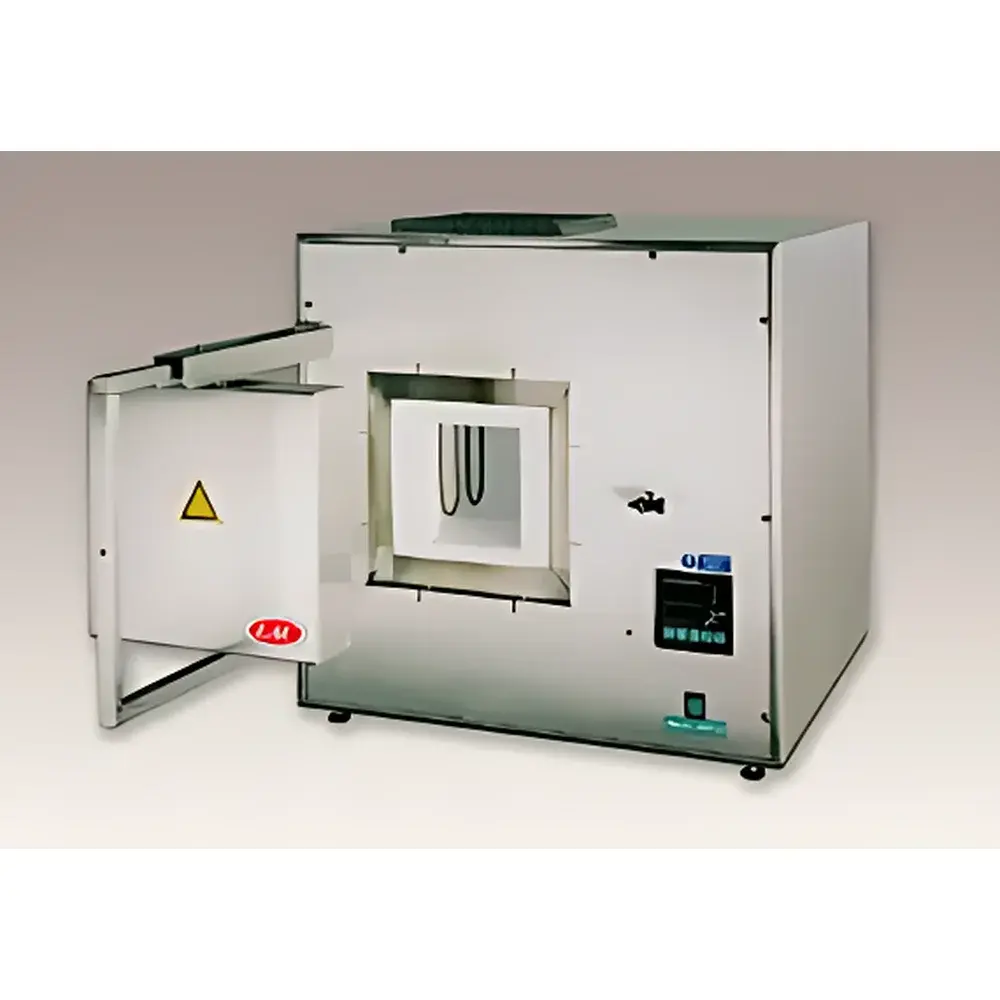
LAC VP Series High-Temperature Muffle Furnace
| Key | Brand: LAC |
|---|---|
| Model | VP Series |
| Max Temperature | 1600–1700 °C |
| Chamber Volume | 2–70 L |
| Power Supply | 230 V or 380 V AC |
| Heating Element | Kanthal Super |
| Thermocouple Type | B- and S-type |
| Control System | INDUSTRY PID Programmable Controller (30 programs × 15 steps, real-time clock) |
| Cooling | Integrated axial fan |
| Safety | Door-mounted safety interlock switch |
| Compliance | CE-marked, designed for GLP-compliant thermal processing environments |
Overview
The LAC VP Series High-Temperature Muffle Furnace is an industrial-grade, laboratory-optimized muffle furnace engineered for precise, repeatable thermal processing up to 1700 °C. Based on resistive heating via Kanthal Super alloy elements and insulated with high-purity refractory materials, it delivers exceptional thermal stability and uniformity across the entire chamber—critical for applications such as glass melting, sintering of quartz and ceramic precursors, ashing of high-temperature-resistant samples, and pre-sintering of advanced oxide-based powders. Its frameless structural design minimizes thermal mass while maximizing heat retention efficiency; the all-stainless-steel outer casing ensures long-term corrosion resistance and mechanical robustness in demanding lab or pilot-scale production settings. The furnace operates under open-air conditions by default but supports optional inert or reducing atmospheres via gas inlet ports—enabling controlled oxidation state management during thermal treatment.
Key Features
- Frameless construction with seamless stainless-steel cladding for enhanced thermal insulation and reduced external surface temperature
- High-efficiency Kanthal Super heating elements—rated for continuous operation at 1700 °C with extended service life and low thermal drift
- Dual thermocouple configuration: B-type (chamber top) and S-type (optional secondary monitoring) for cross-verified temperature measurement and redundancy
- INDUSTRY-series PID controller with non-volatile memory storing up to 30 independent thermal profiles, each comprising 15 programmable ramp/soak steps and scheduled start times enabled by integrated real-time clock (RTC)
- Electromechanical safety interlock switch mounted on the door—automatically de-energizes heating circuit upon door opening
- Integrated axial cooling fan positioned to optimize convective heat dissipation from the outer shell without compromising internal laminar airflow
- Solid-state semiconductor relays eliminating contact arcing, minimizing electromagnetic interference (EMI), and ensuring silent, maintenance-free switching performance
- Optimized chamber ventilation system prevents condensation buildup during cool-down cycles and contributes to ±2 °C temperature uniformity (per ISO 9001 calibration protocol)
Sample Compatibility & Compliance
The LAC VP furnace accommodates a broad range of sample geometries and material classes—including crucibles (Pt, Al₂O₃, SiC, graphite), ceramic setters, and custom fixtures—within its precisely dimensioned cavity. Its refractory lining meets ASTM C71 specifications for high-alumina insulating firebrick, ensuring minimal outgassing and low thermal conductivity (<0.25 W/m·K at 1000 °C). All models are CE-certified and comply with IEC 61000-6-3 (EMC emission limits) and IEC 61000-6-2 (immunity requirements). For regulated environments, the INDUSTRY controller supports audit-trail-capable operation when paired with optional RS485/RS232 communication modules—facilitating integration into 21 CFR Part 11–compliant data acquisition systems used in pharmaceutical, aerospace, and nuclear materials R&D labs.
Software & Data Management
While the furnace operates autonomously via its embedded INDUSTRY controller, optional connectivity enables full digital integration. An RS232 or RS485 interface allows bidirectional communication with Windows-based PCs running LAC’s proprietary ThermalLog software—capable of real-time temperature logging, profile synchronization, remote start/stop commands, and automated report generation in PDF or CSV format. When configured with a graphical strip-chart recorder (optional accessory), analog output signals (4–20 mA or 0–10 V) provide redundant traceability aligned with GLP/GMP documentation standards. All logged data includes timestamped metadata: operator ID, program name, cycle duration, peak temperature, and deviation alerts—supporting full retrospective analysis and regulatory submission readiness.
Applications
- Melting and homogenization of optical-grade silica, borosilicate, and specialty glasses
- Sintering of refractory oxides (e.g., ZrO₂, Y₂O₃-stabilized zirconia, AlN) and carbide ceramics
- Thermal gravimetric analysis (TGA) sample preparation and residue quantification
- Ash content determination per AOAC 942.05 and ASTM D3174 for coal, biomass, and polymer composites
- Pre-firing of catalyst supports and battery cathode precursor materials (e.g., LiCoO₂, NMC)
- Calibration of thermocouples and radiation pyrometers in metrology laboratories
FAQ
What is the maximum recommended operating temperature for continuous use?
The VP series is rated for continuous operation at 1600 °C (VP/16) or 1700 °C (VP/17); intermittent excursions up to +25 °C above nominal rating are permissible for ≤30 minutes per cycle.
Can the furnace be operated under protective atmosphere?
Yes—gas inlet/outlet ports are standard on all VP models; optional quartz or alumina gas distribution manifolds support N₂, Ar, H₂/N₂ mixtures, or vacuum down to 10⁻² mbar with compatible pumping systems.
Is the INDUSTRY controller compliant with FDA 21 CFR Part 11?
Out-of-the-box, it provides electronic signature-ready audit trails when connected via RS485 to validated third-party LIMS or SCADA platforms meeting Part 11 technical controls (e.g., role-based access, encrypted logs, electronic signatures).
How is temperature uniformity verified and documented?
Uniformity mapping is performed per ISO/IEC 17025-accredited procedures using nine-point thermocouple arrays; certificates of conformity include isothermal zone maps and uncertainty budgets referenced to NIST-traceable standards.
What maintenance intervals are recommended for Kanthal Super elements?
Under typical laboratory usage (≤6 cycles/week, average soak time <4 h), element replacement is expected after ≥8,000 operational hours; visual inspection and resistance measurement every 1,500 hours are advised.



