
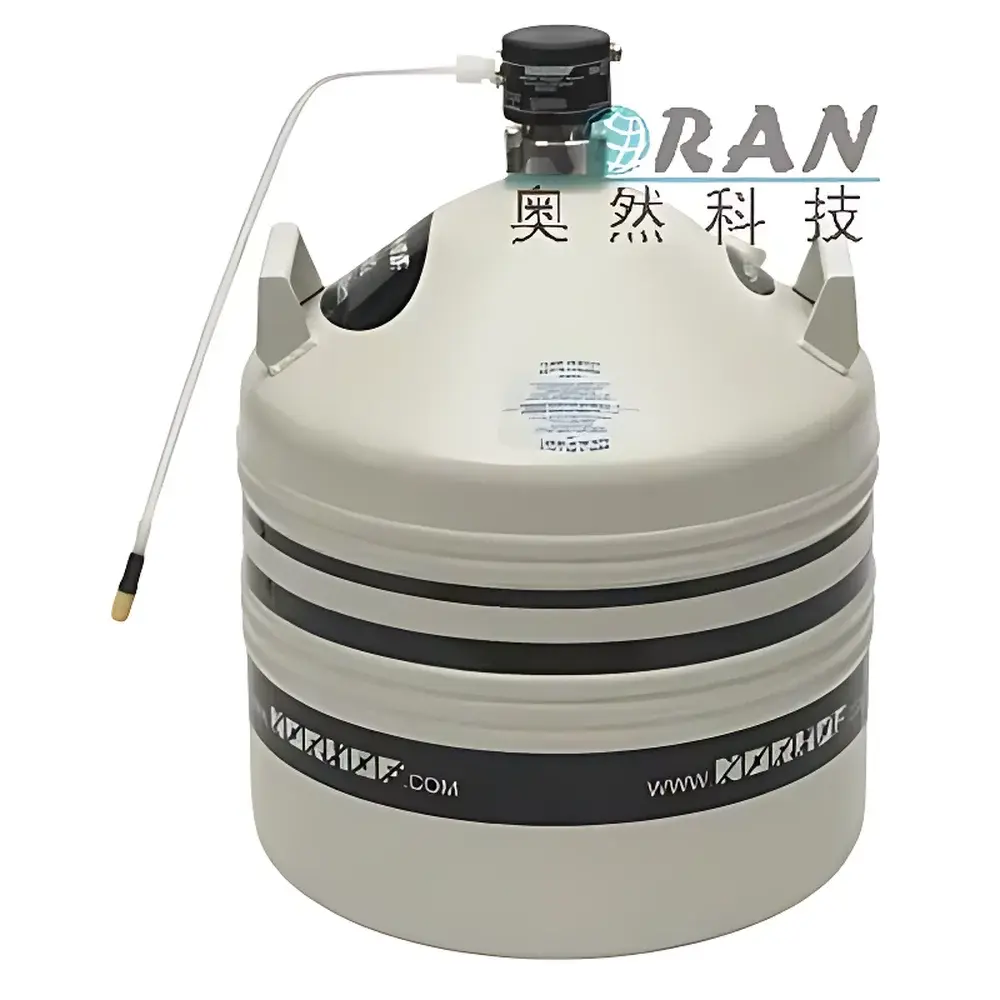
Norhof 405 Economical Manual Liquid Nitrogen Dispensing System
| Brand | Norhof |
|---|---|
| Origin | Netherlands |
| Manufacturer Type | Authorized Distributor |
| Origin Category | Imported |
| Model | 405 |
| Price | €50,000 |
| Static Evaporation Rate | <0.5 L/day |
| Dispensing Flow Range | Dropwise to 1 L/min (Fixed, Non-adjustable) |
| Operating Pressure | <300 mbar |
| Hose Pre-cooling Time | 10–40 s (Dependent on LN₂ Level) |
| Power Supply | 115 V / 230 V AC or 12 V AC/DC |
| Average Power Consumption | 10 W (Peak: 50 W) |
| Dewar Capacity | 35 L / 50 L |
| Dewar Diameter | 480 mm / 500 mm |
| Dewar Height | 643 mm / 727 mm |
| Empty/Full Weight | 13 / 41.5 kg / 17 / 57.5 kg |
| Standard Equipment | Controller, Power Unit, Interconnecting Cables |
| Optional Accessories | 5-Wheel Mobile Base (10 cm height), LN₂ Pump Mounting Bracket |
Overview
The Norhof 405 Economical Manual Liquid Nitrogen Dispensing System is a purpose-engineered, pressure-free cryogenic transfer solution designed for laboratories requiring precise, safe, and energy-efficient handling of liquid nitrogen (LN₂) in low-to-moderate throughput environments. Unlike pressurized dispensing systems that rely on vapor pressure or external gas supply, the Norhof 405 utilizes a manually actuated, gravity-assisted pumping mechanism—eliminating the need for valves, regulators, or pressurization vessels. This design inherently prevents thermal ingress, mechanical vibration, acoustic emission, and splashing during operation, making it especially suitable for sensitive biological sample preparation, small-scale cryopreservation workflows, and teaching laboratories where operational simplicity and personnel safety are paramount. The system operates exclusively within ambient atmospheric conditions and integrates seamlessly with standard Norhof biological dewars (35 L and 50 L variants), maintaining ultra-low static evaporation rates (<0.5 L/day) due to minimized conductive and convective heat exchange pathways.
Key Features
- Pressure-free dispensing architecture ensures zero risk of over-pressurization, valve failure, or uncontrolled LN₂ release
- Manual pump activation provides intuitive, tactile control—no pneumatic or electronic actuation required
- Dropwise-to-1 L/min fixed flow range enables consistent, repeatable transfers without calibration drift or flow-rate adjustment complexity
- No internal valves or seals exposed to cryogenic temperatures—reducing maintenance frequency and long-term reliability risks
- Low thermal load design: minimal surface area contact between transfer hose and ambient air; optimized insulation geometry reduces standby boil-off
- Universal power compatibility: supports 115 V / 230 V AC mains or 12 V AC/DC auxiliary sources (e.g., battery packs or lab UPS systems)
- Compact footprint and modular assembly facilitate integration into biosafety cabinets, cold rooms, or shared core facility spaces
Sample Compatibility & Compliance
The Norhof 405 is validated for use with standard cryovials (0.5–2.0 mL), cryoboxes, microtiter plates, and small-volume transport dewars (e.g., dry-shipping containers rated for ≤7 days). Its non-pressurized delivery method preserves sample integrity during freezing cycles by eliminating thermal shock associated with rapid phase change or turbulent flow. From a regulatory standpoint, the system complies with ISO 13485-aligned manufacturing practices (as applied by Norhof’s certified distribution partners) and meets essential requirements under EU Machinery Directive 2006/42/EC for manually operated equipment. While not classified as a medical device, its design supports GLP-compliant documentation workflows when paired with laboratory information management systems (LIMS) via optional timestamped controller logging.
Software & Data Management
The Norhof 405 features an embedded microcontroller with LED status indicators and manual cycle counting functionality. Although it does not include real-time data export or network connectivity, the controller records cumulative actuation events and power-on duration—data accessible via front-panel display or optional serial interface (RS-232, firmware-dependent). For audit-trail compliance in regulated environments (e.g., biobanking per ISBER Best Practices or FDA 21 CFR Part 11), users may integrate the system into broader facility monitoring platforms using discrete I/O signals (e.g., pulse output per dispense cycle). Firmware updates are performed locally via USB, with version history traceable through Norhof’s authorized service portal.
Applications
- Controlled filling of cryovials and straws prior to long-term storage in vapor-phase LN₂ tanks
- Cooling of small-format reaction vessels during exothermic chemical synthesis or cryo-EM grid preparation
- Refilling of portable dry-shipping containers used in inter-laboratory sample transport
- Teaching demonstrations of cryogenic handling principles in undergraduate life science curricula
- Backup dispensing during scheduled maintenance of automated LN₂ distribution networks
- Point-of-use LN₂ replenishment for benchtop cryomills or localized cooling jackets
FAQ
Is the Norhof 405 compatible with non-Norhof dewars?
Yes—mechanically compatible with any 50 mm neck-opening biological dewar meeting ISO 21619 dimensional standards; however, optimal evaporation performance is guaranteed only with Norhof-certified dewars.
Does the system require annual calibration?
No—flow rate is mechanically fixed and unaffected by temperature or pressure fluctuations; no calibration certificate is issued or required.
Can the dispensing flow be reduced below dropwise rate?
No—the minimum delivery mode is single-drop; finer control requires external pipetting or gravimetric verification.
What is the expected service life of the pump mechanism?
Rated for ≥100,000 actuation cycles under normal laboratory use; stainless-steel and PTFE components resist embrittlement at cryogenic temperatures.
Is CE marking applicable to this unit?
Yes—the complete system (including controller and power supply) carries CE marking under the Low Voltage Directive (2014/35/EU) and EMC Directive (2014/30/EU).




