
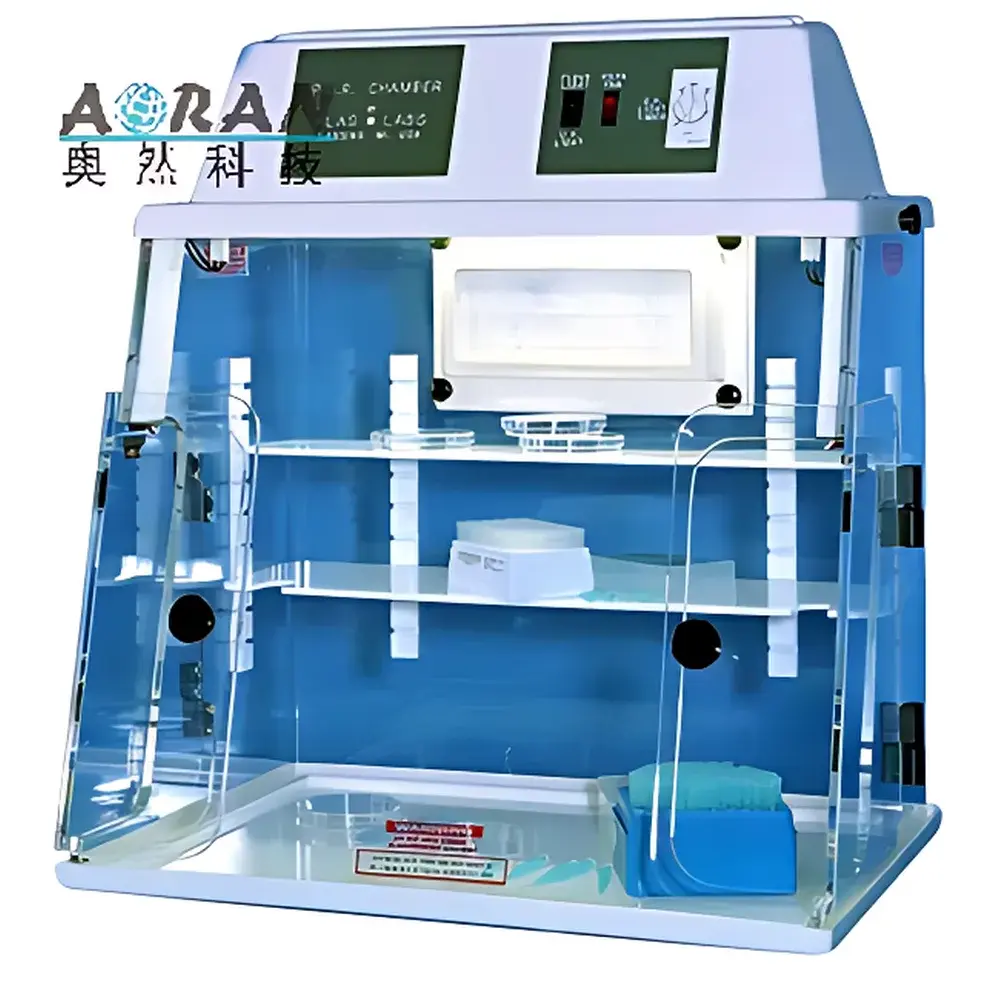
Plas-Labs 825-PCR HEPA Biological Safety Cabinet
| Brand | Plas-Labs |
|---|---|
| Origin | USA |
| Model | 825-PCR HEPA |
| Instrument Type | Class II Biological Safety Cabinet |
| External Dimensions (W×D×H) | 610 mm × 457 mm × 711 mm |
| Internal Dimensions (W×D×H) | 597 mm × 432 mm × 530 mm |
| HEPA Filter Efficiency | ≥99.9997% @ 0.3 µm |
| Operating Noise Level | <40 dB(A) |
| UV Lamp | 254 nm, full-cavity irradiation with 0–30 min timer |
| Viewing Window | 9.5 mm acrylic, beta-radiation shielding |
| Illumination | "Bright Light" LED system, shadow-free, 40,000 h rated life |
| Safety Features | proximity sensors on access doors, positive-pressure internal environment, removable top and outer panels, spill-containment base tray |
| Shelf Configuration | two adjustable white polymer shelves |
| Weight (Shipping) | 51 kg |
Overview
The Plas-Labs 825-PCR HEPA Biological Safety Cabinet is a purpose-engineered Class II biosafety enclosure designed specifically for polymerase chain reaction (PCR) workflow integrity in molecular biology laboratories. Unlike general-purpose laminar flow hoods or standard Class II cabinets, the 825-PCR HEPA integrates dual-layer contamination control: unidirectional HEPA-filtered air supply (≥99.9997% efficiency at 0.3 µm) combined with a fully enclosed, positively pressurized working chamber. This architecture prevents ingress of ambient aerosols—particularly exogenous DNA fragments—that are the primary source of false-positive amplification in sensitive nucleic acid detection assays. The cabinet operates under ISO 14644-1 Class 5 (ISO Class 5) cleanroom-equivalent airflow conditions within the work area, ensuring consistent particulate suppression without compromising operator safety or sample sterility. Its design complies with NSF/ANSI 49–2022 requirements for Class II, Type A2 cabinets, while its UV sterilization subsystem meets IEC 62471 photobiological safety standards for germicidal lamps.
Key Features
- High-efficiency HEPA filtration system certified to remove ≥99.9997% of airborne particles ≥0.3 µm—critical for eliminating trace DNA contaminants from laboratory air
- Monolithic 9.5 mm thick acrylic construction for all side and rear walls, featuring seamless rounded corners to eliminate microbial harborage points and simplify decontamination
- Integrated 254 nm UV-C germicidal lamp with full-cavity coverage and programmable 0–30 minute timer; validated for uniform irradiance distribution per ASTM E3135
- “Bright Light” LED illumination system delivering >500 lux uniformity across the entire work surface with zero shadowing and 40,000-hour operational lifespan
- Positive-pressure internal environment maintained during operation, preventing unfiltered room air infiltration—distinct from conventional Class II A2 cabinets that rely on inward inflow velocity
- Proximity-sensor-activated door interlock system halting UV emission and adjusting airflow when hands approach the opening plane, meeting ANSI Z358.1 personnel protection criteria
- Removable top panel and modular outer shell enable installation of large instrumentation (e.g., thermal cyclers, robotic liquid handlers) directly into the chamber
- Spill-containment base tray with integrated drainage channel facilitates rapid cleanup of reagent spills without cross-contamination risk
Sample Compatibility & Compliance
The 825-PCR HEPA accommodates standard PCR consumables including 0.2 mL tube racks, 96-well plates, pipette tips, and master mix vials. Its internal volume (137 L) supports simultaneous handling of multiple reaction setups without airflow disruption. All materials in direct contact with samples—including acrylic surfaces, polymer shelves, and gasket seals—are autoclavable or compatible with 70% ethanol, sodium hypochlorite (10%), and hydrogen peroxide vapor (HPV) decontamination protocols. The cabinet conforms to key regulatory frameworks applicable to molecular diagnostics labs: NSF/ANSI 49–2022 (Class II biosafety), ISO 15189:2022 (medical laboratory quality requirements), and CLSI EP25-A (evaluation of contamination control in nucleic acid testing). It is routinely deployed in GLP-compliant sequencing core facilities and clinical PCR laboratories undergoing CAP accreditation.
Software & Data Management
The 825-PCR HEPA is a hardware-integrated, microprocessor-controlled enclosure with embedded firmware for real-time monitoring of critical parameters: UV exposure duration, filter service life estimation, airflow velocity stability, and door position status. While it does not include proprietary cloud-based software, all operational logs—including UV cycle timestamps, filter usage hours, and alarm events—are stored locally in non-volatile memory and exportable via USB interface in CSV format. Audit trail functionality satisfies FDA 21 CFR Part 11 requirements for electronic records when paired with validated laboratory information management systems (LIMS). Firmware updates are performed offline using signed binary packages to ensure cybersecurity compliance per NIST SP 800-53 Rev. 5 controls RA-5 and SI-2.
Applications
- Pre-PCR template preparation, including nucleic acid extraction, dilution, and aliquoting in contamination-sensitive workflows
- Assembly of high-fidelity qPCR and digital PCR reaction mixes where carryover contamination must be reduced below 1 copy/µL
- Handling of low-biomass environmental or forensic samples requiring ultra-low background environments
- CRISPR guide RNA complex assembly and sgRNA transfection setup prior to electroporation
- Validation of contamination control procedures per ISO/IEC 17025:2017 clause 7.7 (sampling)
- Training environments for molecular techniques where visual clarity, ergonomic access, and repeatable decontamination cycles are pedagogically essential
FAQ
Does the 825-PCR HEPA meet NSF/ANSI 49 certification requirements for Class II cabinets?
Yes—the unit is independently tested and certified to NSF/ANSI 49–2022 as a Class II, Type A2 biological safety cabinet, with additional validation for PCR-specific aerosol containment.
What is the recommended maintenance schedule for the HEPA filter?
Filter replacement is advised every 18–24 months under typical usage (6–8 hr/day), or after 2,000 operational hours, whichever occurs first; pressure differential monitoring alerts users to premature clogging.
Can the UV lamp be operated while the cabinet is in use?
No—UV emission is automatically disabled when either access door is opened beyond 5 cm, and the system enforces interlocked airflow shutdown during UV cycles.
Is the acrylic viewing window compatible with beta-emitting isotopes used in radiolabeled probe synthesis?
Yes—the 9.5 mm thick cast acrylic attenuates >99% of beta radiation from common isotopes including 3H, 14C, and 32P, as verified by NIST-traceable dosimetry.
How is filter efficiency validated post-installation?
Plas-Labs provides a Certificate of Conformance with DOP/PAO upstream-downstream challenge test data, and users may perform annual in-situ integrity testing per ISO 14644-3 Annex B using a calibrated photometer.





