
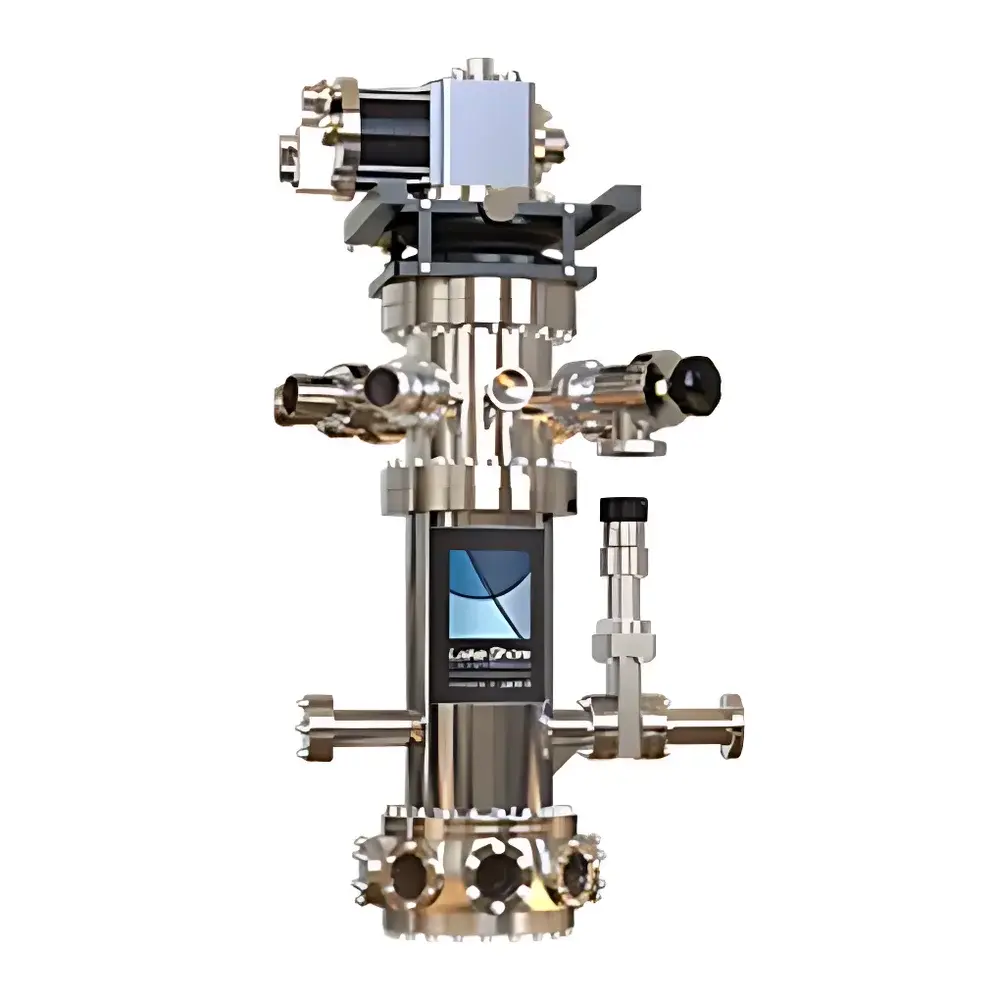
Lake Shore CCS-XG-UHV Low-Vibration Ultra-High Vacuum Cryogenic Thermostat
| Brand | Lake Shore |
|---|---|
| Origin | USA |
| Manufacturer Status | Authorized Distributor |
| Origin Category | Imported |
| Model | CCS-XG-UHV |
| Price | Upon Request |
| Cooling Type | Closed-Cycle Refrigeration |
| Temperature Range | <4 K to 325 K |
| Typical Temperature Stability | ±50 mK |
| Sample Environment | Ultra-High Vacuum (UHV) |
| Bake-Out Temperature (Cold Head Removed) | 200 °C |
| Cool-Down Time | 2–3 h |
| Vibration Level | <40 nm (RMS) |
| Cold Head Position | Top-Mounted |
| Optical Window | Not Standard |
| Approximate Height | 559–660 mm |
| Weight | Configuration-Dependent |
| Recommended Cold Head Maintenance Interval | 10,000 h |
Overview
The Lake Shore CCS-XG-UHV is an engineered cryogenic thermostat designed for demanding low-temperature physics, quantum materials characterization, and nanoscale spectroscopy experiments requiring simultaneous ultra-low temperatures, ultra-high vacuum (UHV) compatibility, and exceptional mechanical stability. Unlike traditional liquid helium cryostats, the CCS-XG-UHV employs a closed-cycle pulse tube or Gifford-McMahon refrigeration system—eliminating the operational complexity, supply chain dependency, and thermal instability associated with cryogenic liquids. Its core architecture integrates a UHV-compatible stainless steel vacuum chamber with actively damped cold stages and vibration-isolated sample mounting platforms. The system achieves base temperatures below 4 K while maintaining long-term thermal stability of ±50 mK over hours—critical for high-resolution transport measurements, scanning probe microscopy (SPM), and cavity optomechanics where thermal drift and micro-vibrations directly degrade signal fidelity.
Key Features
- UHV-rated vacuum chamber (≤1×10⁻¹⁰ mbar typical after bake-out) compatible with standard CF-150/CF-200 flanges and ISO-KF feedthroughs
- Sub-40 nm RMS vibration performance at the sample stage, achieved through multi-stage passive damping, optimized cold head suspension, and low-noise compressor integration
- Top-mounted cold head configuration enabling vertical optical access and simplified integration into existing UHV beamlines or surface science chambers
- Modular electrical feedthrough system supporting DC, low-noise triaxial, BNC, SMA, and microwave-grade coaxial connectors—fully customizable per experimental requirements
- Bake-out capability up to 200 °C with cold head removed, ensuring thorough outgassing and compliance with stringent UHV conditioning protocols
- Programmable temperature control via Lake Shore’s Crossbow software, supporting ramping, soaking, and multi-zone PID tuning with real-time logging
Sample Compatibility & Compliance
The CCS-XG-UHV accommodates a wide range of sample geometries and measurement configurations—including planar thin films, bulk single crystals, 2D heterostructures, and suspended nanomechanical resonators. Optional sample holders include optically transparent sapphire or CaF₂ platforms, four-terminal current-voltage stages with guarded guard rings, spring-loaded plunger contacts for in-situ device probing, and kinematic mounts for sub-micron alignment repeatability. All internal components are constructed from oxygen-free high-conductivity (OFHC) copper, 304/316 stainless steel, and ceramic insulators selected for low outgassing rates (per ASTM E595) and minimal magnetic susceptibility. The system meets ISO 14644-1 Class 5 cleanroom handling standards during assembly and is fully compatible with GLP/GMP-aligned laboratory documentation workflows when paired with audit-trail-enabled software configurations.
Software & Data Management
Control and monitoring are executed through Lake Shore’s Crossbow™ platform—a Windows-based application supporting IEEE-488 (GPIB), USB, and Ethernet interfaces. Crossbow enables synchronized acquisition across multiple Lake Shore sensors (e.g., silicon diodes, Cernox™, ruthenium oxide thermometers) and third-party instruments (lock-in amplifiers, source meters, RF analyzers) via SCPI command sets. All temperature setpoints, sensor readings, heater outputs, and alarm states are timestamped and exportable in CSV or HDF5 format. For regulated environments, optional 21 CFR Part 11-compliant modules provide electronic signatures, user role-based access control, and immutable audit trails—supporting FDA, ISO 17025, and NIST traceability requirements.
Applications
- Quantum transport studies (Hall effect, Shubnikov–de Haas oscillations, superconducting gap mapping)
- Low-temperature scanning tunneling microscopy (STM) and atomic force microscopy (AFM)
- UHV-compatible magneto-optical Kerr effect (MOKE) and Fourier-transform infrared (FTIR) spectroscopy
- Cryogenic RF/microwave characterization of qubits, kinetic inductance detectors (KIDs), and superconducting resonators
- In-situ annealing and surface reconstruction experiments under controlled thermal cycling in UHV
FAQ
Is the CCS-XG-UHV compatible with existing UHV systems using CF-150 flanges?
Yes—the main vacuum chamber features a standard CF-150 conflat flange with helicoflex sealing and is rated for bake-out to 200 °C.
Can I integrate optical access for laser excitation or detection?
Optical access requires custom viewport integration; standard configurations do not include windows, but top- or side-mount quartz or sapphire viewports can be added as factory options.
What refrigeration systems are supported?
The CCS-XG-UHV is configured with either a Cryomech PT415 or Sumitomo RDK-415D pulse tube cryocooler, both delivering 10,000 h MTBF.
How is vibration performance verified and documented?
Vibration is measured using calibrated laser Doppler vibrometers on the sample stage under operating conditions; full test reports—including PSD curves and RMS values—are provided with each unit.
Does Lake Shore offer installation support and on-site commissioning?
Yes—authorized distributors provide UHV leak-checking, thermal anchoring verification, electrical grounding validation, and operator training as part of turnkey delivery packages.



