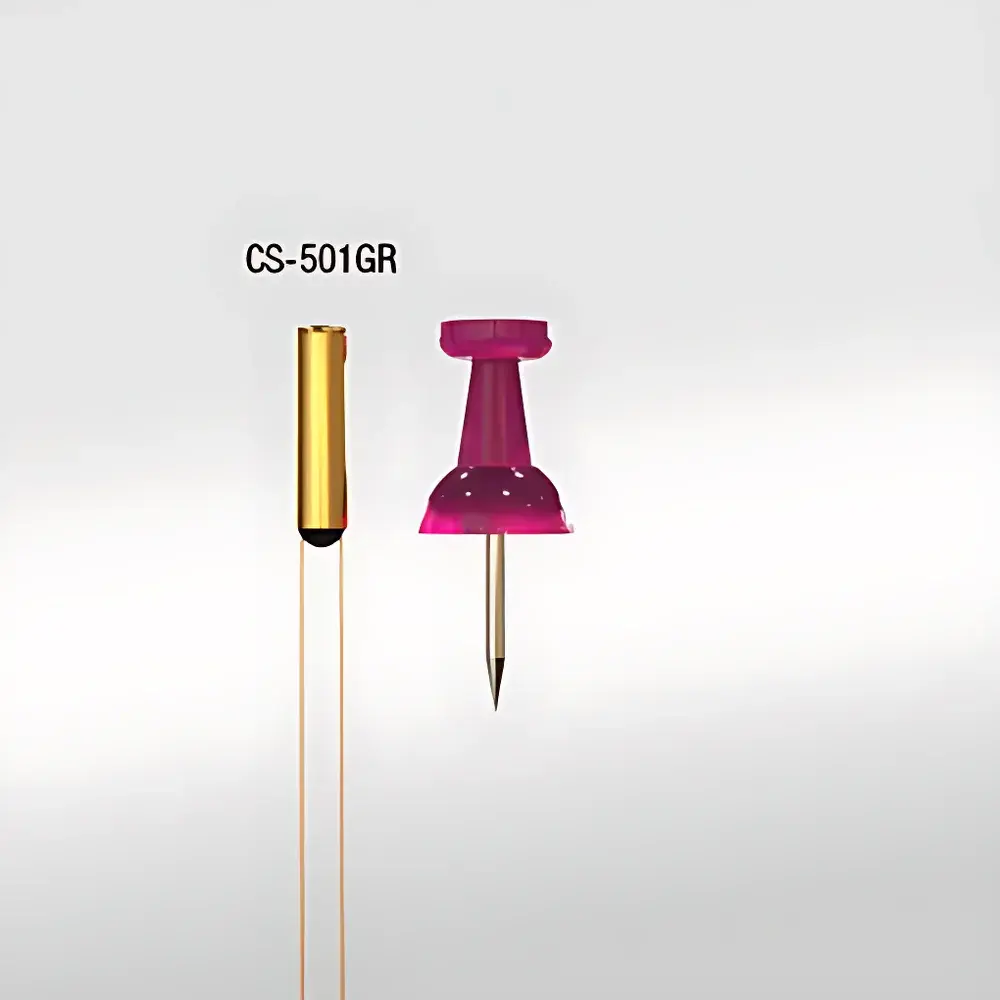
Lake Shore CS Series Capacitive Temperature Sensors
| Brand | Lake Shore |
|---|---|
| Origin | USA |
| Manufacturer Status | Authorized Distributor |
| Product Origin | Imported |
| Model | CS Series |
| Pricing | Upon Request |
Overview
The Lake Shore CS Series Capacitive Temperature Sensors are precision cryogenic temperature sensing elements engineered for high-stability thermal control in extreme electromagnetic environments. Unlike resistive or semiconductor-based sensors, these devices operate on the principle of capacitance variation with temperature—leveraging the intrinsic thermal expansion and dielectric constant shift of a ferroelectric ceramic dielectric. This physical mechanism renders them inherently immune to magnetic field interference, making them uniquely suited for use inside superconducting magnets, MRI systems, dilution refrigerators, and particle accelerator cryostats where fields exceed 10 T. The sensor’s capacitance exhibits monotonic behavior from ~1.4 K up to 290 K, enabling unambiguous temperature mapping without hysteresis-induced ambiguity. While absolute accuracy requires in-situ calibration against a reference sensor (e.g., a calibrated Cernox™ or RuO₂ thermometer), the CS series delivers exceptional short-term stability and repeatability as a feedback element in closed-loop temperature controllers.
Key Features
- Magnetic field immunity: No measurable offset or drift induced by static or sweeping magnetic fields up to 20 T
- High control stability: Sub-millikelvin temperature regulation achievable at 4.2 K when integrated into low-noise servo loops
- Monotonic C(T) response: Ensures unambiguous temperature interpretation across the full 1.4–290 K operating range
- Low intrinsic thermal mass: Enables rapid thermal equilibration with sample mounts and cold stages
- Robust mechanical construction: Hermetically sealed ceramic package with gold-plated copper leads for reliable cryogenic cycling
- Standard nominal capacitance: 6.1 nF at 4.2 K, with typical sensitivity of 26 pF/K near 4.2 K
Sample Compatibility & Compliance
The CS series is compatible with all standard cryogenic mounting configurations—including epoxy bonding, spring clamping, and indium soldering—and exhibits minimal thermal anchoring perturbation due to its low thermal mass (< 10 mg). It complies with ASTM E220–22 (Standard Test Method for Calibration of Thermocouples by Comparison Techniques) for calibration traceability when used with NIST-traceable reference standards. While not certified to ISO/IEC 17025 for standalone metrology, its performance meets GLP/GMP requirements for temperature monitoring in research-grade cryogenic instrumentation. Long-term drift (±1.0 K/year) is well documented and accounted for in Lake Shore’s calibration protocols; users are advised to perform periodic recalibration against a primary sensor during system maintenance cycles.
Software & Data Management
CS sensors interface seamlessly with Lake Shore’s CrossLink™ software suite and third-party DAQ platforms supporting analog voltage-to-capacitance conversion (e.g., Keysight LCR meters, Zurich Instruments HF2LI). The recommended excitation signal—1–5 kHz, 0–7 V peak—is compatible with most commercial capacitance bridges and lock-in amplifiers. CrossLink enables automatic C(T) curve transfer from a reference sensor post-cooling, supporting user-defined interpolation tables and real-time compensation for aging-related drift. Audit trails, calibration history logging, and 21 CFR Part 11–compliant electronic signatures are supported when deployed with Lake Shore’s Model 372 AC Resistance Bridge or Model 336 Temperature Controller in regulated laboratory environments.
Applications
- Temperature stabilization of quantum computing qubit chips inside high-field dilution refrigerators
- Feedback sensing in magnetically shielded cryogenic vacuum chambers for condensed matter physics experiments
- In-situ thermal monitoring of superconducting RF cavities during cavity tuning
- Long-duration space simulation testing where radiation-hardened, non-magnetic sensing is mandatory
- Calibration transfer standards for multi-sensor cryostat mapping (e.g., thermal gradient profiling in adiabatic demagnetization refrigerators)
FAQ
Why must CS sensors be calibrated in situ after cooldown?
Because ferroelectric aging and thermal history alter the C(T) relationship between cooldown cycles, absolute accuracy requires transferring calibration data from a stable reference sensor measured under identical thermal conditions.
What causes short-term capacitance drift after temperature adjustment?
Dielectric relaxation in the ferroelectric material leads to time-dependent polarization decay—typically stabilizing within 60 minutes after thermal or electrical perturbation.
Can CS sensors be used above 290 K?
No—the upper limit is strictly 290 K; prolonged exposure above this threshold accelerates irreversible dielectric degradation and permanent capacitance loss.
Is excitation frequency critical for measurement accuracy?
Yes—operation outside the 1–5 kHz band increases susceptibility to parasitic inductance and stray capacitance, degrading signal-to-noise ratio and introducing phase errors in bridge-based readouts.
How does long-term aging affect control performance?
While absolute accuracy degrades over time (±1.0 K/year), relative stability at fixed setpoints remains unaffected—making CS sensors highly reliable for closed-loop regulation even without frequent recalibration.