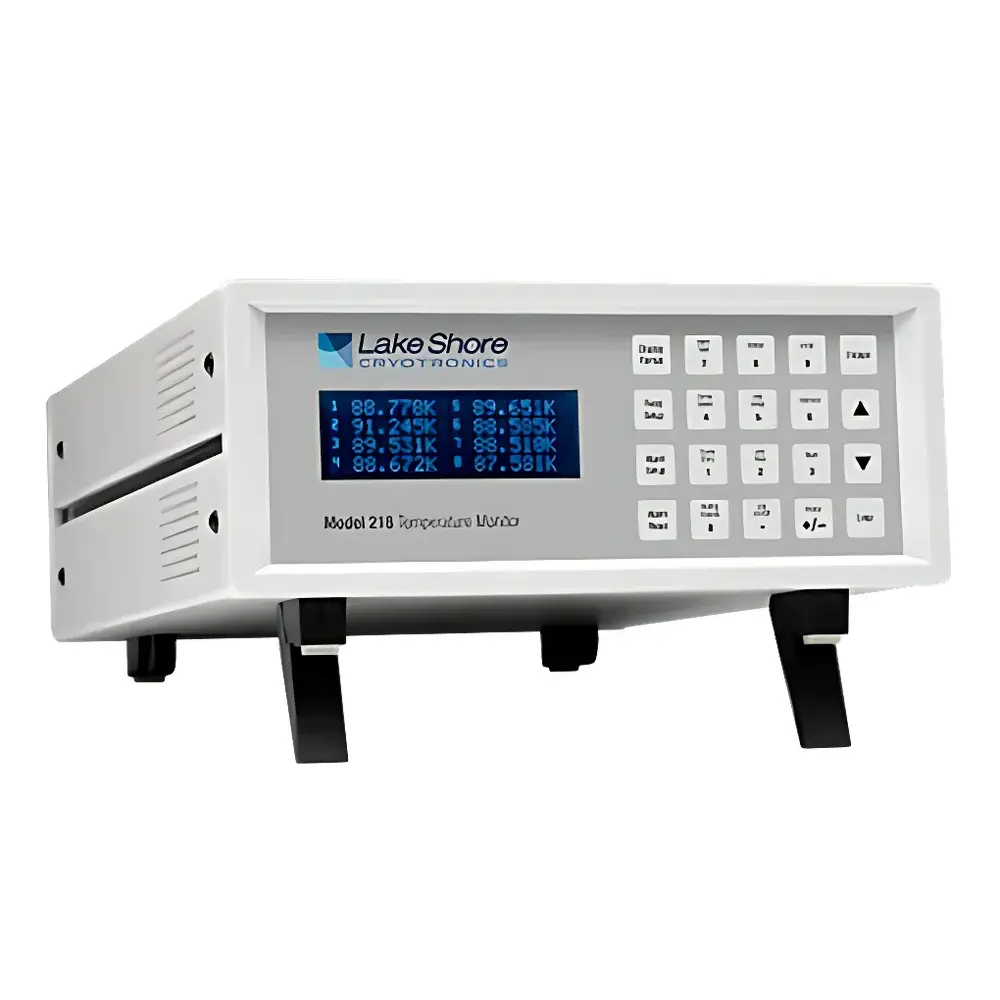
Lake Shore Model 218 Temperature Monitor
| Brand | Lake Shore |
|---|---|
| Origin | USA |
| Model | 218 |
| Input Channels | 8 |
| Sensor Compatibility | Diode (Si, GaAlAs) and Resistance (Pt100, Pt1000, Germanium, Carbon-Glass, Cernox®, Rox™) |
| Temperature Range | 1.2 K to 375 K |
| Resolution | 0.001 K (0–99.999 K), 0.01 K (100–999.99 K), 0.1 K (>1000 K) |
| Update Rate | 16 readings/s total (2 full scans of all 8 channels per second) |
| Calibration Curves | 8 × 200-point user-definable curves |
| SoftCal™ Support | DT-470 diode (30–375 K, ±0.25 K improvement), Pt resistance (70–325 K, ±0.25 K improvement) |
| Interfaces | IEEE-488 (GPIB), RS-232C, dual analog voltage outputs, 8 relay outputs |
| Display | 4-line × 20-character backlit LCD |
| Excitation | 8 independent constant-current sources, 4-wire differential measurement |
Overview
The Lake Shore Model 218 Temperature Monitor is a high-precision, multi-channel cryogenic and general-purpose temperature measurement instrument engineered for laboratories requiring reliable, low-noise, and high-resolution thermal monitoring across demanding experimental environments. Operating on the principle of four-wire differential resistance and diode voltage measurement, the Model 218 employs eight independent constant-current excitation sources—each dedicated to one input channel—to eliminate lead resistance errors and ensure traceable accuracy. While optimized for cryogenic applications down to 1.2 K, its wide dynamic range (1.2 K to 375 K), low thermal EMF architecture, and programmable sensor configuration make it equally suitable for ambient, industrial, and materials science applications where long-term stability and repeatability are critical. The device conforms to fundamental metrological practices for resistance thermometry and semiconductor diode sensing, supporting both standardized calibration curves (e.g., DT-470, PT-1000) and user-defined 200-point interpolation tables compliant with ISO/IEC 17025 traceability requirements.
Key Features
- Eight fully isolated sensor inputs organized into two configurable banks of four—each bank supports uniform sensor type selection (e.g., all Si diodes or all Pt100 RTDs)
- Dual high-speed A/D converters enabling a total system update rate of 16 readings per second, with complete 8-channel scanning at 2 Hz
- Four-wire differential measurement topology with programmable constant-current excitation per channel, minimizing self-heating and lead-induced uncertainty
- Support for industry-standard cryogenic sensors: silicon diodes (DT-470, DT-670), GaAlAs diodes, platinum RTDs (100 Ω and 1000 Ω), germanium, carbon-glass, Cernox®, and Rox™
- SoftCal™ algorithm integrated for in-field curve refinement—improves absolute accuracy by ±0.25 K over defined ranges without external calibration equipment
- IEEE-488 (GPIB) and RS-232C digital interfaces for automated data acquisition and integration into LabVIEW, Python, or MATLAB-based control systems
- Dual analog voltage outputs (0–10 V) and eight programmable alarm relays for real-time process interlocks and feedback control
- Front-panel 4×20 character backlit LCD with selectable display units (K, °C, V, Ω), min/max tracking, linear scaling (Mx + B), and digital filtering (2–64 sample averaging)
Sample Compatibility & Compliance
The Model 218 accommodates a broad spectrum of commercially available temperature sensors used in research-grade cryostats, vacuum chambers, environmental test chambers, and semiconductor fabrication tools. Its input architecture meets the electrical safety and signal integrity requirements outlined in IEC 61000-4-6 (conducted RF immunity) and complies with CE marking directives for electromagnetic compatibility. For regulated environments—including GLP and GMP laboratories—the instrument supports audit-ready operation through timestamped data logging (via host PC), configurable alarm thresholds with latching relay outputs, and firmware-level password protection for configuration changes. While the Model 218 itself does not carry FDA 21 CFR Part 11 certification, its digital interface architecture enables secure integration with validated data acquisition platforms that implement electronic signature, audit trail, and role-based access controls.
Software & Data Management
Data acquisition and remote operation are facilitated via standard SCPI command sets over IEEE-488 or RS-232C. Lake Shore provides free Windows-compatible software (CryoSoft™) for configuration, real-time plotting, and batch export to CSV or Excel formats. All user-defined calibration curves—including those generated via SoftCal™—are stored non-volatile memory with checksum validation to ensure integrity across power cycles. The instrument supports up to eight unique 200-point curves, one per channel, each editable via front-panel keyboard or host interface. Analog outputs can be assigned to any measured parameter (e.g., channel 3 temperature, min/max deviation), enabling direct connection to PLCs or chart recorders without intermediate DAQ hardware. Remote lockout mode disables front-panel editing while preserving readout functionality—a feature commonly employed during unattended long-duration experiments.
Applications
- Cryogenic system monitoring in dilution refrigerators, adiabatic demagnetization refrigerators (ADR), and closed-cycle cryocoolers
- Thermal mapping of superconducting magnet windings, quantum computing dilution units, and infrared detector arrays
- Process temperature validation in vacuum deposition systems, plasma etch tools, and thin-film sputtering chambers
- Material property characterization under controlled thermal conditions—e.g., resistivity vs. temperature sweeps for novel oxides or topological insulators
- Environmental chamber qualification per ASTM E742 and ISO 17025 temperature uniformity testing protocols
- Calibration lab support for secondary standard transfer using reference-grade platinum RTDs and calibrated diodes
FAQ
What sensor types are natively supported without external signal conditioning?
Silicon diodes (including DT-470, DT-500D, DT-670), GaAlAs diodes, 100 Ω and 1000 Ω platinum RTDs, germanium, carbon-glass, Cernox®, and Rox™ sensors—all connected via standard 4-wire configurations.
Can the Model 218 perform real-time linearization using custom calibration data?
Yes. Each of the eight input channels supports storage and application of a unique 200-point user-defined curve, imported via front panel or host interface, and applied in real time during measurement.
Is SoftCal™ compatible with third-party sensors?
SoftCal™ is designed specifically for Lake Shore–calibrated DT-470 diodes and standard platinum RTDs. While it may be applied to other sensors, accuracy improvements are only characterized and guaranteed for Lake Shore–certified devices.
How is measurement traceability maintained across extended deployments?
Traceability is preserved through NIST-traceable calibration certificates provided with Lake Shore sensors, combined with the instrument’s stable current sources (<±0.01% drift/year) and temperature-compensated A/D conversion—enabling recalibration intervals aligned with ISO/IEC 17025 laboratory accreditation requirements.
Does the Model 218 support alarm hysteresis or delayed triggering?
Alarm thresholds are programmable with adjustable hysteresis and response delay (0–60 s), preventing nuisance tripping during transient thermal events such as pump cycling or cooldown ramping.