
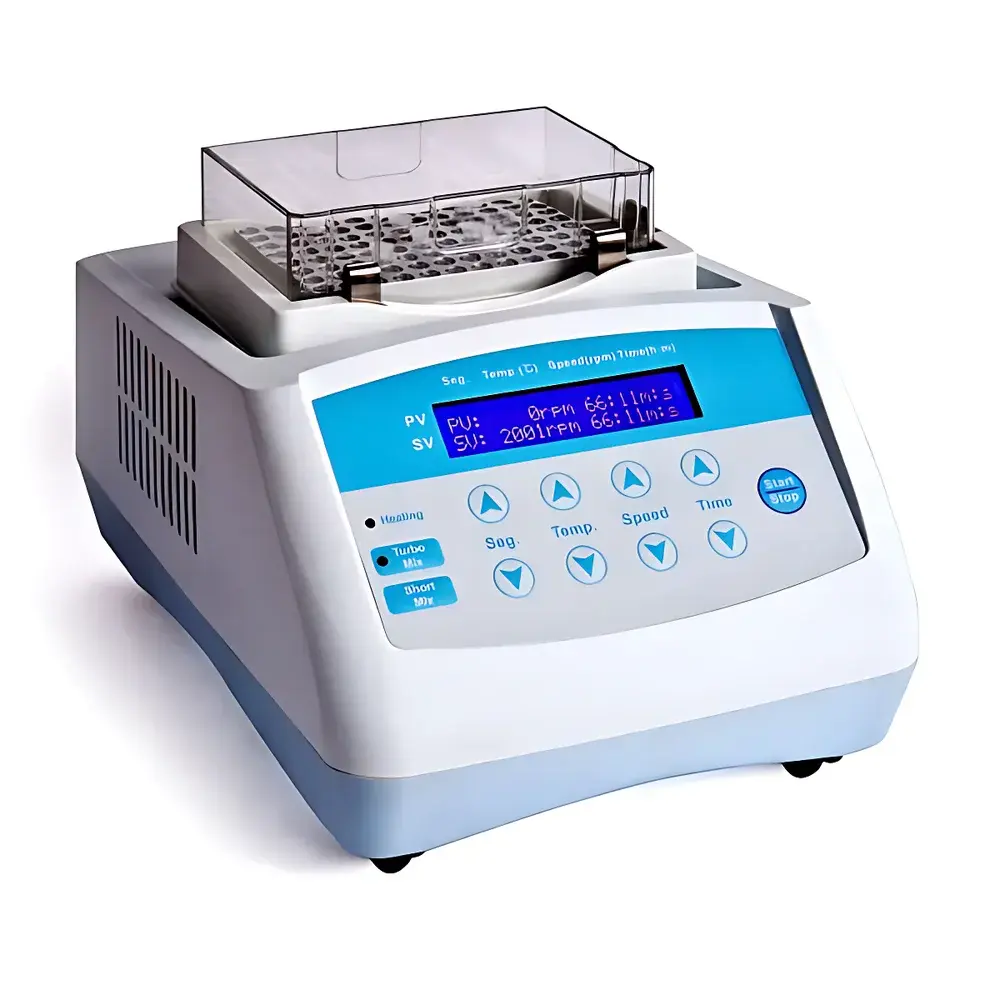
Langbo DMK-1 Advanced Low-Temperature Constant-Temperature Metal Bath
| Brand | Langbo |
|---|---|
| Model | DMK-1 |
| Temperature Range | −10 °C to 100 °C |
| Stability @ 100 °C | ≤ ±0.5 °C |
| Uniformity @ 40 °C | ≤ ±0.3 °C |
| Max. Module ΔT @ 40 °C | 0.3 °C |
| Display Resolution | 0.1 °C |
| Timer Range | 0–99 h 59 min |
| Heating Time (20 °C → 100 °C) | ≤15 min |
| Cooling Time (20 °C → −5 °C, 30 °C ambient) | ≤20 min |
| Cooling Time (20 °C → −10 °C, 25 °C ambient) | ≤30 min |
| Max. Power | 200 W |
| Dimensions (W×D×H) | 300 × 220 × 170 mm |
| Net Weight | 5 kg |
| Compliance | CE-marked design principles |
Overview
The Langbo DMK-1 Advanced Low-Temperature Constant-Temperature Metal Bath is a precision-engineered dry block thermostat designed for reproducible thermal control across demanding life science, clinical diagnostics, and analytical chemistry applications. Unlike water baths, this metal-block system eliminates evaporation, contamination risk, and condensation—delivering rapid, uniform heating and active cooling via integrated Peltier elements and high-efficiency heat-sink architecture. Its operational range spans −10 °C to 100 °C, enabling both cryogenic sample stabilization (e.g., enzyme preservation at −5 °C) and high-temperature incubation (e.g., PCR pre-denaturation at 95 °C). The unit employs closed-loop PID temperature regulation with real-time feedback from multiple embedded platinum resistance thermometers (PT100), ensuring stability ≤ ±0.5 °C at 100 °C and spatial uniformity ≤ ±0.3 °C across the block surface at 40 °C—critical for quantitative assays requiring inter-sample consistency.
Key Features
- Five-stage programmable protocol capability: Users can define up to five sequential temperature setpoints with independent dwell times (0–99 h 59 min each), supporting complex thermal ramping profiles without external controllers.
- Dual-mode visual interface: Backlit LCD displays real-time block temperature (0.1 °C resolution) and countdown timer simultaneously; intuitive membrane keypad enables gloved operation in biosafety cabinets or cold rooms.
- Integrated safety architecture: Auto-diagnostic self-check at power-on; audible alarm triggers on overtemperature (>105 °C), sensor failure, or thermal runaway; hardware-based overtemperature cutoff prevents irreversible damage to samples or block.
- Field-adjustable temperature calibration: Offset correction (±9.9 °C range) allows traceable alignment to NIST-traceable reference thermometers—essential for ISO/IEC 17025-accredited laboratories.
- Modular interchange system: Quick-release mechanism enables tool-free swapping of aluminum blocks within <10 seconds; all modules are autoclavable (121 °C, 20 min) and chemically resistant to ethanol, isopropanol, and 10% sodium hypochlorite.
- Thermal performance validation: Verified cooling rates include ≤20 min (20 °C → −5 °C at 30 °C ambient) and ≤30 min (20 °C → −10 °C at 25 °C ambient), meeting ASTM E2865-22 criteria for thermal response characterization of dry block systems.
Sample Compatibility & Compliance
The DMK-1 accommodates standardized consumables via ten interchangeable block configurations (DMK-1-A through DMK-1-J), supporting formats from 96-well PCR plates (0.2 mL) to 50 mL conical tubes. All blocks maintain rated thermal specifications across their full operating range (−10 °C to 100 °C), with exception of F, G, H, and I modules limited to ≥0 °C minimum due to mechanical seal constraints. Each module undergoes individual thermal mapping per ISO 13485 Annex C prior to shipment. The instrument’s electrical design conforms to IEC 61010-1:2010 for laboratory equipment safety; firmware supports audit trail generation (user ID, timestamp, parameter changes) required under FDA 21 CFR Part 11 for regulated environments when paired with validated LIMS integration.
Software & Data Management
While the DMK-1 operates as a standalone device, its RS-232 serial port enables bidirectional communication with third-party laboratory information management systems (LIMS) or custom Python/Matlab scripts using ASCII command protocol (e.g., “TEMP?” returns current reading; “SET 37.0” initiates setpoint change). Optional Langbo LogView software (v2.1+) provides time-stamped CSV export of temperature logs at user-defined intervals (1–60 s), graphical overlay of multi-run comparisons, and automated pass/fail reporting against predefined SOP thresholds. All data files include embedded metadata: instrument serial number, module ID, calibration date, and operator credentials—supporting ALCOA+ data integrity principles.
Applications
- Enzyme kinetics studies requiring sub-zero stabilization of restriction enzymes or ligases prior to reaction initiation.
- Controlled thawing of cryopreserved cell lines (e.g., PBMCs, stem cells) at precisely −5 °C to minimize ice recrystallization damage.
- Temperature-dependent immunoassay incubations (e.g., ELISA, lateral flow) where uniform well-to-well thermal exposure directly impacts signal-to-noise ratio.
- Standby conditioning of HPLC autosampler trays to prevent analyte precipitation during long-sequence runs.
- Calibration verification of infrared thermometers and contact probes using NIST-traceable block references.
- Pre-analytical sample equilibration for mass spectrometry workflows where thermal history affects metabolite stability.
FAQ
Does the DMK-1 support remote monitoring via Ethernet or Wi-Fi?
No—only RS-232 serial connectivity is provided. Network interfaces are excluded to maintain electromagnetic compatibility in sensitive instrumentation suites.
Can the same block be used for both heating and cooling cycles without recalibration?
Yes. Each block is characterized across the full −10 °C to 100 °C range; no recalibration is needed between thermal modes.
Is the unit suitable for continuous operation at −10 °C in a 30 °C laboratory environment?
It achieves −10 °C under specified ambient conditions (≤25 °C); sustained operation at maximum cooling load in warmer environments may reduce longevity of Peltier elements.
Are replacement modules supplied with individual calibration certificates?
Certificates of Conformance (CoC) are included with each module; full calibration certificates (ISO/IEC 17025) are available upon request at additional cost.
What maintenance is required to sustain thermal accuracy over time?
Annual verification using a calibrated reference thermometer is recommended; cleaning with lint-free cloth and 70% ethanol suffices—no lubrication or internal servicing is required.



