
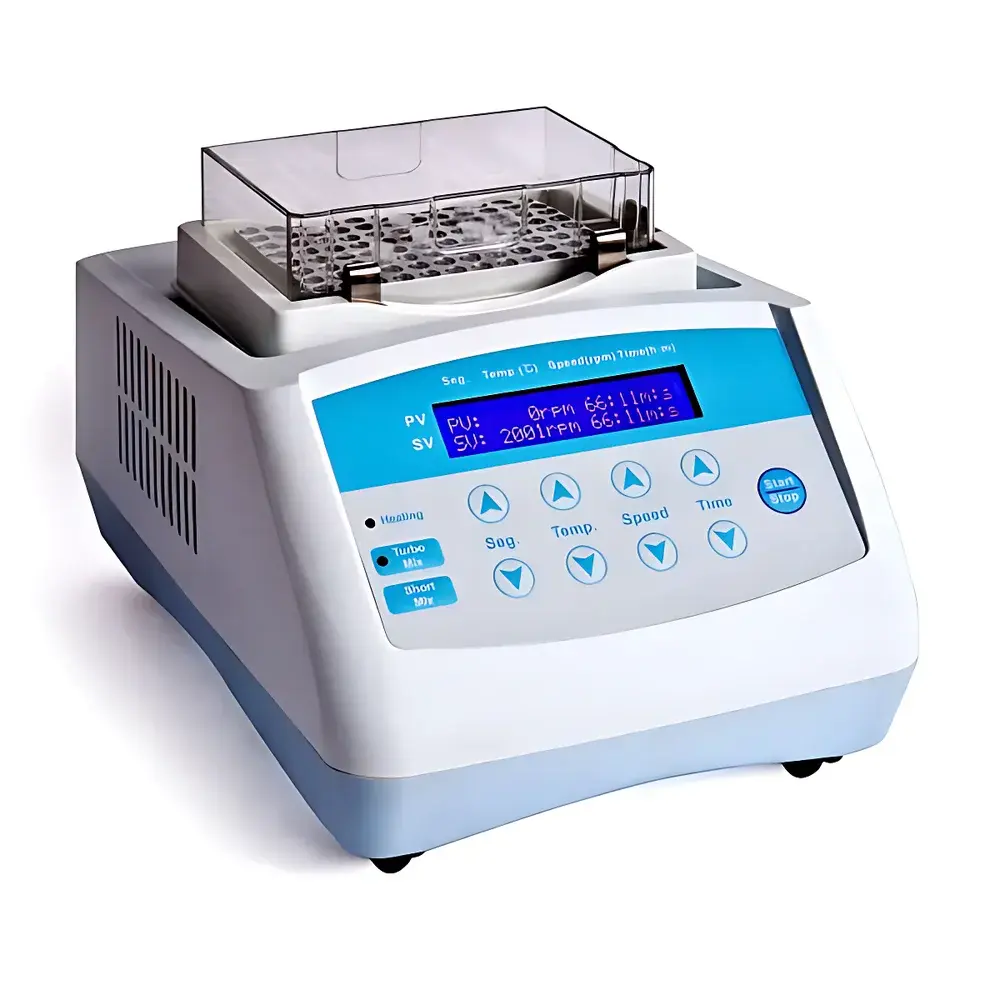
Langbo ZMK-1 Oscillating Constant-Temperature Metal Bath
| Brand | Langbo |
|---|---|
| Origin | Jiangsu, China |
| Model | ZMK-1 |
| Heating/Cooling Range | 0–100 °C |
| Temperature Uniformity | ≤±0.3 °C |
| Temperature Stability | ±0.3 °C |
| Display Resolution | 0.1 °C |
| Heating Rate | <20 min (20 °C to 100 °C) |
| Cooling Performance | ≥7 °C/min (100 °C → 20 °C) |
| Minimum Achievable Block Temperature | 0 °C (ambient ≤20 °C), 4 °C (ambient ≤25 °C), 10 °C (ambient ≤30 °C) |
| Oscillation Speed | 200–1500 rpm (1-rpm increment) |
| Oscillation Mode | Horizontal orbital, 2 mm amplitude |
| Timer Range | 0–99 h 59 min |
| Max Power Consumption | 200 W |
| Dimensions (W×D×H) | 300×220×170 mm |
| Net Weight | 8.5 kg |
| Motor Type | Brushless DC |
| Safety Features | Over-temperature protection, over-current protection, block overheat cutoff, auto-restart after power recovery |
Overview
The Langbo ZMK-1 Oscillating Constant-Temperature Metal Bath is an engineered thermal platform designed for precise, simultaneous temperature control and orbital mixing of small-volume samples in microcentrifuge tubes, PCR strips, enzyme-linked immunosorbent assay (ELISA) plates, and Falcon tubes. Unlike water baths or dry-block heaters, the ZMK-1 employs a solid aluminum heating/cooling block with integrated Peltier thermoelectric modules—enabling bidirectional thermal regulation (heating and active cooling) without external chillers or refrigerants. Its operation follows the principle of conductive heat transfer from the precisely temperature-regulated metal block to sample vessels, ensuring rapid thermal equilibration and minimal gradient deviation across the block surface. The device is widely deployed in molecular biology labs for enzyme reactions, cell lysis, ligand binding assays, and reagent equilibration where both thermal homogeneity and gentle mechanical agitation are critical to assay reproducibility.
Key Features
- Microprocessor-controlled PID temperature regulation with linear response and high repeatability (±0.3 °C stability, ≤±0.3 °C uniformity across the block)
- Integrated brushless DC motor delivering smooth, low-vibration orbital shaking (2 mm horizontal amplitude) at adjustable speeds from 200 to 1500 rpm in 1-rpm increments
- LCD interface with real-time display of setpoint, actual block temperature, oscillation speed, and remaining time
- Power-fail recovery function: automatically resumes prior settings—including temperature, rpm, and timer—upon restoration of mains power
- Dedicated calibration mode for user-initiated temperature offset correction, supporting traceable lab verification protocols
- Short-pulse “jog” function for manual, momentary agitation without altering ongoing program parameters
- Multi-layer safety architecture: independent over-temperature cutoff, current-limiting circuitry, thermal fuse, and block surface overheat detection
- Energy-efficient design with peak power draw limited to 200 W, suitable for continuous operation in standard laboratory circuits
Sample Compatibility & Compliance
The ZMK-1 accommodates interchangeable aluminum blocks (sold separately), each engineered for specific vessel geometries and thermal mass profiles. Standard modules include formats for 96-well PCR plates (A, J), 0.5 mL and 1.5–2.0 mL microcentrifuge tubes (B–E), 12–15 mL conical tubes (G), and 50 mL Falcon tubes (H). A universal water-jacketed block (I) enables compatibility with irregularly shaped containers. All blocks maintain rated performance up to 100 °C; maximum safe operating temperature is module-dependent and clearly labeled per ISO 8573-1 and IEC 61010-1 safety guidelines. The instrument conforms to electromagnetic compatibility (EMC) requirements per EN 61326-1 and carries CE marking for use within EU laboratories. While not certified for GMP manufacturing environments, its programmable logging capability and parameter lockout support GLP-aligned workflows in QC and R&D settings.
Software & Data Management
The ZMK-1 operates as a standalone benchtop instrument with no proprietary software dependency. All operational parameters—including temperature setpoint, oscillation speed, duration, and calibration offsets—are stored in non-volatile memory and retained through power cycles. The LCD interface supports intuitive navigation via membrane keypad, with visual feedback for parameter confirmation and error states (e.g., “OVERHEAT”, “BLOCK ERROR”). For auditability, users may manually record session metadata (start time, block ID, target conditions) in lab notebooks or LIMS-compatible spreadsheets. Though lacking native USB/RS232 output or FDA 21 CFR Part 11-compliant electronic signatures, the device’s deterministic behavior, consistent thermal ramping, and repeatable mixing profiles facilitate validation documentation per ASTM E2500 and ISO/IEC 17025 requirements.
Applications
- Thermal activation/inactivation of restriction enzymes, polymerases, and phosphatases
- Cell suspension and homogenization during bacterial lysis or tissue dissociation
- Antibody-antigen incubation in ELISA and lateral flow assay development
- Equilibration of master mixes prior to qPCR setup
- Controlled dissolution testing of lyophilized reagents
- Small-scale crystallization screening under agitated thermal gradients
- Pre-analytical sample conditioning for HPLC, GC, and mass spectrometry workflows
FAQ
What is the minimum ambient temperature required to achieve 0 °C block temperature?
The ZMK-1 achieves 0 °C at the block surface only when ambient temperature is ≤20 °C. At 25 °C ambient, minimum block temperature is 4 °C; at 30 °C ambient, it is 10 °C.
Can multiple modules be used interchangeably without recalibration?
Yes—each module is pre-characterized for thermal response. However, for applications requiring absolute temperature accuracy ≤±0.1 °C, users should perform block-specific offset calibration using a NIST-traceable probe.
Is the oscillation motion truly horizontal and circular?
Yes—the drive mechanism produces consistent 2 mm horizontal orbital motion (not reciprocating or vortexing), optimized to minimize splashing and foaming in low-volume aqueous samples.
Does the unit support continuous operation beyond 99 hours?
No—the maximum timer setting is 99 h 59 min. For extended protocols, users must manually restart or implement external scheduling via lab automation interfaces.
Are replacement blocks supplied with thermal insulation or mounting hardware?
All modules ship with integrated thermal gasketing and secure bayonet-style locking; no additional hardware is required for installation or removal.



