
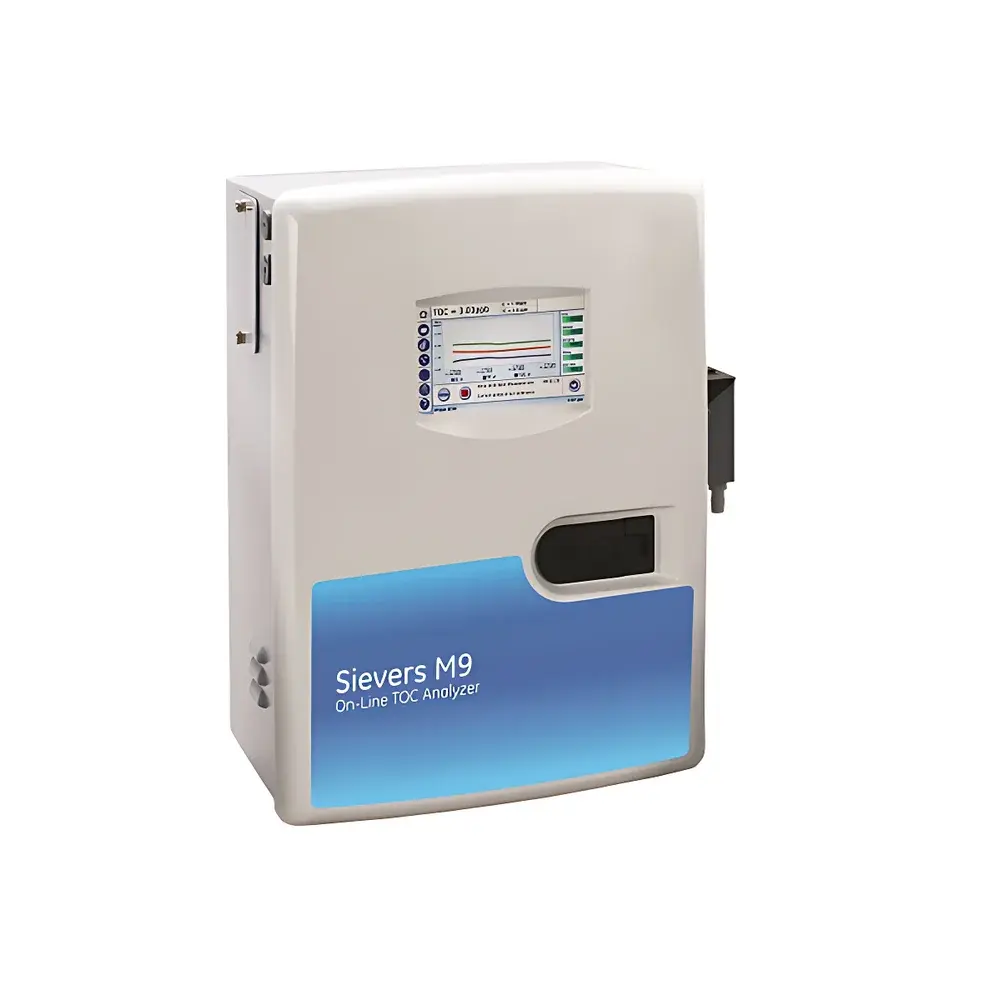
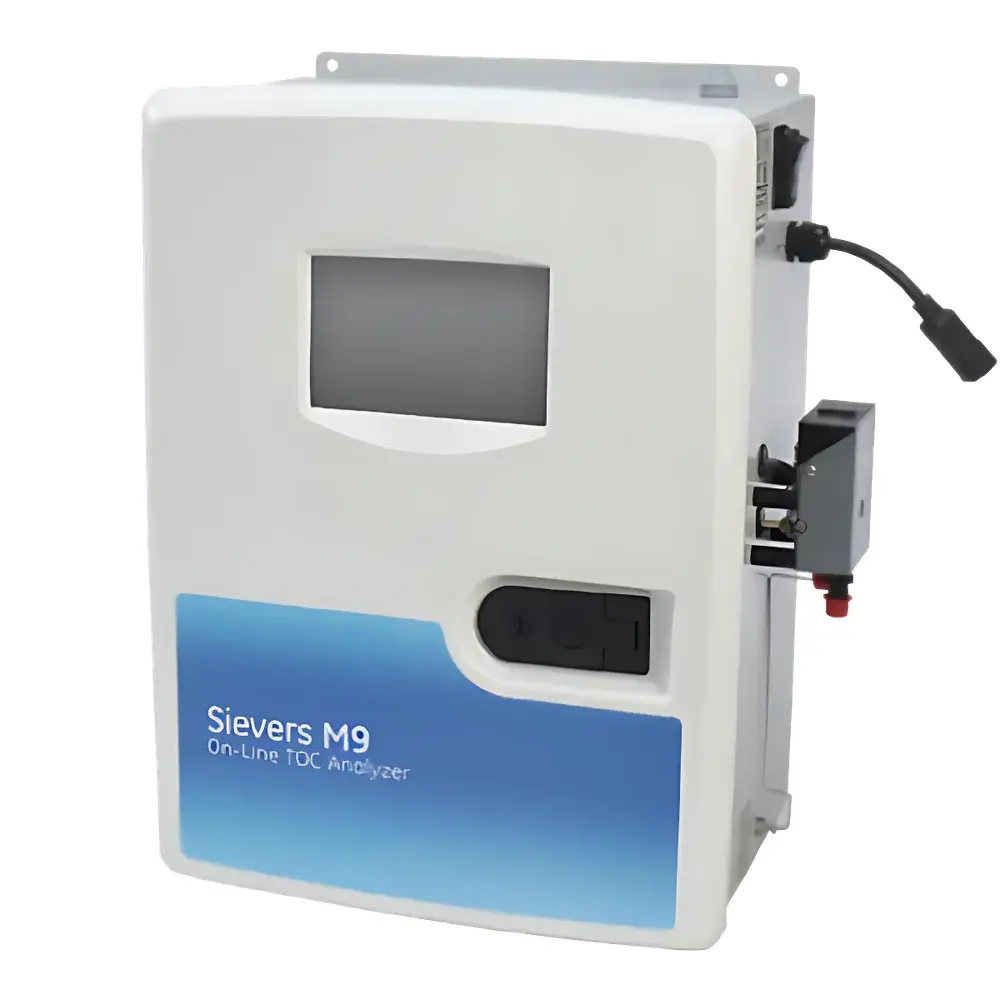
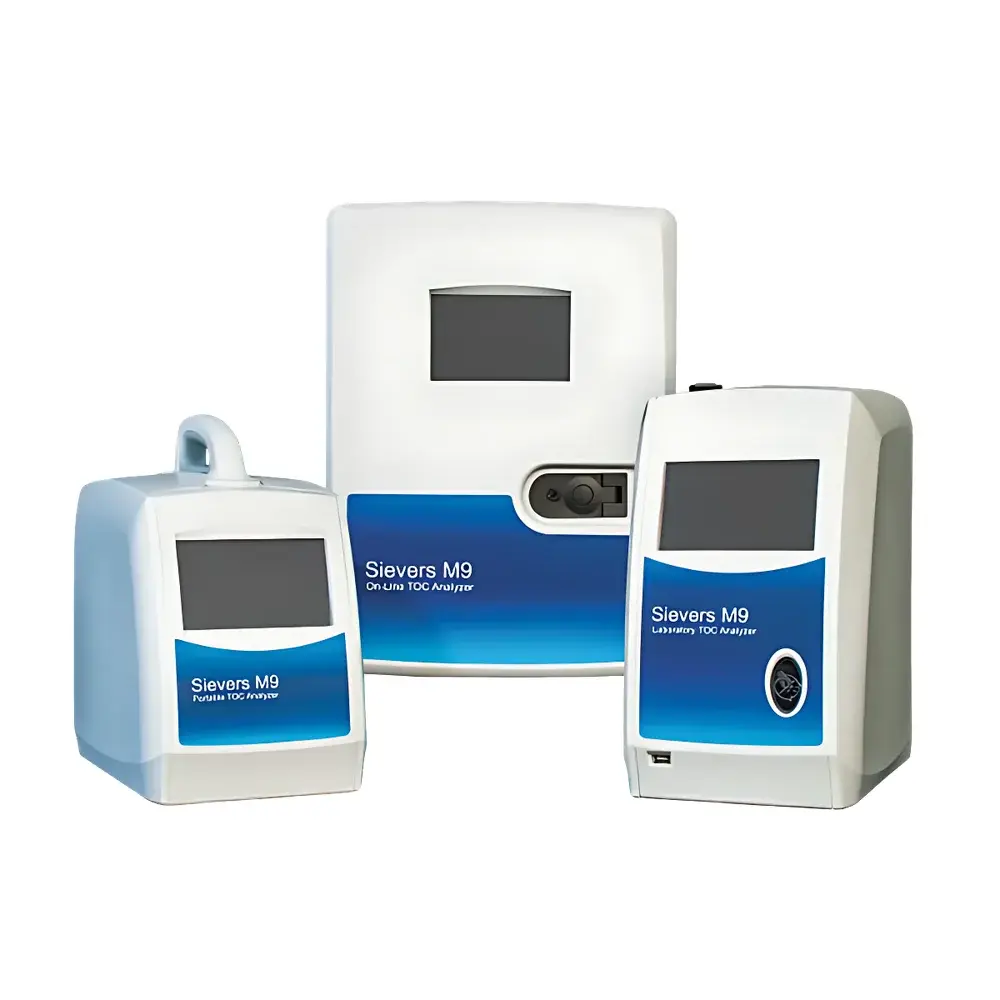
Sievers M9 Online Total Organic Carbon (TOC) Analyzer
| Brand | Sievers (Veolia) |
|---|---|
| Origin | USA |
| Manufacturer | Veolia Water Technologies |
| Type | Online TOC Analyzer |
| Detection Principle | Membrane Conductivity Detection |
| Oxidation Method | UV/Persulfate Oxidation |
| Measurement Range | 0.03 ppb to 50 ppm |
| Accuracy | ±2% or ±0.5 ppb (whichever is greater) |
| Resolution | 0.01 ppb |
| Detection Limit | 0.03 ppb |
| Repeatability | <1% RSD |
| Analysis Time | 2 min (standard), 4 sec (optional Turbo mode) |
| Calibration Stability | 12 months |
| Sample Temperature Range | 5–95 °C |
| Ambient Temperature Range | 5–40 °C |
| Inlet Pressure | ≤100 psig |
| Sample Flow Rate (online) | >50 mL/min |
| Internal Flow Rate | 0.5 mL/min |
| Display | 7" WVGA color touchscreen (800×480) |
| Outputs | 4–20 mA (×3), digital alarms (×4), binary input (×1), USB device (×1), USB host (×2), Modbus TCP/IP |
| Power | 100–240 V~, 50–60 Hz, 100 VA |
| Enclosure Rating | IP45 |
| Certifications | ETL, CE |
| Weight | 15.8 kg |
| Dimensions (H×W×D) | 54.9 × 45.0 × 26.5 cm |
Overview
The Sievers M9 Online Total Organic Carbon (TOC) Analyzer is an industrial-grade, continuous-monitoring instrument engineered for high-precision quantification of organic carbon in aqueous streams across pharmaceutical, semiconductor, power generation, and municipal water treatment applications. It employs a dual-stage oxidation process—ultraviolet (UV) light combined with persulfate chemistry—to fully mineralize non-purgeable organic carbon (NPOC) into carbon dioxide. The resulting CO2 is selectively permeated through a hydrophobic gas-permeable membrane into an ultra-pure deionized water stream, where conductivity changes are measured via a high-stability, low-drift membrane conductivity detector. This proprietary detection architecture eliminates interferences from inorganic ions, chloride, and residual oxidants—common challenges in conventional direct conductivity or NDIR-based TOC systems—thereby delivering robust baseline stability and long-term measurement integrity without carrier gas or reagent consumption.
Key Features
- True online operation with no external reagents, carrier gases, or consumable catalysts—reducing total cost of ownership and operational complexity.
- Modular, corrosion-resistant wetted-path construction using PFA, PEEK, and quartz components, optimized for ultrapure water (UPW), clean-in-place (CIP) cycles, and aggressive process environments.
- Intuitive 7-inch WVGA color touchscreen interface supporting multilingual menus, real-time trend visualization, and one-touch method recall for routine SOP execution.
- Two operational modes: continuous online monitoring (with integrated flow control and pressure regulation) and discrete sampling via the optional Sievers Integrated Online Sampling (iOS) system—enabling automated standard addition, calibration verification, and multi-point validation without manual intervention.
- Turbo mode option delivers a new TOC reading every 4 seconds—critical for rapid feedback control in recirculating UPW loops or dynamic wastewater reuse applications.
- 12-month calibration stability validated per ASTM D5905 and USP <643>, supported by automated system suitability checks and audit-trail-enabled calibration logs compliant with FDA 21 CFR Part 11 requirements.
Sample Compatibility & Compliance
The M9 analyzer accommodates liquid samples across a broad physicochemical spectrum: ultrapure water (resistivity ≥18.2 MΩ·cm), purified water (PW), water for injection (WFI), boiler feedwater, cooling tower makeup, treated wastewater effluent, and raw surface water. Its sample inlet tolerates temperatures from 5 to 95 °C (with optional PVDF iOS required above 60 °C) and pressures up to 100 psig. All fluidic pathways meet ASME BPE surface finish standards (≤0.4 µm Ra), and the analyzer complies with ISO 22196 for antimicrobial surface testing of housing materials. Regulatory alignment includes full traceability to pharmacopeial methods (USP <643>, EP 2.2.44, JP 2.59), EPA Method 415.3, and ASTM D5905 for laboratory and field TOC determination. The embedded software architecture supports electronic signatures, user role-based access control, and immutable audit trails—meeting GLP, GMP, and FDA 21 CFR Part 11 data integrity requirements.
Software & Data Management
Embedded firmware v4.x provides native support for Modbus TCP/IP communication, enabling seamless integration into DCS, SCADA, and MES platforms. Three isolated 4–20 mA analog outputs allow simultaneous transmission of TOC concentration, system status, and diagnostic flags (e.g., lamp intensity, membrane health, flow alarm). Four programmable digital alarm relays support fail-safe shutdown protocols and maintenance scheduling triggers. USB host ports accept external storage for encrypted data export (CSV/Excel), while the USB device port enables remote diagnostics and firmware updates via laptop connection. Data logging includes timestamped raw conductivity values, temperature-compensated TOC results, oxidation efficiency metrics, and full event history—with retention configurable up to 12 months on internal flash memory. Optional cloud connectivity via Veolia’s AQUAVISTA™ platform enables predictive maintenance alerts and fleet-wide performance benchmarking.
Applications
- Pharmaceutical manufacturing: Real-time TOC surveillance at WFI generation points, distribution loops, and point-of-use locations per EU GMP Annex 1 and FDA guidance.
- Semiconductor fab UPW systems: Sub-ppb-level contamination detection during polishing loop monitoring and regeneration cycle validation.
- Power plant chemistry control: Feedwater purity assurance in supercritical and ultra-supercritical boilers to prevent turbine deposit formation.
- Municipal water reclamation: Effluent compliance monitoring against regulatory TOC discharge limits (e.g., California Title 22, EU Urban Wastewater Directive).
- Biotechnology process water: Continuous verification of cleaning validation rinse water and media preparation water quality.
FAQ
Does the M9 require carrier gas or chemical reagents for routine operation?
No. The M9 operates without external carrier gas, acid reagents, or catalysts—relying solely on UV/persulfate oxidation and membrane conductivity detection.
What is the minimum detectable TOC concentration, and how is it verified?
The method detection limit is 0.03 ppb, confirmed per EPA 415.3 protocol using repeated analysis of ultra-low carbon blank water and calculation of standard deviation of the mean.
Can the M9 be used for high-temperature sample streams?
Yes—up to 95 °C with the optional PVDF iOS assembly; standard stainless-steel iOS is rated to 60 °C.
How does the M9 ensure data integrity for regulated environments?
It features time-stamped, user-identified audit trails; electronic signature capability; password-protected configuration tiers; and automatic backup of all calibration, maintenance, and event logs—all aligned with 21 CFR Part 11 Annex 11 expectations.
Is remote diagnostics and software update supported?
Yes—via secure USB device connection or optional Ethernet-based AQUAVISTA™ cloud interface with TLS 1.2 encryption and role-based API access.
Related Products







