
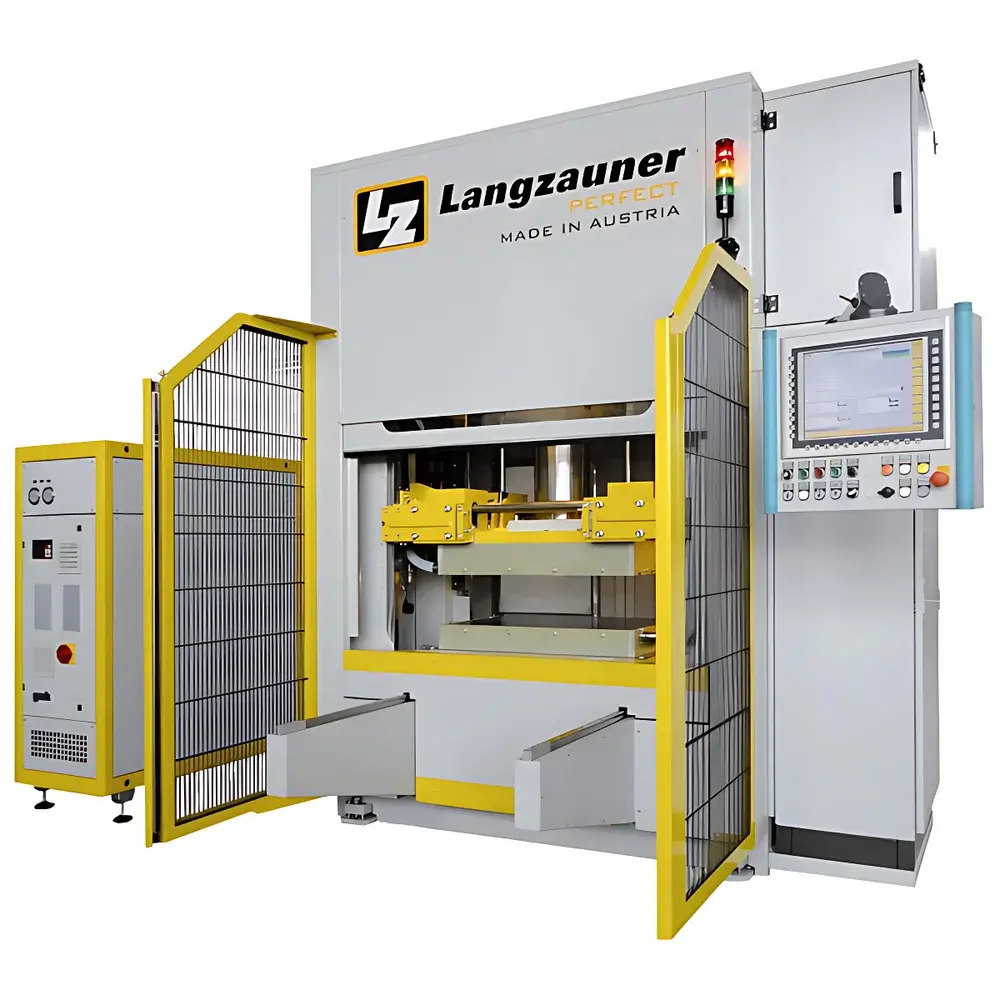
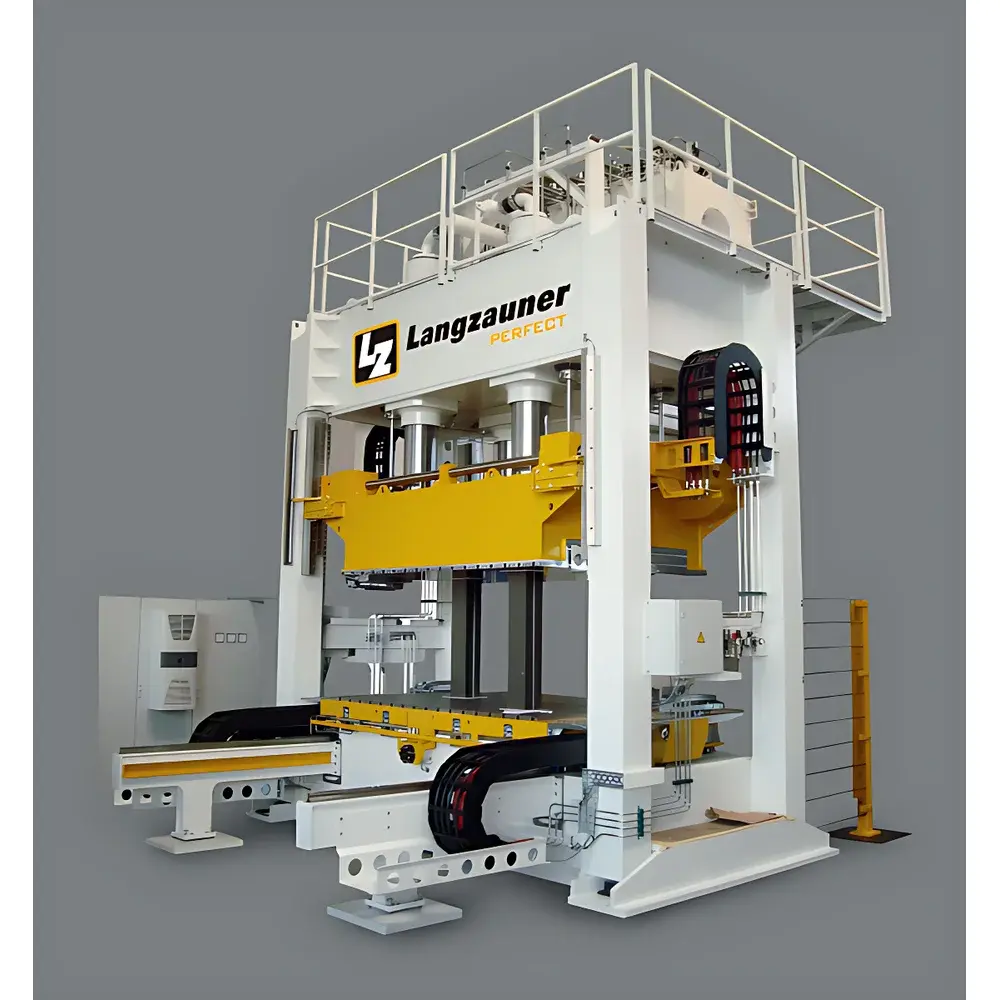
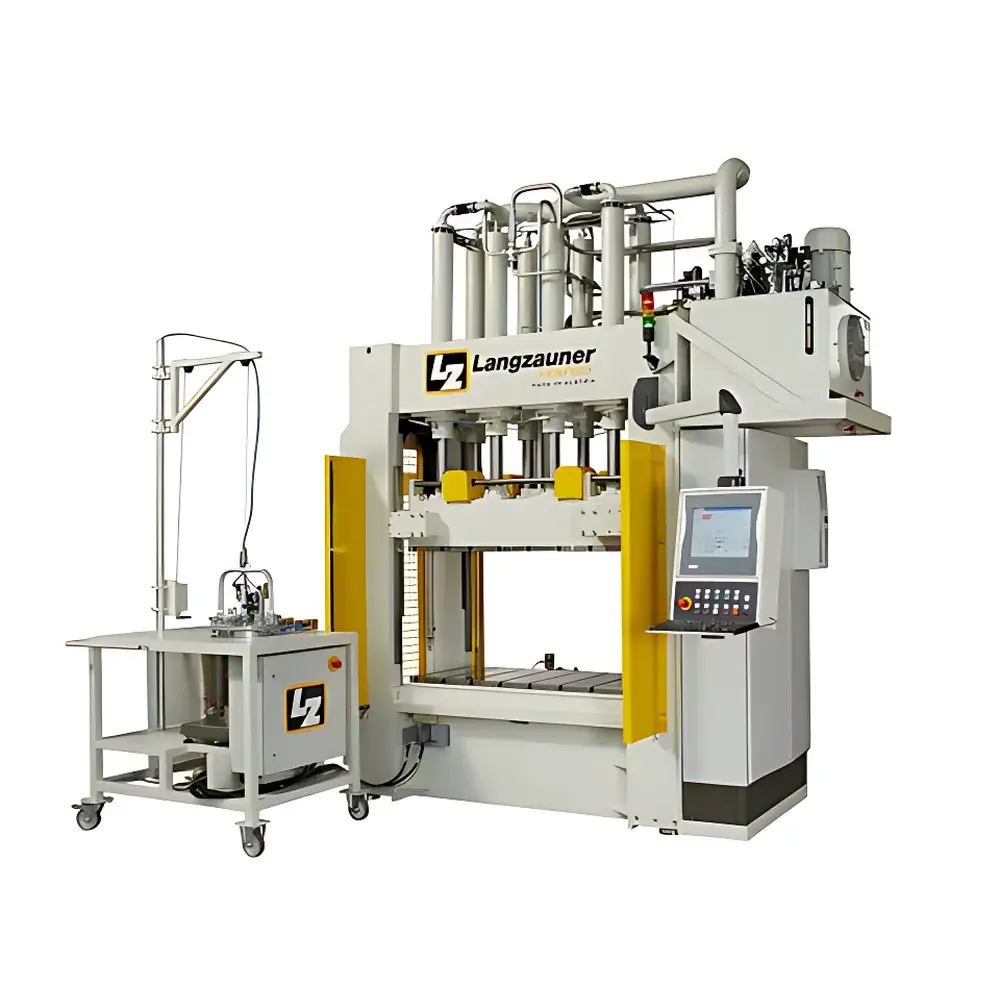
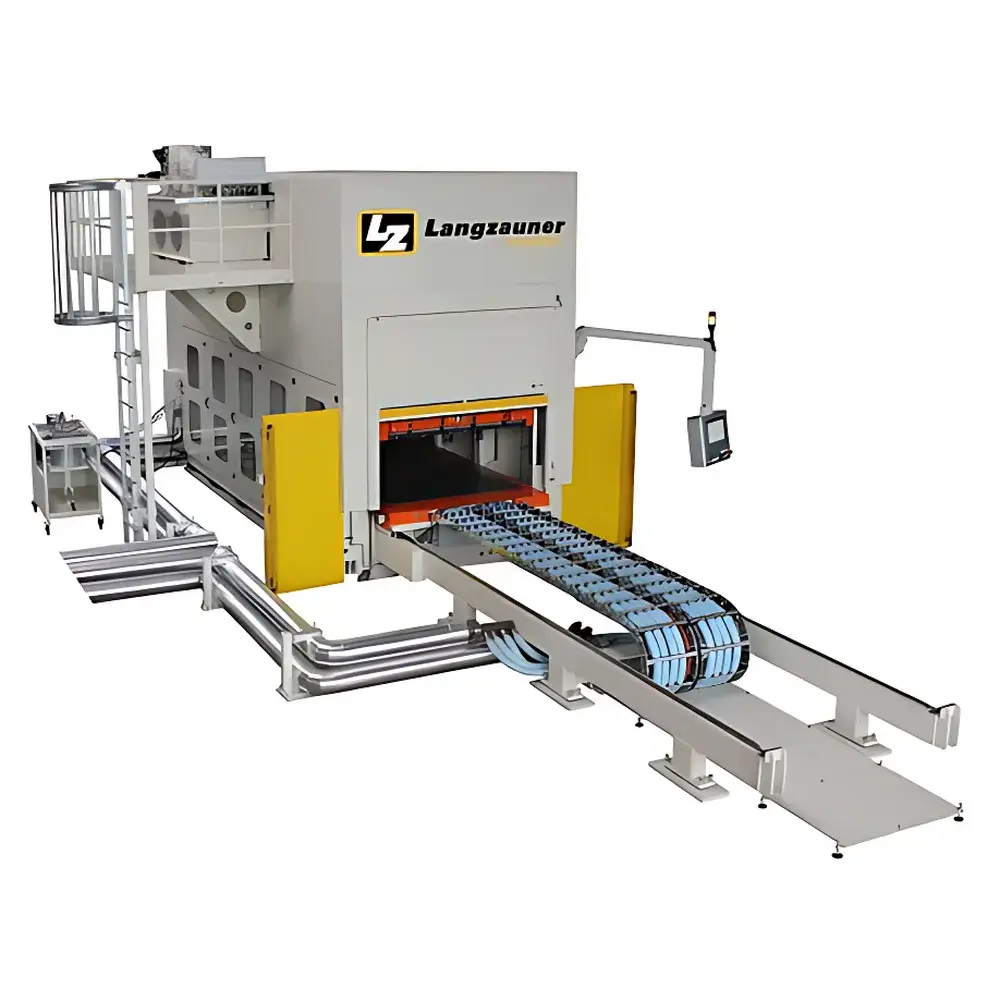
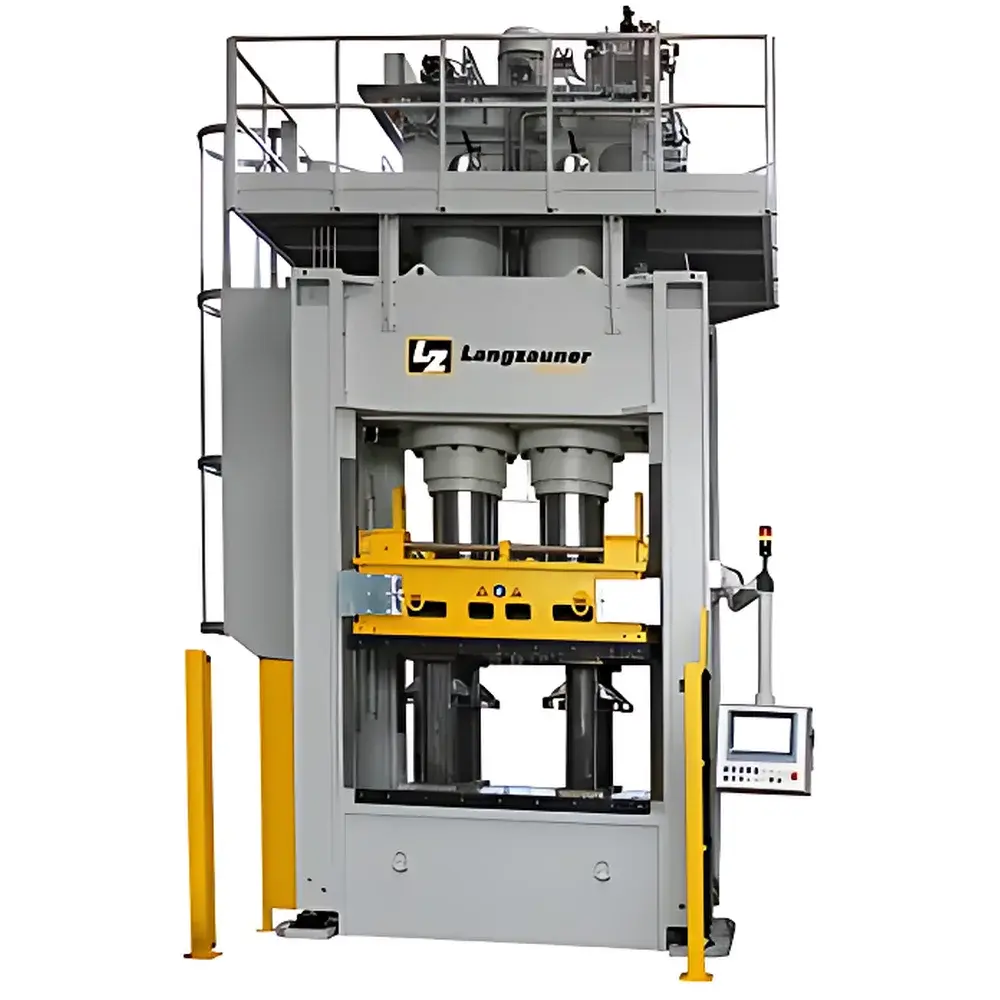
Langzauner Servo-Hydraulic Press System
| Brand | Langzauner |
|---|---|
| Origin | Austria |
| Model | Langzauner Series |
| Drive Type | Servo-controlled hydraulic |
| Pressure Range | 1.5–3,000 metric tons |
| Positional Accuracy | ±0.05 mm |
| Pressure Accuracy | ±1% of full scale |
| Platen Flatness Tolerance | ±0.1 mm |
| Temperature Sensor Inputs | 4 channels |
| Energy Savings vs. Conventional Proportional Systems | >70% |
| Noise Level | Optimized to minimum operational dB(A) |
| Compliance | Designed for ISO 9001-aligned manufacturing environments and GLP-compliant laboratory integration |
Overview
The Langzauner Servo-Hydraulic Press System is an engineered solution for high-precision thermomechanical processing in advanced materials development and industrial-scale composite manufacturing. Unlike conventional hydraulic presses relying on fixed-speed pumps and proportional pressure control valves, this system implements a closed-loop servo-hydraulic architecture—where a variable-speed internal gear pump is directly driven by a high-torque servo motor. This design enables real-time, independent regulation of platen force, displacement, and velocity without throttling losses or continuous pump overdrive. The fundamental principle centers on energy-on-demand actuation: hydraulic pressure is generated only when required, with instantaneous response to setpoint changes in load, position, or rate. This architecture delivers superior repeatability in consolidation cycles (e.g., autoclave-simulated curing, resin transfer molding preform compaction), while meeting the mechanical stability and thermal uniformity requirements of aerospace-grade prepreg layup and wind turbine blade core forming.
Key Features
- Servo-motor-driven internal gear pump eliminates reliance on energy-wasting proportional control valves and constant-pressure hydraulic accumulators.
- Continuous, infinitely variable control of pressing force (1.5–3,000 t), platen velocity (0.01–50 mm/s typical range), and displacement (±0.05 mm positional repeatability).
- Integrated four-channel temperature input interface supports direct connection to industry-standard RTDs or thermocouples (Type K/J/T), enabling synchronized thermal profiling across upper/lower platens and tooling inserts.
- Platen surface flatness maintained within ±0.1 mm across full active area—critical for uniform fiber alignment and void suppression in carbon-fiber laminates.
- Energy consumption reduced by >70% compared to legacy systems operating under constant-pressure, throttled-flow regimes; verified per ISO 14955-1 methodology for machine tool energy assessment.
- Acoustic emission minimized via low-noise pump design and optimized valve switching logic—typical operational noise <72 dB(A) at 1 m distance.
- No external hydraulic controller required: all motion, pressure, and thermal sequencing executed via embedded real-time PLC with deterministic cycle timing.
Sample Compatibility & Compliance
The Langzauner press accommodates diverse sample geometries—from small research coupons (25 × 25 mm) to full-scale structural components (up to 3,000 mm × 1,800 mm active platen area). Tooling interfaces comply with DIN 55100 and ISO 2768-mK dimensional tolerance standards. The system supports both rigid tooling (steel, Invar) and flexible bladder molds used in out-of-autoclave (OOA) processes. For regulated environments, the control firmware includes audit-trail logging (timestamped parameter changes, operator ID, cycle validation flags) aligned with FDA 21 CFR Part 11 data integrity expectations. Mechanical safety conforms to EN 692 (mechanical presses) and EN ISO 13857 (safety distances), with dual-channel emergency stop circuitry and light curtain integration capability.
Software & Data Management
Control is managed through Langzauner’s proprietary HMI software suite, deployable on Windows-based industrial PCs. The interface provides graphical cycle programming (force/position/time profiles), real-time trending of pressure vs. displacement curves, and automated pass/fail evaluation against user-defined process windows. All raw sensor data—including synchronized force, position, temperature, and motor current—are logged in .CSV and HDF5 formats for post-processing in MATLAB, Python (Pandas), or LIMS platforms. Optional OPC UA server module enables seamless integration into MES/SCADA ecosystems (e.g., Siemens SIMATIC IT, Rockwell FactoryTalk) for traceability in AS9100-certified production lines.
Applications
- Aerospace: Prepreg tape placement consolidation, honeycomb core bonding, and titanium alloy hot-forming simulation.
- Renewable Energy: Large-format composite spar cap compression for wind turbine blades; thermoplastic matrix composite joining.
- Sports Equipment: High-performance ski/snowboard core lamination, carbon-fiber bicycle frame co-curing.
- Academic Research: Rheological characterization of thermoset resins under constrained flow, interfacial adhesion studies in multi-material stacks.
- Automotive: Structural battery enclosure forming, CFRP subframe compression bonding.
FAQ
Does the Langzauner press support closed-loop temperature control during pressing cycles?
Yes—the integrated 4-channel thermal input allows real-time feedback to external ovens or embedded cartridge heaters, enabling synchronized ramp-hold-cool profiles compliant with ASTM D7264 flexural testing prep conditions.
Can the system be validated for GMP-compliant manufacturing environments?
While not inherently GMP-certified, the system’s deterministic control architecture, electronic audit trail, and configurable alarm/event logging meet foundational requirements for IQ/OQ protocols under EU Annex 11 and USP analytical instrument qualification.
What maintenance intervals are recommended for the servo-hydraulic drive?
The gear pump and servo motor assembly is rated for 20,000 operating hours with no scheduled maintenance beyond annual hydraulic fluid analysis (ISO 4406:2017 code 16/14/11) and filter replacement.
Is third-party calibration of force transducers supported?
Yes—load cells are mounted with NIST-traceable calibration certificates; field recalibration can be performed using certified deadweight test kits per ASTM E4.





