
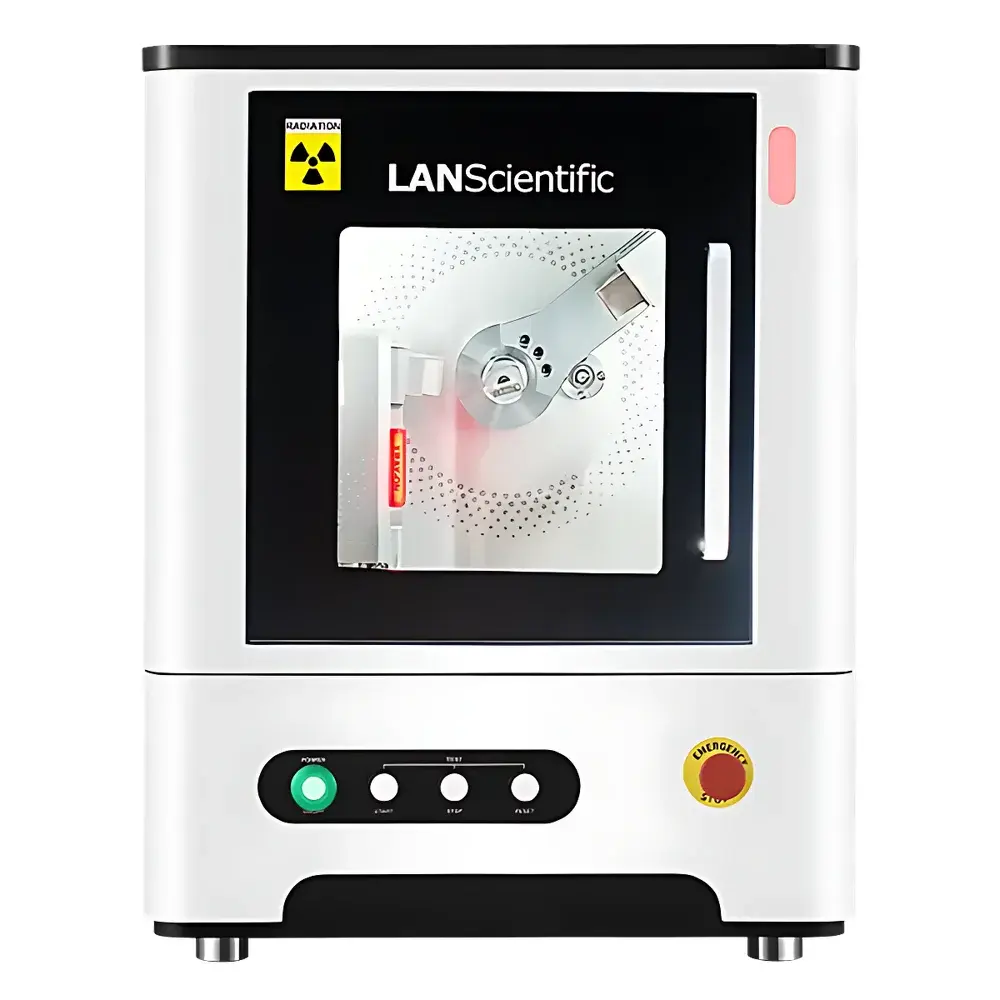
LANScientific FRINGE C1600 Powder X-ray Diffractometer
| Brand | LANScientific |
|---|---|
| Origin | Jiangsu, China |
| Manufacturer Type | Direct Manufacturer |
| Instrument Type | Powder X-ray Diffractometer |
| Model | FRINGE C1600 |
| Regulatory Classification | Domestic (China) |
| Key Features | θ–2θ coupled goniometer with single-axis drive |
| Compliance | Designed for ISO/IEC 17025-aligned lab environments |
Overview
The LANScientific FRINGE C1600 is a benchtop powder X-ray diffractometer engineered for precision crystallographic analysis in industrial quality control and academic research laboratories. It operates on Bragg’s law-based X-ray diffraction (XRD), where monochromatic X-rays interact with periodic atomic lattices in crystalline materials to generate characteristic diffraction patterns. These patterns serve as fingerprint signatures for phase identification, structural refinement, and microstructural characterization. Unlike synchrotron or high-power rotating anode systems, the FRINGE C1600 employs a sealed-tube Cu Kα source (λ = 1.5418 Å) optimized for routine, high-reproducibility measurements across diverse sample forms—powders, pressed pellets, bulk solids, and thin films. Its compact footprint, robust mechanical architecture, and integrated safety interlocks enable deployment in mobile labs, production floors, and GLP-compliant analytical suites without compromising data fidelity.
Key Features
- Patented θ–2θ coupled goniometer with single-axis motorized drive: eliminates mechanical backlash and ensures angular reproducibility better than ±0.02° over full 2θ range (5°–85°).
- Digital multi-channel analyzer (MCA) with pulse-height discrimination: enables simultaneous detection of diffraction peaks and suppression of fluorescent background without requiring a graphite monochromator—improving net peak intensity by up to 30% compared to conventional filtered-source configurations.
- Fully integrated fixed Soller slit assembly: eliminates moving parts in the beam path, enhancing long-term angular stability and enabling vibration-tolerant operation in non-dedicated laboratory spaces—including vehicle-mounted platforms.
- Interlocked radiation safety system: includes dual redundant door switches, automatic X-ray shutter cutoff upon chamber opening, and real-time GUI status indicators confirming enclosure integrity prior to exposure initiation.
- Pre-calibrated detector response and automated alignment routines: reduce setup time and operator dependency while maintaining traceability to NIST-traceable Si standard reference material (SRM 640e).
Sample Compatibility & Compliance
The FRINGE C1600 accommodates standard 25 mm diameter sample holders for loose powders, spin-coated films (<5 µm thick), sintered ceramics, polymer composites, and pharmaceutical tablets. Sample height variation compensation algorithms mitigate preferred orientation effects in anisotropic materials such as clays or layered oxides. The instrument supports ASTM E975 (Standard Practice for X-ray Diffraction Analysis of Metals), ISO 21379:2021 (XRD for cementitious materials), and USP (Powder X-ray Diffraction for Pharmaceutical Polymorph Screening). All firmware and software modules comply with ALCOA+ principles for data integrity; CrystalX includes audit trail logging, electronic signatures, and user role-based access control aligned with FDA 21 CFR Part 11 requirements for regulated environments.
Software & Data Management
CrystalX is the native acquisition and analysis suite, built on a modular architecture supporting both automated workflows and expert-level refinement. Upon completion of a scan, the software performs real-time background subtraction, peak search using second-derivative algorithms, and searches against the ICDD PDF-4+ database (2023 edition). Quantitative phase analysis (QPA) employs the Reference Intensity Ratio (RIR) method per ASTM E1361, with optional Rietveld refinement via embedded TOPAS-Academic engine. Raw .raw and processed .csv outputs are generated with embedded metadata (voltage, current, slit settings, calibration date), ensuring FAIR (Findable, Accessible, Interoperable, Reusable) data handling. Export formats include CIF, XYE, and Bruker RAW compatibility for cross-platform validation.
Applications
The FRINGE C1600 delivers validated performance across sectors requiring rapid, unambiguous crystalline phase assessment: titanium dioxide pigment grading in coatings manufacturing; crystallinity index determination in polypropylene and PET films per ISO 527-2; quantitative analysis of belite/ alite ratios in Portland cement clinker; lattice parameter shifts in cathode materials (e.g., NMC811, LFP) during battery cycling studies; polymorphic screening of active pharmaceutical ingredients (APIs) under ICH Q5A guidelines; and identification of asbestos-group minerals (chrysotile, crocidolite, amosite) in construction materials per EPA Method IO-3.4.
FAQ
Does the FRINGE C1600 require external cooling water or chiller units?
No—it utilizes air-cooled X-ray tube technology with thermal management designed for continuous operation at 40 kV / 30 mA without auxiliary cooling infrastructure.
Can CrystalX perform Rietveld refinement natively?
Yes—TOPAS-Academic integration is licensed and pre-installed; users may perform full-pattern fitting, microstrain analysis, and site occupancy modeling without third-party software dependencies.
Is remote monitoring supported?
Yes—the system includes Ethernet-connected embedded controller with HTTPS-enabled web interface for real-time status checks, queue management, and diagnostic logs accessible from enterprise networks.
What maintenance intervals are recommended?
Annual recalibration of goniometer geometry and detector energy response is advised; X-ray tube lifetime exceeds 10,000 hours under typical QC usage profiles.
Does the instrument meet CE or UKCA marking requirements?
It complies with IEC 61010-1:2010 for electrical safety and IEC 62495:2010 for X-ray equipment; CE marking is available upon request for EU-market configurations with certified radiation shielding verification.





