
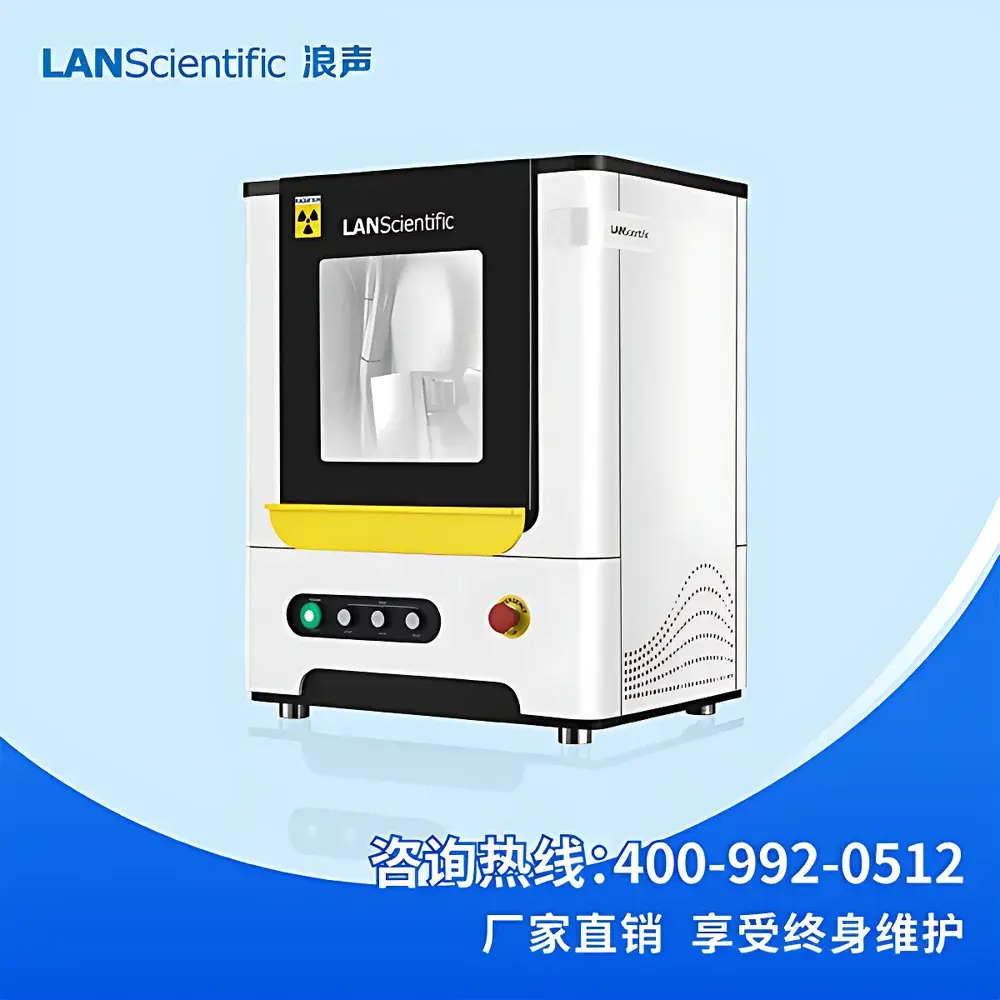
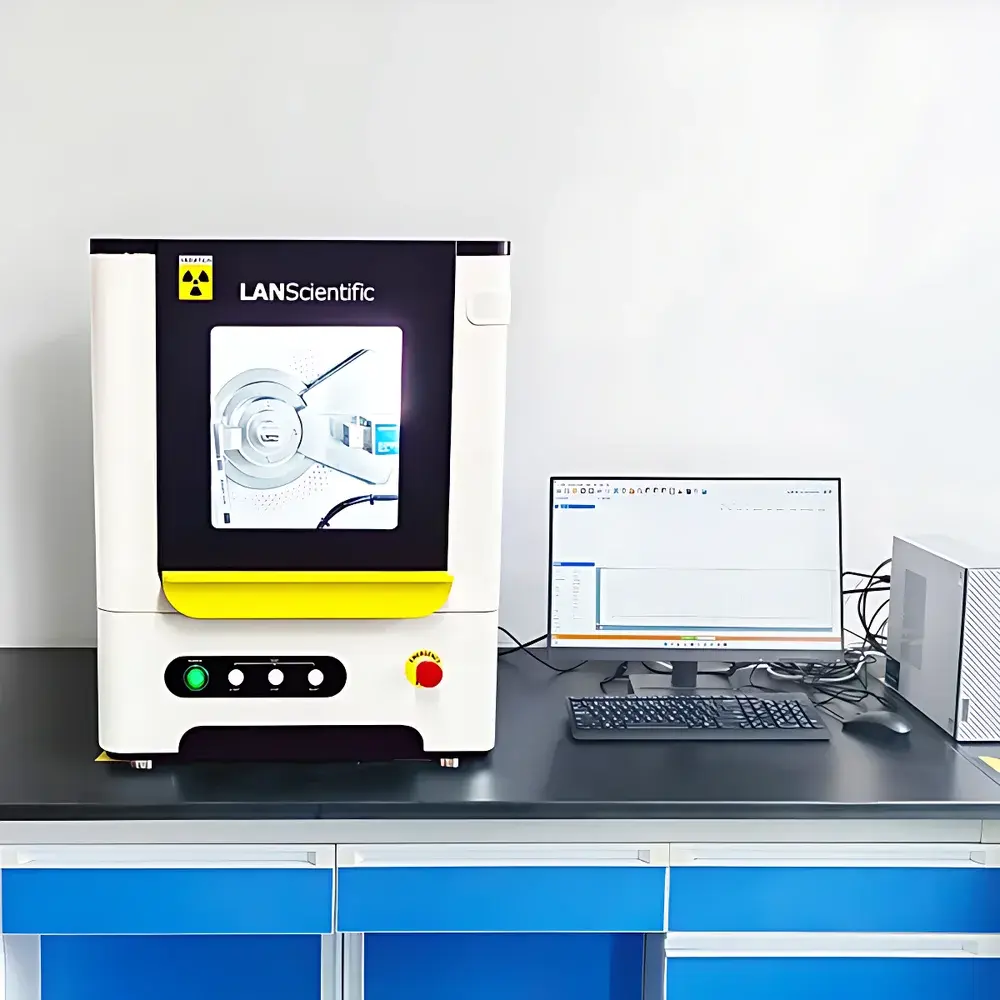
LANScientific FRINGE EV Desktop X-ray Diffractometer
| Brand | LANScientific |
|---|---|
| Origin | Jiangsu, China |
| Manufacturer Type | Original Equipment Manufacturer (OEM) |
| Product Category | Domestic |
| Model | FRINGE EV |
| Instrument Type | Powder X-ray Diffractometer |
| Power Rating | kW-class (air-cooled, sealed-tube source) |
| Detector | Digital Pulse Processing Counter (DPPC), ≥1×10⁷ cps |
| Optical Configuration | Integrated Soller slits, fixed divergence geometry |
| Sample Geometry | Bragg–Brentano θ–2θ reflection mode |
| Safety Compliance | Interlocked sample chamber with auto-shutdown, full enclosure when closed |
| Software | CrystalX — automated phase identification, quantitative Rietveld refinement, crystallinity index calculation, EDS-enabled hybrid XRD/EDS data acquisition |
Overview
The LANScientific FRINGE EV is a benchtop X-ray diffractometer engineered for high-fidelity powder X-ray diffraction (XRD) analysis in resource-constrained or space-limited laboratory environments. It operates on the Bragg–Brentano θ–2θ reflection geometry, where monochromatic Cu Kα radiation (λ = 1.5418 Å) is generated by a sealed-tube, air-cooled X-ray source rated at kW-class power output. Incident X-rays pass through integrated Soller slits and a fixed divergence slit before impinging on the sample mounted at the goniometer center. Diffracted beams satisfying Bragg’s law (nλ = 2d sinθ) are collected via a parallel-beam path incorporating anti-scatter and receiving slits, then detected by a high-throughput Digital Pulse Processing Counter (DPPC). Unlike conventional scintillation or semiconductor detectors requiring secondary monochromators, the DPPC simultaneously delivers high-resolution diffraction patterns and energy-dispersive spectral (EDS) data—enabling concurrent phase identification and elemental composition screening without hardware reconfiguration.
Key Features
- kW-class air-cooled X-ray source: Delivers stable, high-intensity output suitable for rapid data acquisition and low-abundance phase detection in heterogeneous catalysts and nanomaterials.
- Integrated Soller slit assembly: Fixed optical configuration eliminates moving parts in the beam path, enhancing long-term angular reproducibility and mechanical robustness—critical for mobile or field-deployable applications including车载 lab platforms.
- DPPC detector system: Real-time pulse processing enables count rates ≥1×10⁷ cps with intrinsic energy discrimination, supporting simultaneous XRD pattern collection and qualitative/semi-quantitative EDS analysis without external monochromation.
- Full-interlock safety architecture: Motorized air-spring lift door with position sensing; automatic X-ray tube shutdown upon door opening; visual and software-based chamber status feedback compliant with IEC 61010-1 and national radiation safety regulations.
- Space-optimized benchtop footprint: Compact chassis (W × D × H < 600 × 550 × 480 mm) with vertically actuated large-window access door minimizes desktop occupancy while maintaining ergonomic sample loading.
Sample Compatibility & Compliance
The FRINGE EV accommodates powdered, solid块状, and thin-film specimens up to 30 mm in diameter and 25 mm in height. Its θ–2θ goniometer supports angular ranges from 5° to 90° 2θ with 0.01° minimum step resolution, enabling analysis of crystalline phases across diverse material classes—including transition-metal oxides, zeolites, supported noble-metal nanoparticles (e.g., Pt/C, Pd/Al₂O₃), and amorphous-crystalline composites. The system meets ISO 17025 requirements for analytical instrument qualification and supports GLP/GMP-aligned workflows via audit-trail-enabled CrystalX software. Data files conform to the ICDD PDF-4+ and CIF standard formats, ensuring interoperability with third-party Rietveld refinement tools (e.g., TOPAS, GSAS-II) and regulatory submissions under FDA 21 CFR Part 11.
Software & Data Management
CrystalX is a purpose-built, Windows-native application integrating instrument control, real-time data visualization, and automated analytical workflows. Upon completion of scan acquisition, the software executes sequential tasks: background subtraction, peak search using modified Savitzky–Golay smoothing, database-matching against the ICDD PDF-4+ library (≥1.1 million entries), and Rietveld-based quantitative phase analysis with uncertainty propagation. Crystallinity indices (e.g., % crystalline vs. amorphous content) are computed using the reference intensity ratio (RIR) method per ASTM E1361. All processing parameters, raw scans, and metadata are stored in encrypted SQLite databases with time-stamped user logs—fully traceable for internal QA review or external audit.
Applications
The FRINGE EV serves as a primary characterization tool for catalytic materials development, particularly in precious-metal catalyst formulation, regeneration, and deactivation studies. Typical use cases include: quantification of active phase dispersion (e.g., Pt crystallite size via Scherrer analysis), detection of sintering-induced phase transitions (e.g., γ-Al₂O₃ → α-Al₂O₃), identification of coke-related graphitic carbon deposits, and monitoring of support–metal interface evolution during thermal aging. Beyond catalysis, it supports QC/QA in pharmaceutical solid-form screening (polymorph identification per USP ), mineralogical analysis in construction aggregates (ASTM C29), and crystallinity assessment in polymer composites and battery cathode precursors (e.g., NMC, LFP).
FAQ
What sample preparation protocols are recommended for precious-metal catalyst powders?
Standard back-loading into zero-background silicon or quartz sample holders is advised; particle size distribution should be controlled to <45 µm to minimize microabsorption effects.
Does the system support in situ or operando measurements?
The current configuration is optimized for ambient-pressure, room-temperature analysis; optional heating stages (up to 1000°C) and gas-flow cells are available as validated accessories.
How is calibration traceability maintained?
Factory calibration uses NIST-traceable Si SRM 640e; users may perform daily alignment checks using certified LaB₆ or Al₂O₃ standards.
Is CrystalX compatible with LIMS integration?
Yes—via configurable ODBC drivers and structured XML export templates aligned with ASTM E1482 and ISO/IEC 17025 data exchange requirements.
What maintenance intervals are specified for the X-ray tube and detector?
Tube lifetime exceeds 10,000 operating hours under nominal kW-load conditions; DPPC requires no consumables and is validated for continuous operation over 5-year service cycles.
Related Products




