
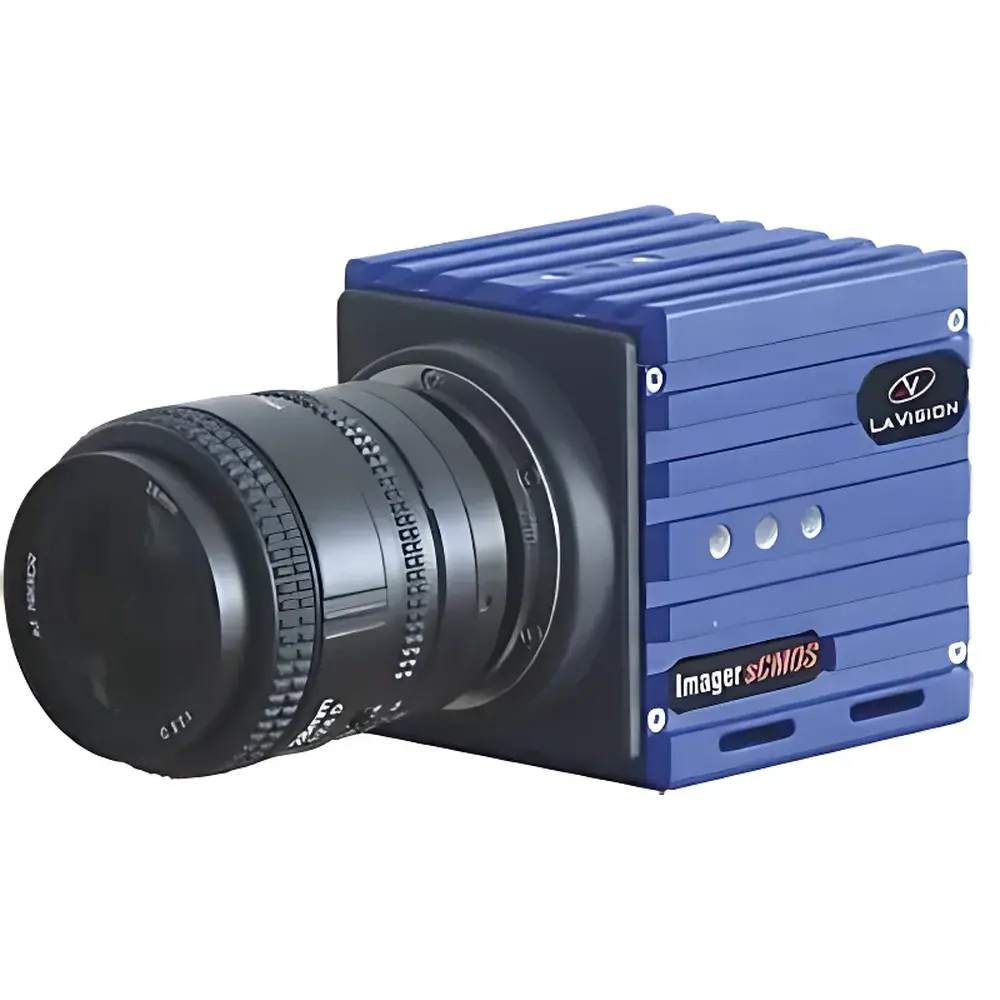
LaVision Imager sCMOS PIV Camera
| Brand | LaVision GmbH |
|---|---|
| Country of Origin | Germany |
| Sensor Type | Scientific CMOS (sCMOS) |
| Resolution | 5.5 MP (2560 × 2160) |
| Full-Resolution Frame Rate | 50 Hz |
| Read Noise | <1.2 e⁻ RMS |
| Dynamic Range | >85 dB |
| Interface | Camera Link HS or CoaXPress 2.0 |
| Cooling | Thermoelectric (−10 °C to +20 °C, adjustable) |
| Shutter Modes | Global shutter, rolling shutter, and double-frame burst mode for PIV |
| Synchronization | TTL/RS-422 trigger input & output, <100 ns jitter |
Overview
The LaVision Imager sCMOS PIV Camera is a high-performance scientific imaging system engineered specifically for quantitative laser-based flow diagnostics. It leverages a back-illuminated, monochrome sCMOS sensor architecture to deliver exceptional photon detection efficiency (>80% QE at 550 nm), low temporal noise, and precise spatial fidelity—critical requirements for particle image velocimetry (PIV), micro-PIV, time-resolved PIV, and other phase-locked optical measurement techniques. Unlike conventional CCD or standard CMOS sensors, the Imager sCMOS integrates on-chip correlated double sampling (CDS), pixel-level analog-to-digital conversion, and advanced clocking schemes to suppress fixed-pattern noise and enable true 16-bit linear digitization across its full dynamic range. Its global shutter operation ensures distortion-free capture of fast-moving tracer particles under pulsed laser illumination, while sub-microsecond inter-frame timing accuracy supports high-fidelity velocity vector field reconstruction in turbulent or transient flows.
Key Features
- 5.5 megapixel resolution (2560 × 2160) with 6.5 µm square pixels for optimal balance between field-of-view coverage and spatial resolution in PIV interrogation windows.
- Ultra-low read noise (<1.2 e⁻ RMS at 50 Hz full-frame rate), enabling reliable signal detection down to single-photon levels in low-laser-energy configurations.
- High quantum efficiency (>80% peak) across visible to near-UV spectrum (350–700 nm), compatible with common PIV lasers including Nd:YAG (532 nm), diode-pumped solid-state (DPSS), and tunable OPO systems.
- Dual-interface support: Camera Link HS (for deterministic real-time streaming) and CoaXPress 2.0 (for long-cable, high-bandwidth acquisition up to 25 Gbps), both compliant with GenICam v3.x standards.
- Thermoelectric cooling with ±0.1 °C stability over extended acquisitions, reducing dark current to <0.5 e⁻/pixel/s at −10 °C—essential for long-exposure micro-PIV or volumetric tomographic PIV (Tomo-PIV).
- Built-in hardware triggering with programmable delay and pulse width, supporting synchronized double-frame, triple-frame, and multi-burst acquisition modes required for cross-correlation analysis and acceleration estimation.
Sample Compatibility & Compliance
The Imager sCMOS is designed for integration into standardized optical metrology platforms used in academic laboratories, aerospace test facilities, and industrial R&D centers. Its mechanical footprint and mounting interface conform to ISO 10110-3 optical housing standards, facilitating alignment with beam expanders, cylindrical lenses, and stereoscopic PIV mirror rigs. The camera meets CE marking requirements per EU Directive 2014/30/EU (EMC) and 2014/35/EU (LVD). Firmware and driver stacks are validated for compatibility with Windows 10/11 (64-bit) and Linux kernel 5.4+ environments. For regulated environments—including pharmaceutical fluid dynamics validation and automotive thermal management testing—the system supports audit-ready metadata logging (timestamp, exposure, gain, temperature) traceable to NIST-traceable calibration sources, aligning with GLP and ISO/IEC 17025 documentation practices.
Software & Data Management
The Imager sCMOS operates natively within LaVision’s DaVis 10.2+ software suite, which provides end-to-end PIV workflow control—from hardware configuration and image pre-processing (background subtraction, contrast enhancement, masking) to cross-correlation (FFT-based or recursive multigrid), vector validation (universal outlier detection, median filtering), and post-processing (vorticity, strain rate, Reynolds stress tensor derivation). All raw image data are stored in HDF5 format with embedded EXIF-like metadata (including laser sync status, camera temperature, and gain settings), ensuring FAIR (Findable, Accessible, Interoperable, Reusable) data principles. Optional integration with MATLAB, Python (via PyDaVis API), and LabVIEW enables custom algorithm development and automated reporting pipelines compliant with FDA 21 CFR Part 11 when configured with electronic signature and audit trail modules.
Applications
- Aerodynamic boundary layer studies in wind tunnels and low-speed compressible flow facilities.
- Combustion chamber flow-field mapping using OH-PLIF/PIV hybrid setups.
- Microfluidic device characterization—including droplet formation, mixing efficiency, and electrokinetic transport in lab-on-a-chip systems.
- Volumetric PIV (Tomo-PIV) with four-camera configurations for 3D–3C velocity reconstruction in complex geometries.
- Unsteady wake dynamics behind bluff bodies, turbine blades, and biomedical implants under pulsatile flow conditions.
- Validation of large-eddy simulation (LES) and direct numerical simulation (DNS) models through statistically converged ensemble-averaged velocity fields.
FAQ
What is the minimum inter-frame time supported in double-frame PIV mode?
The Imager sCMOS achieves hardware-limited inter-frame intervals as low as 300 ns in double-frame burst mode, configurable via external TTL trigger edge detection.
Does the camera support binning or region-of-interest (ROI) readout to increase frame rate?
Yes—hardware ROI selection and vertical/horizontal binning (1× to 4×) are fully supported, enabling frame rates exceeding 200 Hz at reduced resolution without compromising synchronization integrity.
Is calibration data provided with the camera?
Each unit ships with factory-measured flat-field correction maps, pixel response non-uniformity (PRNU) profiles, and dark current temperature curves, all accessible via DaVis or third-party calibration toolkits.
Can the Imager sCMOS be used for non-PIV applications such as Schlieren imaging or fluorescence lifetime imaging (FLIM)?
While optimized for PIV, its high SNR, global shutter, and low-noise architecture make it suitable for high-speed Schlieren, shadowgraphy, and gated fluorescence imaging—provided appropriate optical filters and timing controllers are integrated.
How is firmware updated, and is remote maintenance supported?
Firmware updates are performed via DaVis or standalone LaVision Update Manager; remote diagnostic access is available under signed service agreements with encrypted SSH tunneling and session logging.






