
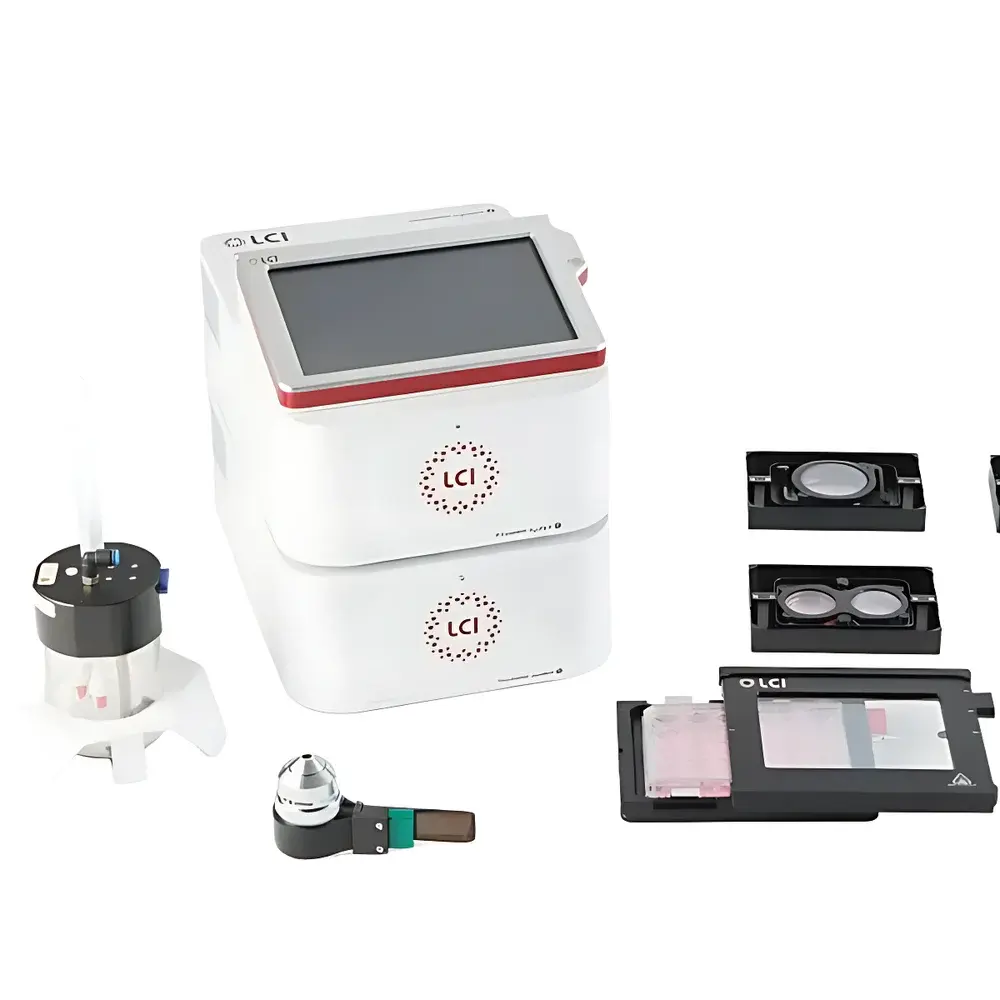
LCI T-Series Live Cell Imaging Incubation System for Inverted Microscopes
| Brand | LCI (Live Cell Instrument) |
|---|---|
| Origin | South Korea |
| Model | T-Series |
| Type | Integrated Microscope-Compatible Live Cell Incubator |
| Heating Channels | 4 (Chamber Body, Lid, Humidifier, Objective Heater) |
| Control Modes | External Feedback, Sample-Sensed, Manual |
| Humidity Control | ≥90% RH (via integrated water reservoir & heated humidifier) |
| Gas Control | CO₂, O₂ (optional), N₂ mixing via PID-regulated solenoid valves & mixing chamber |
| Temperature Control | PID-based, with real-time thermal mapping and alarm logging |
| Interface | Android-based touchscreen control panel with remote mobile/web access |
| Compliance | Designed for GLP-compliant long-term time-lapse imaging |
Overview
The LCI T-Series Live Cell Imaging Incubation System is an engineered solution for maintaining physiologically relevant microenvironments directly on inverted microscopes during extended live-cell observation. Built upon Couette-flow-optimized thermal architecture and closed-loop gas-humidity coupling, the system delivers precise spatiotemporal control of temperature (±0.1 °C stability), relative humidity (≥90% RH), CO₂ (0–20% v/v), and optional O₂ (0.1–21% v/v) — all while minimizing thermal drift, condensation risk, and mechanical interference with high-NA objective lenses. Unlike standalone incubators requiring optical path interruption, the T-Series integrates seamlessly beneath the microscope stage, preserving parfocality and enabling uninterrupted acquisition across hours to days. Its modular design supports both standard Petri dishes and specialized magnetic-bottom imaging chambers — critical for confocal, TIRF, and super-resolution modalities where mechanical stability and thermal homogeneity are non-negotiable.
Key Features
- Triple-Mode Adaptive Temperature Control: Combines external ambient feedback (world’s first implementation), direct sample-surface thermometry, and user-defined setpoint regulation — each mode dynamically optimizing PID parameters to suppress overshoot and stabilize thermal gradients across the imaging plane.
- Four-Independent-Channel PID Regulation: Independently controlled heating zones include chamber body, removable lid, integrated humidifier, and objective heater — ensuring uniform thermal distribution without hotspots or edge cooling effects.
- Magnetic Modular Interfacing: Patented magnetic connectors enable tool-free attachment/detachment of humidifier modules, gas lines, and objective heaters — eliminating cable strain, reducing setup time by >65%, and supporting rapid reconfiguration between experimental configurations.
- Saturated-Humidity Maintenance: Dual-stage humidification: a heated water reservoir beneath the stage supplies vapor, while CO₂-enriched gas passes through a temperature-regulated humidifier coil — preventing medium evaporation and osmotic stress over multi-day acquisitions.
- Gas Mixing Architecture: Electromechanically actuated solenoid valves, calibrated mass flow sensors, and a diffusion-mixing chamber ensure repeatable gas composition delivery; internal recirculation pump guarantees laminar, particle-free flow across the chamber volume.
- Objective-Specific Thermal Coupling: Flexible silicone-band objective heater conforms to 10×–100× oil-, water-, or glycerol-immersion objectives — actively compensating for conductive heat loss and stabilizing lens temperature within ±0.3 °C during high-frame-rate acquisition.
Sample Compatibility & Compliance
The T-Series accommodates standard 35 mm, 60 mm, and 100 mm Petri dishes, glass-bottom dishes (MatTek, Ibidi), microfluidic chips (e.g., OrganoPlate®), and custom magnetic-base chambers. All interfaces comply with ISO 13485-aligned mechanical tolerances and RoHS-compliant material specifications. The system supports documentation workflows aligned with FDA 21 CFR Part 11 requirements: timestamped parameter logs (temperature, humidity, gas concentration, alarm events) are exportable in CSV format with cryptographic hash verification. Firmware updates maintain traceability per IEC 62304 Class B software lifecycle standards. No modifications to microscope optics or stage mechanics are required — compatibility confirmed with Nikon Ti2-E, Olympus IX83, Zeiss Axio Observer, and Leica DMi8 platforms.
Software & Data Management
Control is executed via an embedded Android-based GUI hosted on a 10.1″ capacitive touchscreen panel, featuring real-time thermal contour visualization, multi-parameter trend graphs (up to 72 h history), and configurable threshold alarms with audible/visual notification. Remote operation is enabled through the LCI Connect mobile application (iOS/Android) and web dashboard (HTTPS/TLS 1.2), supporting role-based access control and session auditing. All system parameters — including CCP (Computer-Controlled Protocol) sequences for time-varying gas ramps or thermal gradients — are programmable and saved as encrypted .lciq project files. Raw sensor data (1 Hz sampling) is automatically archived to internal eMMC storage and optionally synced to network-attached storage (NAS) via SMB/CIFS protocol — fully compatible with LabArchives ELN and Benchling LIMS integration pipelines.
Applications
- Long-term time-lapse imaging of stem cell differentiation, organoid maturation, and wound-healing assays under physiological O₂ (5%) and CO₂ (5%) conditions.
- High-resolution calcium dynamics recording using GCaMP variants, requiring stable osmolarity and minimal thermal noise at 37 °C.
- TIRF and single-molecule tracking experiments demanding sub-100 nm axial stability — enabled by vibration-damped chamber base and lens-temperature synchronization.
- Co-culture studies involving immune cell–tumor spheroid interactions, where independent O₂ gradient programming simulates hypoxic tumor niches.
- Automated screening workflows integrating with motorized stages and autofocus systems — supported via TTL-triggered parameter synchronization.
FAQ
Does the T-Series require modification of my existing inverted microscope?
No. The system mounts directly onto standard microscope stages using non-invasive clamping brackets — no drilling, adhesive bonding, or optical alignment recalibration is necessary.
Can I log temperature and gas data alongside my microscope acquisition timestamps?
Yes. Synchronized NTP time-stamping ensures microsecond-level alignment between environmental parameter logs and camera frame metadata (via TTL or software API handshake).
Is the humidifier reservoir refillable during imaging sessions?
Yes. The front-access water reservoir features a sealed quick-fill port with optical liquid-level sensing — allowing replenishment without opening the chamber or interrupting CO₂ flow.
What level of O₂ control precision does the system achieve?
With optional O₂ module, the system maintains setpoints within ±0.3% v/v (0.1–21% range) using dual-stage electrochemical sensing and proportional solenoid actuation.
How is firmware updated, and is version history retained?
Updates are performed via USB or secure HTTPS download; each firmware revision is cryptographically signed, and prior versions remain accessible for rollback validation — compliant with ISO/IEC 17025 clause 5.9.4.





