
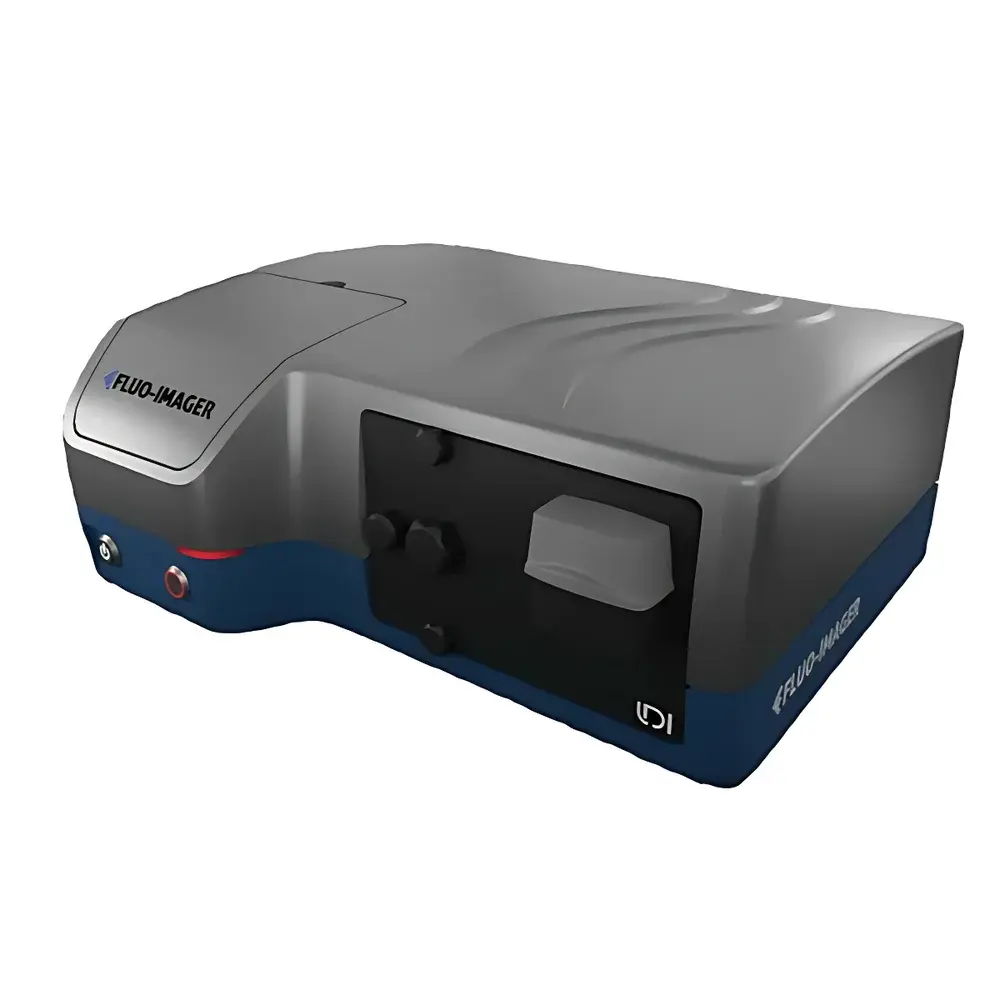
LDI Fluo-Imager™ 3D Spectral Fluorescence Fingerprint Analyzer
| Brand | LDI |
|---|---|
| Origin | Imported (Non-Chinese) |
| Manufacturer Status | Authorized Distributor |
| Instrument Type | Steady-State & Time-Resolved Fluorescence Spectrometer |
| Excitation/Emission Dispersion | Grating + Filter-Based Monochromators |
| Light Source | 10 W Xenon Arc Lamp (≈100,000 SFS acquisitions lifetime) |
| Excitation Range | 220–660 nm |
| Emission Range | 200–750 nm |
| Detector | Photomultiplier Tube (PMT) with Reference & Signal Photodiodes |
| Sample Compartment | Standard 12.5 × 12.5 × 45 mm Quartz Cuvette |
| Data Interface | USB |
| Power Supply | 12 VDC (AC Adapter: 100–240 V, 50–60 Hz) |
| Power Consumption | 20 W |
| Dimensions | 15 × 24 × 40 cm |
| Weight | 11 kg |
| Operating Temperature | 10–40 °C |
| Measurement Cycle | 2 min per scan |
| Detection Limits | Crude Oil (Heavy/Medium: 0.5 mg/L |
| Light | 0.3 mg/L), Kerosene (0.1 mg/L), Diesel/Gasoline/Lubricants (0.2–0.5 mg/L), Phenol (0.01 mg/L), Naphthalene (5 µg/L), Anthracene/Benzo[a]pyrene (1 µg/L), Chlorophyll-a (1 µg/L) |
| Compliance | Designed for ASTM D5869, ISO 10603, USP <1058>, and GLP/GMP-aligned data integrity workflows (audit trail, electronic signatures, 21 CFR Part 11–compatible software architecture) |
Overview
The LDI Fluo-Imager™ 3D Spectral Fluorescence Fingerprint Analyzer is an engineered solution for rapid, reagent-free identification and quantification of organic compounds in aqueous matrices. It operates on the principle of Spectral Fluorescent Signatures (SFS), a three-dimensional fluorescence technique that records intensity as a function of both excitation wavelength (λex) and emission wavelength (λem). This generates a unique, compound-specific topographic map—termed the SFS matrix—that reflects intrinsic electronic transitions in fluorophores. Unlike conventional single-wavelength fluorimeters, the Fluo-Imager™ captures full excitation-emission matrices (EEMs) across UV–Vis spectral domains (220–660 nm excitation; 200–750 nm emission), enabling discrimination between structurally similar aromatic species—including PAHs, BTEX, DOM fractions (humic/fulvic acids), chlorophylls, phycobiliproteins, and petroleum hydrocarbons—without chemical derivatization or extraction. Its design prioritizes field-deployable robustness while maintaining laboratory-grade reproducibility, supporting both discrete cuvette-based analysis and continuous flow-through monitoring in natural waters, process streams, and wastewater effluents.
Key Features
- Integrated dual-mode operation: steady-state EEM acquisition plus fixed-wavelength fluorescence and absorbance measurement at user-defined bands
- Automated background correction for fluorescent dissolved organic matter (FDOM), essential for accurate contamination assessment in humic-rich natural waters
- Onboard self-diagnostic routine verifying lamp output stability, monochromator wavelength accuracy, PMT gain consistency, and detector linearity prior to each measurement cycle
- Modular spectral library architecture supporting user-defined calibration sets for custom analytes—enabling trace-level quantification of target compounds via multivariate regression (e.g., PLS, PCA-LDA)
- Real-time multi-analyte detection: simultaneous quantification of up to eight co-eluting or co-dissolved fluorophores using pattern-matching algorithms against reference SFS databases
- Reagent-free, non-destructive analysis: no sample acidification, solvent extraction, or derivatization required; original sample integrity preserved for downstream testing
- Configurable alert thresholds with hardware-triggered visual/audible alarms upon exceedance of pre-set concentration limits
Sample Compatibility & Compliance
The Fluo-Imager™ accommodates diverse liquid samples including raw surface water, groundwater, drinking water, boiler/cooling water, industrial process streams, produced water, and marine effluents. Its quartz cuvette cell (12.5 × 12.5 × 45 mm) ensures compatibility with turbid or colored matrices when paired with inner-filter effect compensation routines embedded in Fluo-Scan software. The system adheres to analytical rigor expected in regulated environments: spectral data files retain immutable metadata (timestamp, instrument ID, lamp hours, calibration status); software enforces role-based access control and audit-trail logging compliant with FDA 21 CFR Part 11 requirements. Calibration protocols align with ISO 10603 (water quality — fluorescence measurement of organic pollutants) and ASTM D5869 (standard test method for fluorescence screening of petroleum contaminants in water). All measurements are traceable to NIST-traceable fluorescence standards (quinine sulfate, quinine bisulfate).
Software & Data Management
Fluo-Scan software provides two operational tiers: Standard Mode for routine screening and Advanced Mode for method development, spectral deconvolution, and multivariate modeling. Each acquired SFS dataset is stored with full provenance—including raw intensity values, excitation/emission slit widths, integration time, PMT voltage, and ambient temperature—ensuring full analytical transparency. Post-acquisition tools include baseline subtraction, Rayleigh scatter removal, PARAFAC decomposition, and supervised classification training. Users may generate up to 256-point fluorescence calibration curves, apply multivariate models for surrogate parameter estimation (e.g., total petroleum hydrocarbons, COD, BOD5), and export results in CSV, HDF5, or .mat formats for integration into LIMS or statistical platforms. Software architecture supports TLS 1.2 encryption, digital signature validation, and configurable retention policies meeting GLP and GMP documentation standards.
Applications
- Early-warning detection of oil spills and hydrocarbon leaks in rivers, lakes, coastal zones, and offshore platforms
- Monitoring of PAHs and phenolic compounds in industrial wastewater discharge points and landfill leachate
- Algal bloom tracking via chlorophyll-a, phycocyanin, and phycoerythrin SFS signatures in reservoirs and aquaculture systems
- Process water quality assurance in power generation (boiler feedwater), semiconductor manufacturing (ultrapure water), and pharmaceutical production
- Regulatory compliance screening for EPA Method 418.1 equivalents and EU Water Framework Directive priority substances
- Research applications in biogeochemistry, DOM characterization, and contaminant fate studies
FAQ
What is the fundamental measurement principle of the Fluo-Imager™?
It acquires excitation-emission matrices (EEMs) using a xenon arc lamp and dual grating/filter monochromators, generating compound-specific 3D fluorescence fingerprints without chemical modification.
Can it quantify non-fluorescent compounds?
Yes—via concurrent absorbance measurement at selected wavelengths, enabling correction for inner-filter effects and estimation of non-fluorescent surrogates (e.g., nitrate, turbidity) through multivariate calibration.
How is background fluorescence from natural organic matter handled?
The system applies real-time FDOM subtraction using pre-characterized humic/fulvic acid reference spectra, isolating anthropogenic signal contributions.
Is method validation support available?
Yes—application notes, SOP templates, and ICH Q2(R2)-aligned validation packages (accuracy, precision, LOD/LOQ, linearity, robustness) are provided for regulated use cases.
Does it comply with 21 CFR Part 11?
Fluo-Scan software includes electronic signature capability, audit trail with immutable timestamps, and role-based permissions—fully configurable to meet Part 11 requirements for electronic records and signatures.





