
LECO MOSH/MOAH GC×GC-TOF/FID Comprehensive Mineral Oil Confirmation Analyzer
| Brand | LECO |
|---|---|
| Origin | USA |
| Manufacturer Type | Original Equipment Manufacturer (OEM) |
| Instrument Type | Time-of-Flight Mass Spectrometer (TOF-MS) |
| Chromatography Type | Comprehensive Two-Dimensional Gas Chromatography (GC×GC) |
| Mass Range | m/z 1500 |
| Sensitivity | <1 fg (on-column, octadecane) |
| Scan Speed | 35,000 spectra/s |
| Detector Configuration | Dual Detection — High-Resolution TOF-MS + Flame Ionization Detector (FID) with Long-Life Design |
| Model | Pegasus BT 4D MOSH/MOAH System |
Overview
The LECO Pegasus BT 4D MOSH/MOAH GC×GC-TOF/FID is a purpose-engineered analytical platform designed for definitive molecular fingerprinting and quantification of mineral oil saturated hydrocarbons (MOSH) and aromatic hydrocarbons (MOAH) in complex matrices—including food packaging, edible oils, pharmaceutical excipients, and environmental samples. Unlike conventional single-dimension GC-FID or LC-GC-FID methods—which suffer from co-elution, unresolved complex mixtures (UCM), and ambiguous “hump” integration—the system leverages comprehensive two-dimensional gas chromatography (GC×GC) coupled with high-speed, high-mass-accuracy time-of-flight mass spectrometry (TOF-MS) and parallel flame ionization detection (FID). This dual-detection architecture enables simultaneous acquisition of structural identification data (via TOF-MS) and absolute quantitative response (via FID), satisfying both qualitative confirmation and regulatory-grade quantitation requirements under ISO 17025, EU Commission Regulation (EU) No 10/2011, and EFSA Scientific Opinions on mineral oil migration.
Key Features
- True GC×GC separation with cryogenic modulation: Achieves peak capacity >10,000, resolving critical isomeric interferences such as MOSH vs. POSH (polyolefin oligomeric saturates) and MOAH vs. biogenic terpenoids—common false positives in LC-GC-FID workflows.
- High-fidelity TOF-MS detection: 35,000 spectra/s acquisition rate ensures full spectral fidelity across narrow GC×GC peaks; mass accuracy 10,000 (FWHM at m/z 500) support confident compound class assignment and library matching against NIST, Wiley, and custom MOSH/MOAH spectral libraries.
- Integrated FID with long-life design: Optimized for stable, linear response over 7 orders of magnitude (0.1–1000 ng C/s); calibrated to ASTM D5292 and ISO 10378 for hydrocarbon quantification independent of molecular structure.
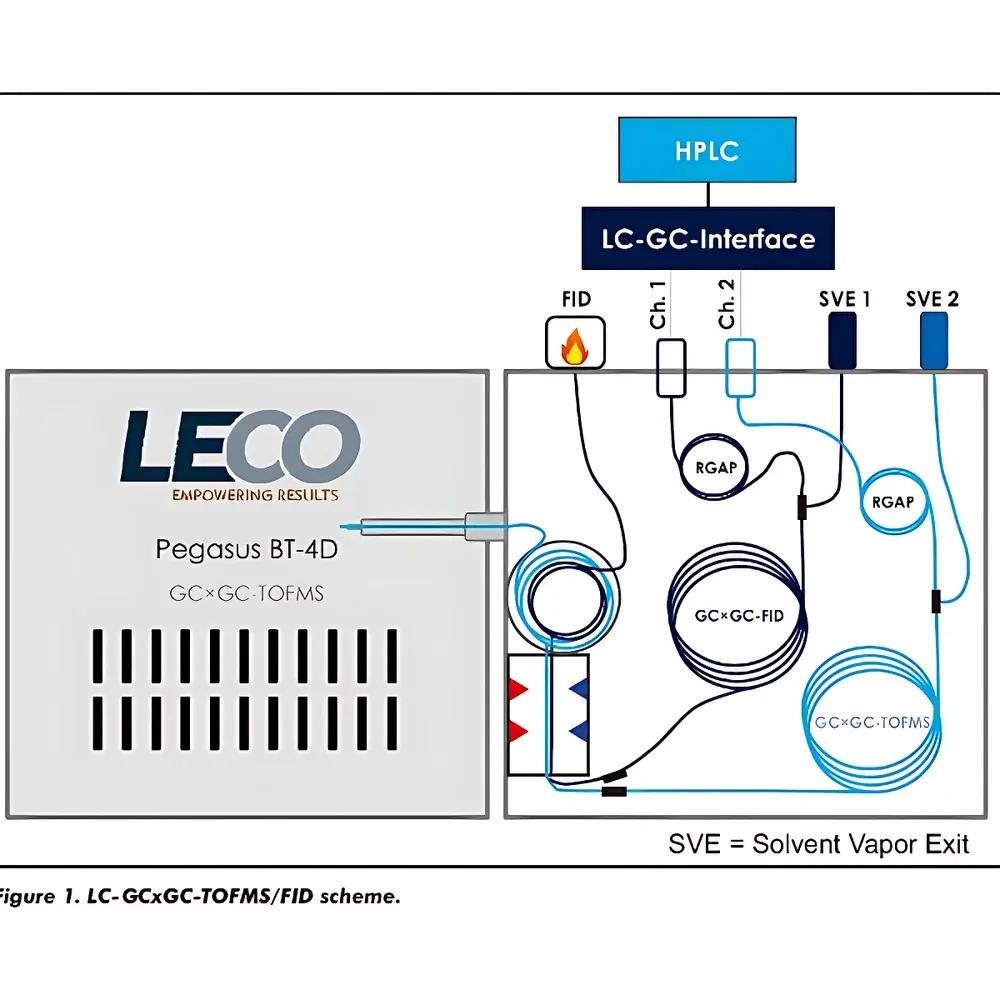
- Retention gap–optimized column set: Customized 1D (DB-5ms) / 2D (BPX-50) configuration with precise retention gap length ensures temporal alignment between TOF-MS and FID signals—critical for cross-detector data fusion and deconvolution-based quantitation.
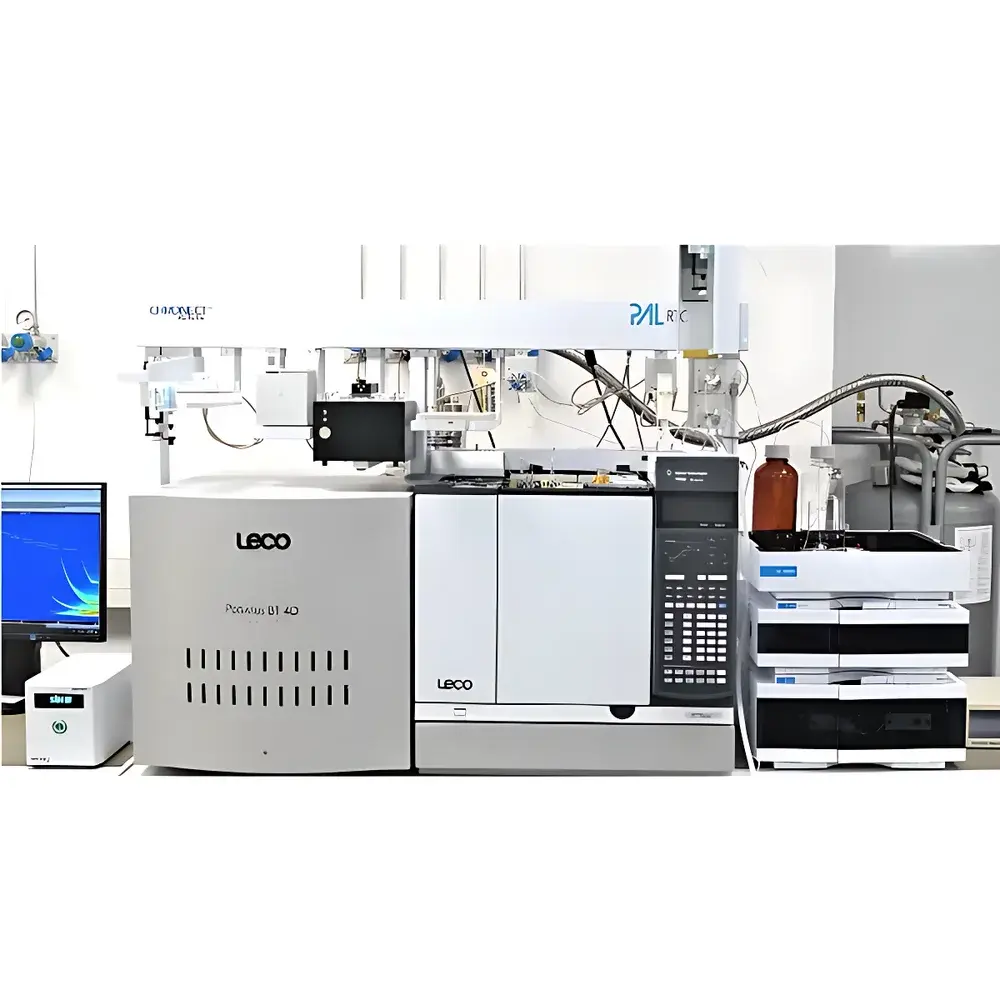
- Modular platform architecture: Supports three validated configurations—(a) standalone GC×GC-TOFMS for method verification and false-positive screening; (b) fully integrated GC×GC-TOFMS/FID for simultaneous confirmatory analysis; (c) automated LC-GC×GC-TOFMS/FID for offline fractionation of MOSH/MOAH prior to online 2D separation and detection.
Sample Compatibility & Compliance
The system is validated for solid-phase extraction (SPE)-prepared extracts from diverse sample types: paperboard, recycled cardboard, polyolefin films, infant formula powders, olive oil, cocoa butter, and soil leachates. It complies with GLP and GMP data integrity requirements via audit-trail-enabled ChromaTOF v5.2 software (21 CFR Part 11 compliant), supports electronic signatures, and generates raw data files (.tdf) compatible with third-party review tools. Method validation adheres to ICH Q2(R2) guidelines for specificity, linearity, LOD/LOQ (<0.1 mg/kg for MOSH, <0.05 mg/kg for MOAH), precision (RSD <8% intra-day), and robustness across matrix effects.
Software & Data Management
ChromaTOF v5.2 MOSH/MOAH Edition provides dedicated workflows for peak deconvolution, class-selective integration (e.g., C16–C35 saturated alkanes, 3–7 ring MOAH), interference subtraction (POSH, squalene, phytosterols), and automatic UCM boundary definition. All processing steps are traceable, reproducible, and exportable to CSV, PDF, or XML formats for regulatory submission. Raw data archiving follows ISO/IEC 17025:2017 Clause 7.5.3 requirements, with optional integration into LIMS via ODBC or API.
Applications
- Regulatory compliance testing for mineral oil migration in food contact materials (FCMs)
- Forensic source attribution in contamination incidents involving lubricants, printing inks, or recycling streams
- Judicial evidentiary analysis supporting civil litigation and criminal sentencing under EU REACH and national food safety statutes
- Third-party certification for BRCGS, IFS, and SQF audited facilities
- R&D support for polymer manufacturers seeking to eliminate MOSH/MOAH precursors in synthetic resins and additives
FAQ
Why is GC×GC-TOF/FID required when LC-GC-FID is already standardized?
LC-GC-FID lacks sufficient peak capacity to resolve MOSH from structurally similar POSH or MOAH from terpenoids—leading to systematic overestimation. GC×GC-TOF/FID delivers orthogonal separation and mass-specific detection, enabling unambiguous assignment and correction of false positives.
Can this system quantify 3–7 ring MOAH independently?
Yes—through TOF-MS spectral deconvolution and retention index filtering in ChromaTOF, combined with FID response calibration using certified MOAH reference standards (e.g., naphthalene homologs, alkylbenzenes).
Is method transfer supported between labs?
Full method portability is ensured via ChromaTOF’s instrument-independent method templates, retention time locking (RTL), and embedded calibration protocols—validated across >40 global reference laboratories per LECO’s 2023 Interlaboratory Study Report.
What maintenance intervals apply to the dual detector system?
The TOF-MS ion source requires cleaning every 6 months under routine use; the FID nozzle and jet are inspected quarterly. Both detectors share a common gas supply and vacuum manifold, minimizing downtime during scheduled service.
Does the system support untargeted screening beyond MOSH/MOAH?
Yes—ChromaTOF’s full-scan TOF-MS mode enables retrospective analysis of unknown contaminants (e.g., plasticizers, antioxidants, process impurities) without re-injection, leveraging the same GC×GC separation and high-resolution mass data.






