
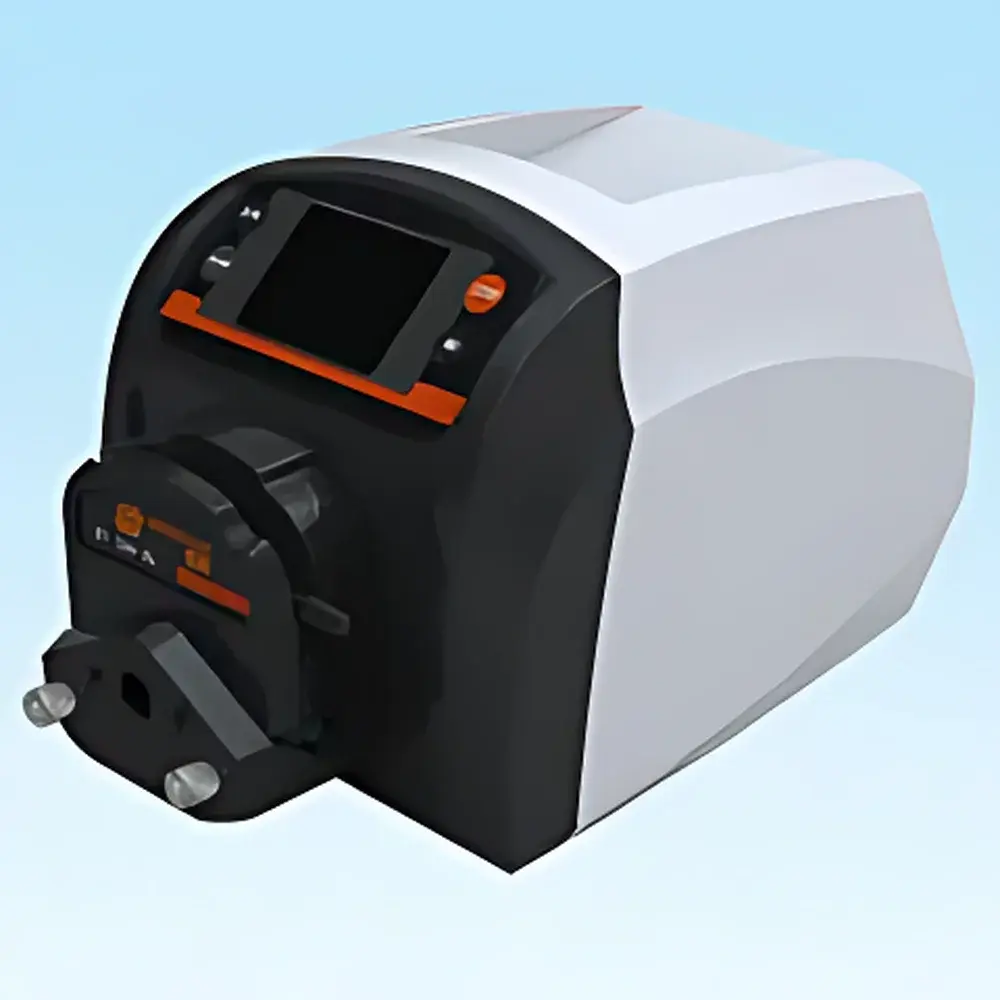
LeFever BT101L (YZ15) Flow-Mode Peristaltic Pump
| Brand | LeFever |
|---|---|
| Origin | Hebei, China |
| Model | BT101L (YZ15) |
| Flow Rate Range | 0.006–420 mL/min |
| Speed Range | 0.1–150 rpm |
| Speed Resolution | 0.1 rpm |
| Speed Accuracy | ±0.2% |
| Display | 65,535-color TFT LCD with capacitive touch interface |
| External Control | Isolated digital I/O (5/12/24 V logic), analog input (0–5 V / 0–10 V / 4–20 mA), frequency input (0–10 kHz), RS485 with MODBUS RTU protocol |
| Power Supply | AC 220 V ±10%, 50/60 Hz |
| Power Consumption | <40 W |
| Operating Environment | 0–40 °C, RH <80% |
| Dimensions (L×W×H) | 255 × 180 × 185 mm |
| Weight | 5.1 kg |
| Compatible Pump Heads | YZ15, YZ25, DG1, DG2 |
| Flow Setting Mode | Direct volumetric flow input (mL/min) |
| Special Functions | “Quick Dispensing” mode, infrared remote control, intelligent thermal management, guided operation wizard |
Overview
The LeFever BT101L (YZ15) Flow-Mode Peristaltic Pump is an engineered solution for precise, contamination-free fluid handling in analytical laboratories, bioprocessing workflows, and quality control environments. Based on the peristaltic principle—where rollers compress a flexible tube to generate positive displacement—the BT101L delivers consistent, pulse-dampened flow without contact between the pump mechanism and the fluid path. This design eliminates risk of cross-contamination, avoids seal wear or leakage, and ensures full compatibility with aggressive solvents, cell cultures, and sterile reagents. Its core architecture supports both speed-based and direct-flow-mode operation, enabling users to define target volumetric delivery rates (mL/min) without manual calibration against tubing geometry—a feature critical for reproducible dispensing across variable tube inner diameters and material compliance.
Key Features
- Direct Flow-Setting Interface: Input target flow rate (mL/min) directly via touchscreen; internal firmware calculates optimal rotational speed based on selected tubing type and dimensions, minimizing operator-dependent error.
- Capacitive Touch TFT Display: 65,535-color LCD with intuitive icon-driven navigation and real-time parameter visualization—including current speed, accumulated volume, direction status, and system temperature.
- Intelligent Operation Wizard: Context-aware guidance system assists first-time users through pump head installation, tubing loading, flow calibration, and dispensing setup—reducing training time and procedural variability.
- Low-Noise Thermal Management: Adaptive fan control modulates cooling output based on motor load and ambient temperature, maintaining acoustic emissions below 45 dB(A) during continuous operation.
- Infrared Remote Control: Enables non-contact start/stop, direction reversal, and flow adjustment—ideal for glove-box integration or biosafety cabinet use where physical access is restricted.
- Multi-Protocol External Control: Supports isolated TTL-level digital inputs (5/12/24 V), analog voltage/current signals (0–5 V, 0–10 V, 4–20 mA), frequency modulation (0–10 kHz), and industrial-grade RS485 communication using MODBUS RTU—facilitating seamless integration into PLC-controlled or LIMS-managed lab automation systems.
Sample Compatibility & Compliance
The BT101L accommodates a broad range of peristaltic tubing materials—including silicone, Viton®, Tygon® B-44-3, and Pharmapure®—when used with compatible pump heads (YZ15, YZ25, DG1, DG2). Tube selection determines maximum pressure rating, chemical resistance, and flow accuracy; recommended tubing IDs span 0.5 mm to 4.8 mm. While not certified for GMP manufacturing under FDA 21 CFR Part 11, the pump’s deterministic control architecture, audit-ready parameter logging (via optional software), and traceable external command protocols support GLP-aligned documentation practices. All electrical components comply with IEC 61010-1:2010 for laboratory equipment safety, and electromagnetic compatibility meets EN 61326-1:2013 Class A requirements.
Software & Data Management
When connected via RS485, the BT101L communicates bidirectionally with host systems supporting MODBUS RTU registers. Key accessible parameters include real-time speed, total dispensed volume, operational state (running/stopped), direction flag, and error codes (e.g., tubing occlusion, motor stall, overtemperature). Optional PC software provides extended functionality: batch dispensing programming, CSV export of run logs, firmware updates, and customizable alarm thresholds. Data timestamps are synchronized to host system clock; no internal RTC is embedded. For regulated environments, the pump can be configured to log all user-initiated changes with operator ID tagging when integrated into validated instrument control platforms.
Applications
- Automated sample dilution and reagent addition in HPLC, IC, and spectrophotometric workflows
- Continuous media perfusion in cell culture bioreactors and microfluidic organ-on-chip platforms
- Controlled eluent delivery in column chromatography and solid-phase extraction (SPE)
- Accurate aliquoting of standards, QC samples, and calibration solutions in clinical chemistry labs
- Low-shear transfer of shear-sensitive suspensions—including liposomes, protein aggregates, and primary cell isolates
- Integration into custom-built analytical instruments requiring programmable, low-maintenance fluid propulsion
FAQ
Does the BT101L support automatic tubing wear compensation?
No. The pump does not monitor or adapt to tubing fatigue in real time. Users must perform periodic visual inspection and replace tubing according to manufacturer-recommended service intervals based on operating hours and chemical exposure.
Can flow rate be calibrated for non-standard tubing?
Yes. Using the built-in calibration function, users may measure actual delivered volume over a defined time interval and apply a correction factor—stored per tubing ID—to improve volumetric accuracy beyond default lookup-table estimates.
Is the pump suitable for sterile filtration processes?
It can be used upstream or downstream of sterile filters provided tubing and connections maintain aseptic integrity. However, the pump itself is not sterilizable (e.g., autoclave- or gamma-compatible) and lacks IP-rated enclosure for cleanroom classification.
What is the maximum backpressure tolerance?
Maximum sustainable backpressure depends on tubing material, wall thickness, and pump head configuration. With standard silicone tubing (ID 3.2 mm) and YZ15 head, typical limit is ~1.5 bar at 150 rpm. Operation above rated pressure may accelerate tubing fatigue and reduce flow stability.
Does the device support password-protected parameter locking?
Yes. The touchscreen interface allows administrator-level password protection for critical settings—including speed limits, flow units, and external control enable/disable states—to prevent unauthorized configuration changes in shared lab environments.



