
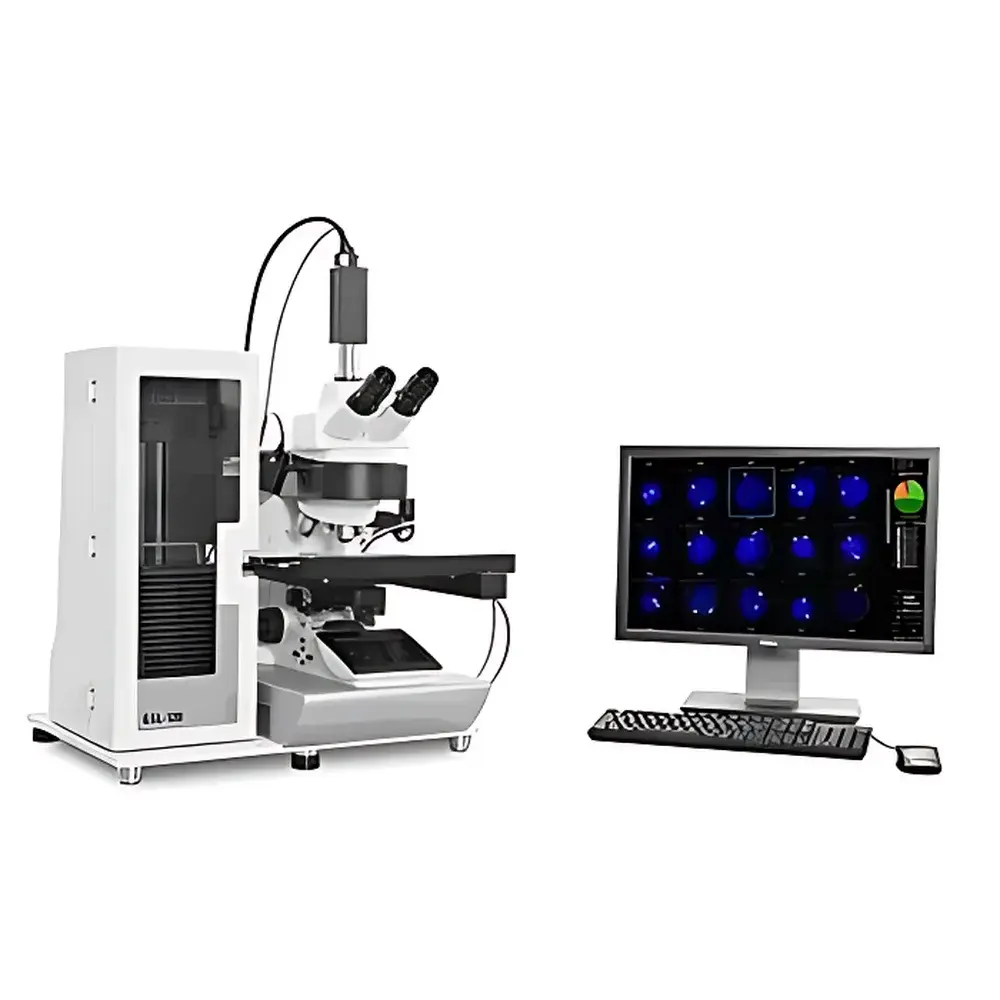
Leica CytoVision® Automated Cytogenetics Platform
| Brand | Leica |
|---|---|
| Origin | Germany |
| Manufacturer Type | Authorized Distributor |
| Product Origin | Imported |
| Model | CytoVision® |
| Pricing | Available Upon Request |
Overview
The Leica CytoVision® Automated Cytogenetics Platform is a fully integrated, modular workstation engineered for high-throughput chromosomal analysis in clinical cytogenetics and research laboratories. Built upon the principles of digital microscopy and automated image acquisition, CytoVision® combines Leica’s precision optical hardware—ranging from manual to fully motorized upright microscopes—with a validated, FDA-registered software suite designed for karyotyping, fluorescence in situ hybridization (FISH), multiplex-FISH (M-FISH), comparative genomic hybridization (CGH), and non-human karyotype analysis. The system operates on a standardized digital imaging pipeline: automated slide scanning, intelligent metaphase finding, high-resolution image capture, and algorithm-assisted chromosome classification—all compliant with ISO 15189 and CAP-accredited laboratory workflows. Its architecture supports both single-user review and distributed multi-station environments, enabling parallel processing of acquisition, analysis, and reporting without physical microscope access.
Key Features
- Fully automated metaphase capture: Up to 120 slides per unattended session with adaptive focus tracking and dynamic exposure optimization.
- Modular software architecture: Independent, licensable modules for karyotyping, FISH enumeration, M-FISH spectral analysis, CGH ratio profiling, Z-stack acquisition, spot counting, and non-human karyotype assembly (e.g., mouse, primate, avian).
- Hardware-agnostic integration: Native compatibility with Leica DM series upright microscopes—including DM6 B, DM6000 B, and DM3000 models—with optional motorized stages, filter turrets, and objective changers.
- Distributed workflow support: Client-server deployment model enabling concurrent use across acquisition stations, review workstations, and remote expert terminals via secure LAN or HTTPS-based web access.
- Audit-ready data management: Full electronic chain-of-custody logging, time-stamped image metadata, user-specific activity tracking, and built-in compliance with 21 CFR Part 11 requirements for electronic records and signatures.
Sample Compatibility & Compliance
CytoVision® accommodates standard 25 × 75 mm glass slides prepared using G-banding, R-banding, Q-banding, or fluorescent probes (e.g., centromeric, locus-specific, whole-chromosome paints). It supports dual-channel and multichannel fluorescence imaging with spectral unmixing capabilities for M-FISH. All image acquisition parameters—including exposure time, gain, gamma, and white balance—are stored as immutable metadata within each TIFF or DICOM-compliant file. The platform adheres to ISO/IEC 17025 for testing laboratories and aligns with CLIA, CAP, and UK NEQAS cytogenetics proficiency testing standards. Software validation documentation—including IQ/OQ/PQ protocols—is provided for GLP/GMP-regulated environments.
Software & Data Management
The CytoVision® software suite features a role-based interface with configurable user permissions (e.g., technician, reviewer, supervisor). Image data are stored in a centralized SQL Server database with automatic backup scheduling and RAID-protected storage options. All captured metaphases retain original pixel data, calibration information, and acquisition context (microscope model, objective magnification, camera settings). Reporting templates comply with ISCN 2020 nomenclature and export directly to LIS/HIS systems via HL7 v2.5 or ASTM E1384 interfaces. Integrated DICOM-SR support enables structured reporting for PACS archiving. Electronic signature workflows include biometric or token-based authentication, supporting full traceability for regulatory audits.
Applications
- Clinical constitutional cytogenetics: Routine karyotype analysis for aneuploidy, structural rearrangements, and marker chromosome identification.
- Oncology cytogenetics: Detection of clonal abnormalities in hematologic malignancies (e.g., Philadelphia chromosome, del(5q), +8) and solid tumors.
- Prenatal diagnostics: Rapid aneuploidy screening and detailed karyotyping from amniotic fluid, CVS, or POC specimens.
- Research cytogenetics: High-content chromosome painting, telomere length quantification, and spatial genome organization studies using Z-stack reconstruction.
- Reference laboratory scalability: Load-balanced server deployment supporting >50 concurrent users across geographically dispersed sites.
FAQ
Is CytoVision® compatible with non-Leica microscopes?
No—CytoVision® is validated exclusively for use with Leica Microsystems’ DM-series upright microscopes. Third-party hardware integration is not supported due to proprietary stage control, illumination synchronization, and autofocus calibration requirements.
Does the system support DICOM export for PACS integration?
Yes—CytoVision® exports both primary images and structured reports (DICOM-SR) compliant with Supplement 122, enabling seamless ingestion into enterprise PACS and EMR systems.
Can karyotype analysis be performed remotely without local microscope access?
Yes—review workstations operate independently of acquisition hardware; analysts access pre-captured metaphase images over the network, apply banding corrections, rearrange chromosomes, and generate ISCN-compliant reports without physical microscope interaction.
What validation documentation is included for regulated labs?
Leica provides comprehensive validation packages including Installation Qualification (IQ), Operational Qualification (OQ), Performance Qualification (PQ) test scripts, and 21 CFR Part 11 implementation guidance—fully customizable for site-specific risk assessments.
How is data integrity ensured during long-term archival?
All image files are stored with embedded MD5 checksums; database transactions are ACID-compliant; and version-controlled software updates preserve backward compatibility with legacy .cyt and .kpf project files for ≥10 years.





