
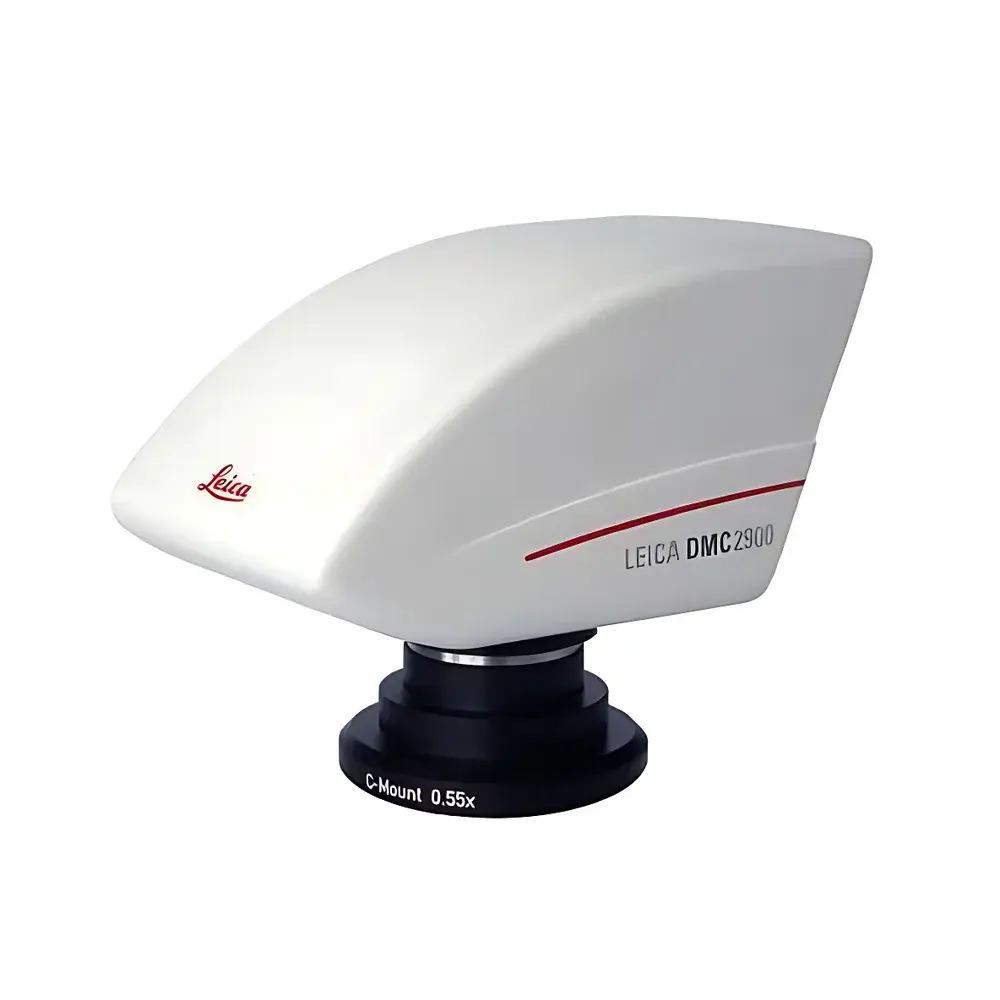
Leica DMC2900 Microscope Digital Camera
| Brand | Leica |
|---|---|
| Origin | Germany |
| Model | DMC2900 |
| Sensor Resolution | 3.1 Megapixels (CMOS) |
| Interface | USB 3.0 (backward compatible with USB 2.0) |
| Frame Rate | Up to 30 fps |
| Color Engine | CIE-Lab |
| Software Compatibility | Leica Application Suite (LAS) v4.x and later, LAS AF |
| Filter | Removable UV/IR cut filter |
| Compliance | CE, RoHS, FDA 21 CFR Part 11 ready (via LAS software audit trail) |
Overview
The Leica DMC2900 is a high-performance digital microscope camera engineered for precision imaging in routine and advanced light microscopy applications. Built around a globally shuttered 3.1-megapixel CMOS sensor, it delivers consistent, low-noise color fidelity across visible wavelengths—optimized for brightfield, polarized light, and basic fluorescence modalities. Its native USB 3.0 interface enables sustained real-time image acquisition at up to 30 frames per second (fps), eliminating latency during live focusing, sample navigation, and time-lapse documentation. Unlike legacy CCD-based systems, the DMC2900 leverages modern sensor architecture and embedded CIE-Lab color space processing to ensure stable white balance, accurate gamma correction, and robust shadow recovery—critical for reproducible quantitative analysis in regulated environments. Designed as an integral component of Leica Microsystems’ optical ecosystem, the DMC2900 maintains mechanical and electronic interoperability with all Leica DM-series upright, inverted, and stereomicroscopes—including DM750P (polarization), DM2700M (metallurgical), and DMI6000B (research-grade inverted platforms).
Key Features
- 3.1 MP global-shutter CMOS sensor with 1/2.3″ optical format, delivering optimal pixel size (2.2 µm) for high signal-to-noise ratio in brightfield and polarization imaging
- USB 3.0 interface with plug-and-play operation—supports hot-swap connectivity on both desktop and mobile workstations; includes mechanical locking screw for vibration-resistant laptop integration
- CIE-Lab color engine enabling real-time chromatic correction, dynamic contrast enhancement, and hardware-accelerated vignetting compensation
- Removable UV/IR cut filter for spectral integrity protection and dust mitigation—compatible with standard Leica filter cubes and condenser optics
- Full synchronization with Leica Application Suite (LAS) software suite, including LAS AF for automated focus stacking and mosaic stitching with sub-pixel registration accuracy
- Firmware-upgradable architecture supporting future protocol extensions, including time-stamped metadata embedding and DIC calibration profiles
Sample Compatibility & Compliance
The DMC2900 is validated for use with fixed and live biological specimens, metallurgical cross-sections, geological thin sections, and polymer composites under standard Köhler illumination. It supports ISO 10934-1 (microscopy terminology), ASTM E2821 (digital image acquisition in metallurgy), and USP (imaging system validation for pharmaceutical microscopy). When deployed with LAS software configured for audit trail logging, electronic signatures, and user-access controls, the system meets GLP and GMP requirements per FDA 21 CFR Part 11 for regulated documentation workflows. The camera’s CE marking confirms conformity with EU electromagnetic compatibility (2014/30/EU) and low-voltage (2014/35/EU) directives.
Software & Data Management
The DMC2900 operates natively within Leica Application Suite (LAS) v4.13 or higher, providing seamless integration with LAS Core, LAS AF (for extended depth-of-field reconstruction), and LAS X (for multi-channel fluorescence quantification). All acquired images retain EXIF-compliant metadata—including objective magnification, illumination intensity, exposure time, and stage coordinates—enabling traceable correlation with instrument configuration logs. Raw data export supports TIFF (16-bit linear), JPEG2000 (lossless compression), and HDF5 (for large-volume time-series storage). LAS software implements role-based permissions, version-controlled protocol templates, and encrypted database archiving—facilitating compliance with ISO/IEC 17025 laboratory accreditation standards.
Applications
- Routine histopathology documentation and educational slide digitization
- Polarized light analysis of birefringent materials (e.g., pharmaceutical crystals, mineral thin sections)
- Metallurgical grain structure assessment per ASTM E112 and ISO 643
- Quality control in printed circuit board (PCB) inspection and solder joint evaluation
- Live-cell imaging in non-confocal widefield setups requiring rapid focus adjustment and mosaic tiling
- Forensic fiber and particulate analysis with calibrated scale bar overlay and measurement annotation
FAQ
Is the DMC2900 compatible with non-Leica microscopes?
Yes—when used with third-party C-mount adapters (1× or 0.5× reduction), the DMC2900 functions as a generic USB 3.0 imaging device. However, full hardware-level synchronization (e.g., motorized filter wheel triggering, objective encoding) requires native Leica microscope integration.
Does the camera support binning or region-of-interest (ROI) readout?
No—the DMC2900 operates in full-frame mode only. Binning is emulated in LAS software via pixel averaging post-capture, preserving raw sensor fidelity for downstream analysis.
What is the maximum cable length supported for USB 3.0 operation?
Standard passive USB 3.0 cables are rated up to 3 meters. For longer distances, active optical USB 3.0 extenders (certified to USB-IF specifications) maintain full bandwidth and timing integrity.
Can the DMC2900 be used for fluorescence imaging?
It is suitable for moderate-intensity fluorescence applications (e.g., FITC, TRITC, DAPI) when paired with appropriate emission filters and LED illumination. For low-light or multi-channel confocal-grade work, Leica recommends the DFC365FX or DFC9000 GT models.
Is firmware update capability available in the field?
Yes—firmware updates are distributed via Leica’s official support portal and installed through LAS software without requiring service center intervention.





