
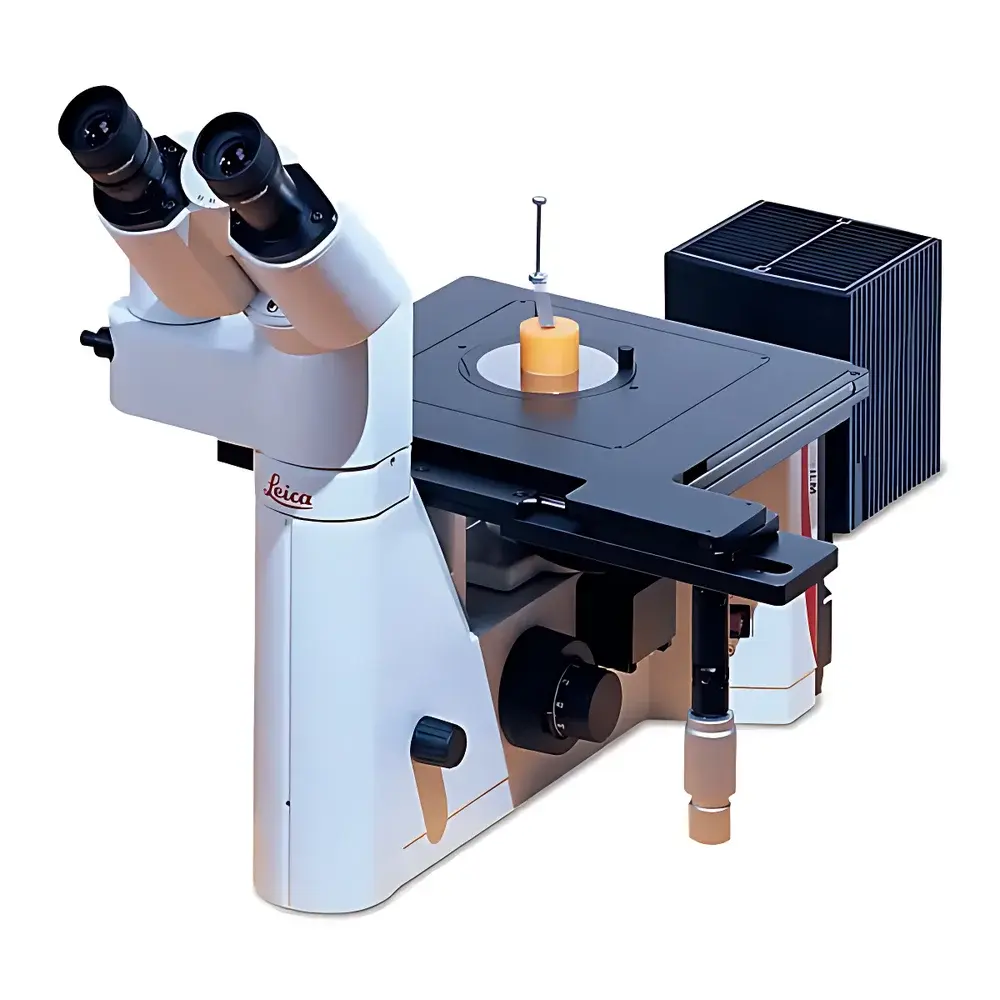
Leica DMI LM Inverted Metallurgical Microscope
| Brand | Leica |
|---|---|
| Origin | Germany |
| Model | DMI LM |
| Optical System | HC Infinite Correction |
| Observation Modes | Brightfield, Polarized Light |
| Eyepieces | 10× (WF18), optional 12.5×/16×/25× |
| Objectives | 1.25×, 5×, 10×, 20×, 50×, 100×, 250× |
| Magnification Range | 50×–1000× (with 10× eyepiece) |
| Nosepiece | 4-position, M25 brightfield turret |
| Stage | 247 × 230 mm fixed platform, XY travel 60 × 40 mm |
| Focus Mechanism | Coaxial coarse/fine adjustment (7 mm up / 2 mm down) |
| Illumination | LED cold-light source (≥20,000 h lifetime), integrated polarizer/analyzer modules, removable filter sets |
| Camera Interface | C-mount |
| Tube | 30° inclined binocular tube, interpupillary adjustment 48–75 mm, 100% side-port photo output |
Overview
The Leica DMI LM is an inverted metallurgical microscope engineered for high-precision microstructural analysis of opaque, reflective specimens—primarily metals, alloys, ceramics, and advanced composites. Its inverted optical architecture positions the objective lenses beneath the specimen stage, enabling unobstructed access to large, heavy, or irregularly shaped samples mounted on standard metallographic mounts. The system employs Leica’s proprietary HC (High Contrast) infinite-corrected optical design, featuring simultaneous axial and radial chromatic aberration correction across the entire visible spectrum. This dual-correction strategy eliminates stray light artifacts and ensures diffraction-limited resolution, high contrast, and faithful color fidelity—critical for quantitative phase identification, grain size measurement, inclusion analysis, and defect characterization in accordance with ASTM E112, ISO 643, and EN 10365 standards.
Key Features
- Robust inverted platform with a 247 × 230 mm rigid stage and 60 × 40 mm precision XY mechanical travel—optimized for stability during high-magnification imaging and long-duration automated measurements.
- HC infinite-corrected optical path integrating matched objective lenses, tube lenses, wide-field eyepieces (10× WF18 standard), and side-port C-mount interface—ensuring consistent wavefront fidelity from specimen to camera sensor.
- Four-position M25 brightfield nosepiece with parfocal, spring-loaded objectives (1.25× to 250×), supporting rapid switching between low-magnification overview and high-resolution detail inspection without refocusing.
- Integrated LED illumination system delivering uniform Köhler illumination, >20,000-hour service life, and thermal stability—eliminating intensity drift and spectral shift over time, essential for reproducible photomicrography and digital metrology.
- Single-handed polarized light operation via slide-in polarizer/analyzer modules—enabling immediate transition between brightfield and polarization contrast for birefringent phase discrimination (e.g., martensite vs. austenite, slag vs. oxide inclusions).
- Ergonomic 30° inclined binocular tube with 48–75 mm interpupillary adjustment and 100% light-diverted side port—supporting simultaneous visual observation and high-fidelity digital capture without beam-splitter losses.
Sample Compatibility & Compliance
The DMI LM accommodates standard metallographic specimens up to 50 mm in height and 150 mm in diameter, including mounted cross-sections, as-polished or etched surfaces, and coated or plated components. Its fixed-stage design minimizes vibration coupling during microhardness testing or in situ thermal cycling experiments. The optical train complies with ISO 8578 (microscope performance testing), DIN EN ISO 10993-12 (biocompatibility evaluation of metallic implants), and ASTM E3 (specimen preparation for metallography). All optical components are certified free of hazardous substances per RoHS 2011/65/EU, and mechanical assemblies meet IP20 environmental protection requirements for laboratory use.
Software & Data Management
The microscope integrates seamlessly with Leica Application Suite (LAS) X software via USB 3.0 or GigE Vision interface. LAS X supports full GLP/GMP-compliant documentation workflows—including audit trails, electronic signatures (21 CFR Part 11 ready), and metadata-embedded image export (TIFF, JPEG2000, NDPI). Optional modules include: Leica DVM6 Extended Depth of Field (EDF) for focus-stacked 3D surface reconstruction; Leica QWin Pro for automated grain size distribution (ASTM E112), phase fraction quantification (ISO 9042), and inclusion rating (ASTM E45); and Leica Metallography Suite for standardized reporting templates aligned with ISO/IEC 17025 accredited labs.
Applications
- Quality control of castings, forgings, and weldments—detecting porosity, shrinkage cavities, hot tears, and intergranular cracking.
- Heat treatment verification—identifying phase transformations (e.g., ferrite/pearlite ratios, carbide morphology in tool steels) and decarburization depth profiling.
- Failure analysis—characterizing fatigue striations, brittle fracture surfaces, corrosion products, and coating delamination interfaces.
- Research in additive manufacturing—evaluating melt pool geometry, unmelted powder retention, and epitaxial grain growth in Ni-based superalloys or Ti-6Al-4V.
- Forensic metallurgy—comparative analysis of bullet jacket composition, toolmark replication fidelity, and fire-damaged structural steel microstructures.
FAQ
What types of specimens are compatible with the DMI LM?
Standard metallographic mounts (up to 50 mm height), bulk samples with flat polished surfaces, and industrial components requiring direct observation without sectioning.
Does the DMI LM support fluorescence observation?
No—this model is configured exclusively for transmitted brightfield and polarized light contrast on reflective specimens; fluorescence capability requires the DMI6000 B platform with motorized filter turrets and high-intensity xenon/LED excitation sources.
Can the microscope be integrated into automated production line inspection systems?
Yes—via programmable Z-drive compatibility, TTL-triggered shutter control, and GenICam-compliant camera interface, enabling synchronization with robotic handling and real-time pass/fail decision logic.
Is calibration traceable to national standards?
Leica provides factory calibration certificates traceable to PTB (Physikalisch-Technische Bundesanstalt) for magnification accuracy, stage movement linearity, and illumination uniformity—valid for 12 months under normal operating conditions.
What maintenance is required for long-term optical performance?
Annual cleaning of objective front lenses and condenser optics using lens-grade solvents; biannual verification of Köhler alignment and polarizer extinction ratio; no routine lamp replacement due to solid-state LED illumination.





