
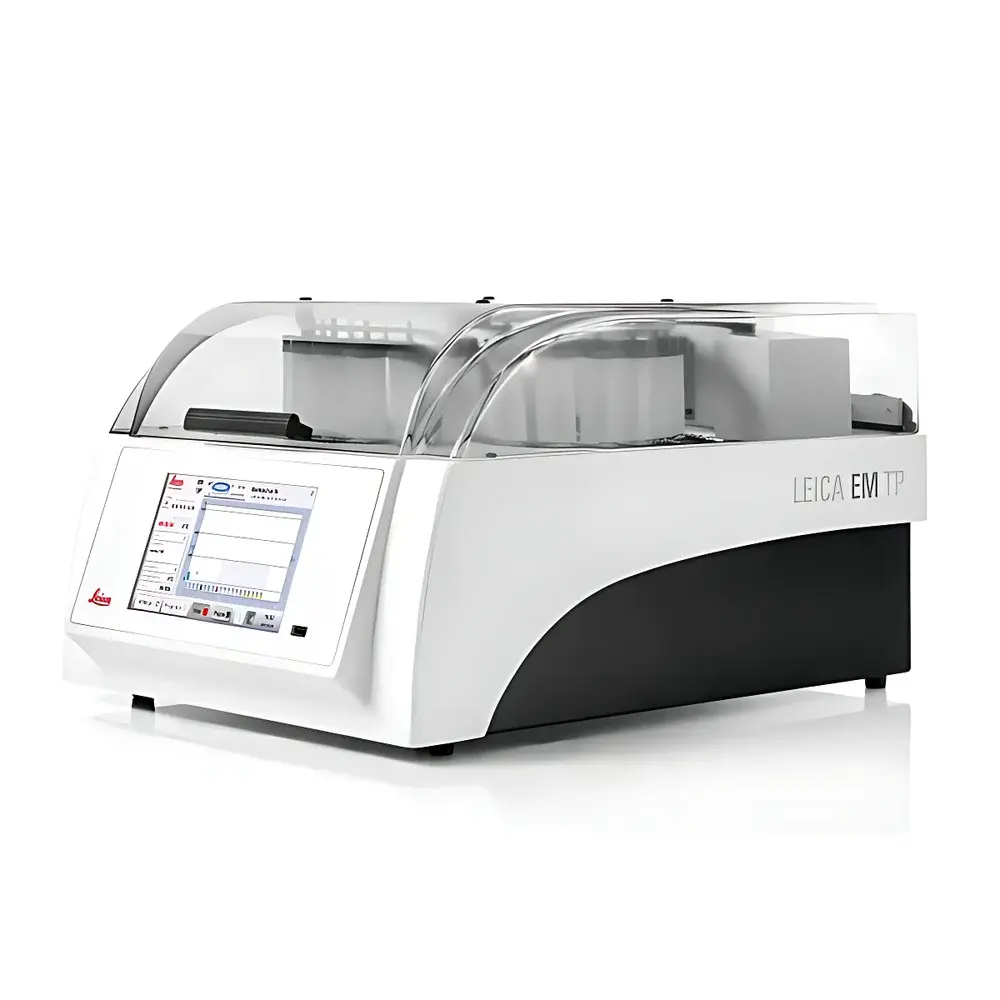
Leica EM TP Automated Tissue Processor
| Brand | Leica |
|---|---|
| Origin | Austria |
| Model | EM TP |
| Temperature Control Range | +4 °C to +60 °C |
| Sample Capacity | 56 (EM mode), 16 (LM mode), or 168 (3-basket EM mode) |
| Reagent Volume per Step | 10 mL (EM), 50 mL (LM or 3-basket EM) |
| Agitation Amplitude | 6 mm |
| Frequency | 0, 0.25, 0.5, 1, 2, 3 Hz |
| Programmable Steps | Up to 99 protocols stored |
| Reagent Library Capacity | 200 entries |
| Delayed Start/End | Yes |
| Display | LCD, 20×4 character |
| Touchscreen Interface | Integrated |
| Pre-cooling/Pre-heating (EM mode) | Yes |
| Compliance | Designed for GLP/GMP-aligned workflows |
Overview
The Leica EM TP is a fully automated, benchtop tissue processor engineered for high-fidelity specimen preparation prior to light microscopy (LM) and transmission electron microscopy (TEM). It employs precisely controlled sequential immersion—based on standardized dehydration, infiltration, and clearing protocols—to replace manual, operator-dependent processing steps with deterministic, thermally regulated fluid exchange. Unlike conventional processors relying on gravity-fed or static incubation methods, the EM TP integrates active agitation, programmable temperature stabilization, and timed reagent transfer across discrete chambers. This architecture ensures consistent solvent penetration, minimizes tissue shrinkage or distortion, and maintains biomolecular integrity—critical prerequisites for ultrastructural analysis at sub-100 nm resolution. Its dual-mode design (LM and EM configurations) enables laboratories to standardize histological and ultrastructural workflows within a single platform, reducing cross-method variability and supporting comparative morphological studies.
Key Features
- Programmable multi-step processing with up to 99 user-defined protocols stored onboard
- Temperature-controlled environment from +4 °C to +60 °C, with independent pre-cooling and pre-heating of reagent bottles in EM mode
- Adjustable agitation: 6 mm amplitude with selectable frequencies (0, 0.25, 0.5, 1, 2, 3 Hz) to optimize resin infiltration kinetics without mechanical stress
- Modular basket system: Supports three interchangeable configurations—16-sample LM baskets, 56-sample EM baskets, or a triple-basket EM setup accommodating up to 168 specimens per run
- Touchscreen-guided interface with 20×4-character LCD display for intuitive protocol building, parameter validation, and real-time status monitoring
- Automated reagent delivery with precise timing and volume control—10 mL per step in EM mode; 50 mL per step in LM or triple-basket mode
- Delay-start and delay-end functionality for unattended overnight or weekend runs, maintaining thermal stability throughout idle periods
- Integrated reagent library management (200 entries) enabling rapid recall of validated solvents, fixatives, and resins
Sample Compatibility & Compliance
The EM TP accommodates diverse biological tissues—including neural, muscular, vascular, and plant specimens—across standard cassettes, biopsy cups, and specialized EM embedding molds. Its sealed chamber design prevents evaporation and cross-contamination between reagent steps, while temperature uniformity (±0.5 °C) ensures reproducible fixation kinetics and resin polymerization profiles. The system complies with foundational requirements for Good Laboratory Practice (GLP) and Good Manufacturing Practice (GMP) environments: all protocol executions are timestamped, user-logged, and non-erasable; parameter changes trigger automatic event records; and saved protocols include full metadata (reagent IDs, dwell times, temperatures, agitation settings). While not FDA 21 CFR Part 11–certified out-of-the-box, its audit-trail architecture supports integration into validated digital quality management systems when paired with compliant LIMS or ELN platforms.
Software & Data Management
The embedded firmware provides a menu-driven, icon-assisted workflow for defining processing sequences—including step-specific temperature setpoints, dwell durations, agitation profiles, and reagent selection from the onboard library. Protocols can be exported via USB for archival or cross-instrument replication. No external PC is required for operation, though optional Leica Application Suite (LAS) modules enable remote monitoring and batch report generation (PDF/CSV). All executed runs retain complete traceability: start/end timestamps, actual vs. target temperatures per step, agitation activation logs, and reagent consumption history. This granular data layer supports root-cause analysis during troubleshooting and satisfies documentation requirements for internal audits or ISO 13485–aligned pathology labs.
Applications
- Standardized TEM sample preparation: glutaraldehyde/osmium fixation, ethanol/acetone dehydration, propylene oxide transition, and Epon/Araldite infiltration
- LM-compatible paraffin embedding workflows with xylene-based clearing and molten wax infiltration
- Correlative light and electron microscopy (CLEM) sample preparation where identical tissue blocks undergo parallel LM staining and EM ultrastructural analysis
- High-throughput screening studies requiring inter-batch comparability—e.g., toxicology assessments, developmental biology time-series, or therapeutic intervention models
- Resin optimization experiments leveraging variable agitation frequencies and temperature ramping to assess polymerization efficiency and sectioning quality
FAQ
Can the EM TP process both LM and EM samples in the same run?
No—LM and EM protocols require distinct reagent chemistries, volumes, and temperature profiles. However, users may alternate between modes across consecutive runs using saved, mode-specific protocols.
Is external ventilation or fume hood integration required?
Yes. As with all organic solvent–based tissue processors, operation must occur inside a certified chemical fume hood to ensure personnel safety and regulatory compliance with OSHA and EU Directive 2004/37/EC.
Does the EM TP support vacuum-assisted infiltration?
No. It relies on thermal cycling and controlled agitation for resin penetration; vacuum infiltration requires dedicated hardware not integrated into this platform.
How is calibration verified?
Temperature sensors are factory-calibrated against NIST-traceable references. Users may perform periodic verification using external calibrated thermometers inserted into designated test ports during idle cycles.
What maintenance intervals are recommended?
Daily: chamber wipe-down and waste bottle inspection. Quarterly: pump tubing replacement and agitation mechanism lubrication. Annually: full system performance qualification (SPQ) including thermal uniformity mapping and timing accuracy validation.




