
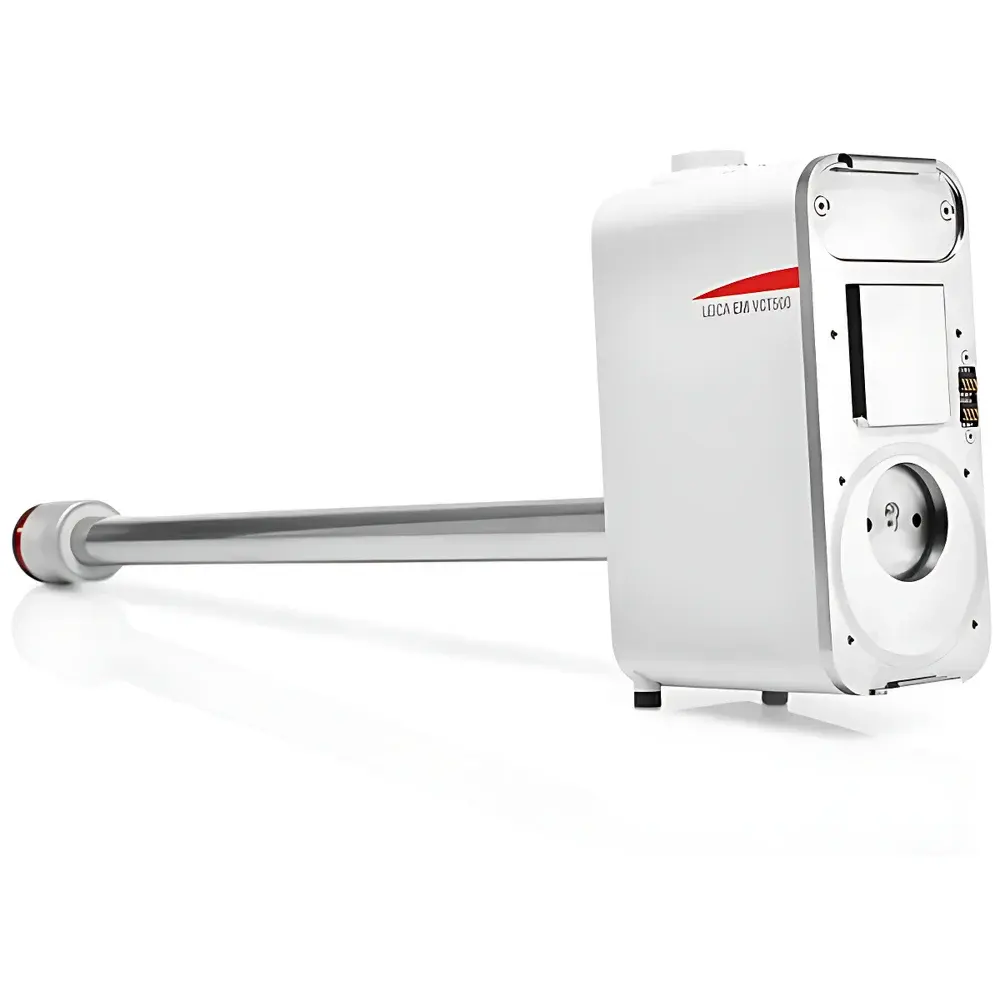
Leica EM VCT500 Vacuum Cryo-Transfer System
| Brand | Leica |
|---|---|
| Origin | Austria |
| Model | EM VCT500 |
| Application | Cryogenic Sample Transfer for Electron Microscopy |
| Compatibility | Cryo-SEM, Cryo-TEM, Cryo-CLEM, FIB-SEM, High-Pressure Freezing (HPF), Cryo-Ultramicrotomy |
| Cooling Mode | Active Liquid Nitrogen (LN₂) Cooling |
| Transfer Environment | Ultra-High Vacuum (UHV) or Controlled Atmosphere (e.g., N₂, Ar) |
| Interface Standard | ISO-KF 40 / CF 63 Flange Compatible |
| Temperature Monitoring | Integrated Pt100 Sensor with Real-Time Readout |
| Vacuum Monitoring | Integrated Pirani + Cold Cathode Gauge |
| Sample Stage Options | Three Standard Carriers (Gatan 626, EMGrid, Leica EM AutoGrid) |
| Customization | OEM Integration Support, Multi-Port Valve Manifolds, LN₂ Auto-Refill Interface |
Overview
The Leica EM VCT500 is a high-integrity vacuum cryo-transfer system engineered for seamless, contamination-free sample handling in cryo-electron microscopy workflows. It operates on the fundamental principle of maintaining uninterrupted cryogenic conditions (< −140 °C) and ultra-high vacuum (UHV, ≤10⁻⁶ mbar) from sample preparation through transfer to analytical instruments—including cryo-scanning electron microscopes (cryo-SEM), cryo-transmission electron microscopes (cryo-TEM), cryo-correlative light and electron microscopy (cryo-CLEM) platforms, and focused ion beam–SEM (FIB-SEM) systems. Unlike ambient-air transfer methods, the EM VCT500 eliminates ice contamination, surface recrystallization, and hydrocarbon adsorption by enforcing strict thermal and vacuum continuity across all interfaces. Its modular architecture integrates directly with Leica’s full suite of cryo-preparation tools—including the EM ICE high-pressure freezer, EM UC7/FC7 cryo-ultramicrotome, EM ACE600/ACE900 freeze-fracture coaters, and EM TIC 3X cryo-FIB—enabling end-to-end workflow traceability under GLP-compliant conditions.
Key Features
- Active LN₂-cooled transfer rod with integrated Pt100 temperature sensor and real-time digital readout (±0.5 °C accuracy)
- Dual-stage vacuum isolation: Pirani gauge for rough vacuum monitoring (10⁻³–10⁰ mbar) and cold cathode gauge for UHV verification (10⁻⁸–10⁻³ mbar)
- Patented multi-position valve manifold enabling simultaneous connection to up to three independent preparation modules (e.g., HPF, cryo-ultramicrotomy, freeze-etching)
- ISO-KF 40 and CF 63 flange compatibility for direct integration with major SEM/TEM manufacturers’ cryo-stages (including Thermo Fisher, Zeiss, JEOL, and Hitachi)
- Modular carrier support for Gatan 626-type holders, Leica EM AutoGrids, and custom EMGrid-compatible specimen mounts
- Optional automated LN₂ auto-refill interface with level monitoring and pressure-regulated delivery (EN 13445-compliant piping)
Sample Compatibility & Compliance
The EM VCT500 supports biological, polymeric, and soft-material specimens prepared via high-pressure freezing (HPF), plunge freezing, or cryo-sectioning. It maintains structural fidelity for vitrified water layers down to <10 nm thickness and preserves native-state epitopes for immunogold labeling workflows. All vacuum components conform to ISO 10110-7 (optical component cleanliness) and ASTM E2877-21 (cryogenic system integrity testing). The system meets EU Machinery Directive 2006/42/EC requirements and is designed for compliance with FDA 21 CFR Part 11 when paired with Leica’s EM VCM workstation and LAS X software—supporting electronic signatures, audit trails, and secure user access control. Vacuum interlocks and temperature-triggered safety shutoffs satisfy IEC 61000-6-2 EMC immunity standards.
Software & Data Management
When operated with the Leica EM VCM cryo-workstation, the EM VCT500 feeds synchronized metadata—including timestamped vacuum logs, stage temperature profiles, and valve actuation sequences—into LAS X LMS (Laboratory Management System). This enables full chain-of-custody documentation aligned with ISO/IEC 17025:2017 accreditation requirements. All process parameters are exportable as CSV or XML for integration into ELN (Electronic Lab Notebook) platforms such as LabArchives or Benchling. Audit trails record operator ID, session start/end times, parameter modifications, and alarm events—fully compliant with GLP and GMP environments requiring traceable instrument qualification (IQ/OQ/PQ).
Applications
- Cryo-SEM imaging of hydrated biofilms, extracellular vesicles, and frozen-hydrated tissue sections without metal coating
- Cryo-TEM grid loading and insertion under continuous <−170 °C conditions to prevent devitrification during TEM grid storage
- Correlative workflows: transferring light-microscopy–localized regions of interest (ROIs) from cryo-CLEM slides directly to FIB-SEM for lamella milling
- High-resolution cryo-FIB lift-out of lamellae from HPF-frozen mammalian cells, followed by in-situ transfer to TEM for tomography
- Serial block-face cryo-SEM of resin-embedded or frozen samples using integrated cryo-planing and stage retraction protocols
FAQ
What vacuum level does the EM VCT500 maintain during transfer?
The system achieves and sustains ≤5×10⁻⁷ mbar in the transfer path when pumped with a turbomolecular pump and backed by a dry scroll pump.
Can the EM VCT500 interface with non-Leica cryo-preparation tools?
Yes—it features standardized KF40/CF63 flanges and electrical signal protocols (RS-485, TTL) compatible with third-party HPF units, cryo-ultramicrotomes, and FIB-SEM stages meeting ISO 27401:2020 vacuum interface specifications.
Is temperature calibration traceable to NIST standards?
All Pt100 sensors are factory-calibrated against NIST-traceable reference baths (−196 °C to 25 °C), with calibration certificates provided per unit.
How many transfer cycles can be performed before maintenance?
Under typical usage (≤10 transfers/day), the EM VCT500 requires seal inspection every 6 months and full vacuum gauge recalibration annually—per Leica’s Preventive Maintenance Schedule PM-EMVCT500 Rev. 3.2.
Does the system support automated transfer scripting?
Via optional Leica ScriptEngine API, users can define custom transfer sequences—including staged valve opening, timed LN₂ dosing, and vacuum ramp profiles—for reproducible multi-step workflows.





