
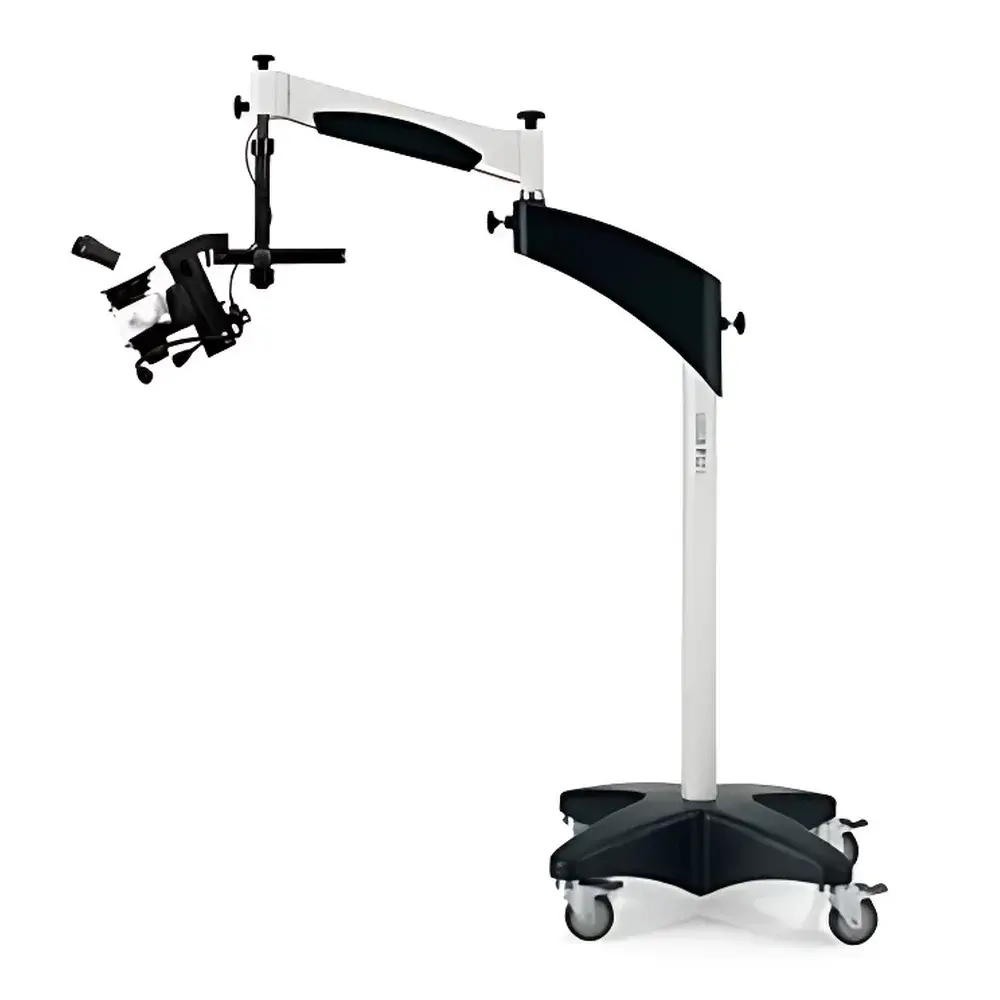
Leica F12 I Mobile Floor Stand for Stereo Microscopes
| Brand | Leica |
|---|---|
| Origin | Germany |
| Model | F12 I |
| Maximum Horizontal Reach | 1.2 m |
| Arm Rotation | 360° continuous horizontal rotation |
| Vertical Adjustment | telescoping vertical column |
| Compatibility | designed for standard stereo microscopes with C-mount or dovetail interface |
| Integrated LED Illumination Support | yes, with built-in cable management and power routing |
| Weight Class | lightweight structural design (approx. 28 kg) |
| Compliance | CE-marked, conforms to EN 61000-6-3 (EMC) and EN 61000-6-2 (immunity) |
Overview
The Leica F12 I Mobile Floor Stand is an engineered mechanical support platform specifically developed for stereo microscopes used in precision visual inspection workflows across conservation science, forensic documentation, industrial quality control, and academic research laboratories. Unlike fixed benchtop mounts or wall brackets, the F12 I employs a dual-axis articulated arm architecture—comprising a 360° continuously rotatable horizontal boom and a vertically telescoping central column—to deliver full three-dimensional positional freedom without requiring sample relocation. Its operational principle relies on high-tolerance kinematic joints, gas-spring-assisted counterbalance mechanisms, and precision-machined aluminum alloy construction to maintain stable optical alignment under variable load conditions (up to 5 kg payload). The stand is not an imaging device itself but a critical ergonomic and metrological interface that ensures consistent working distance, parfocality, and vibration-damped stability—key prerequisites for photogrammetric documentation, comparative morphological analysis, and non-contact surface evaluation.
Key Features
- 360° continuous horizontal rotation of the main cross-arm, enabling seamless circumferential access around large or immobile specimens such as paintings, archival documents, circuit boards, or ballistic evidence.
- Telescoping vertical column with fine-locking collar, offering adjustable height range from 850 mm to 1,450 mm to accommodate seated or standing operators and varied work surface configurations.
- Horizontal reach extension up to 1,200 mm from the base centerline—optimized for inspecting oversized objects placed on tables, carts, or mounted on walls without compromising microscope focus integrity.
- Integrated cable management system with internal routing channels for illumination power, camera USB/USB-C, and optional encoder or motorized focus cables—reducing tripping hazards and electromagnetic interference.
- Modular mounting interface compatible with Leica M-series and other industry-standard stereo microscopes via ISO 8038-compliant dovetail rails or M42 × 0.75 C-mount adapters.
- Low-center-of-gravity cast-iron base (420 × 420 mm) with four individually lockable dual-brake casters (75 mm diameter), certified for static load capacity ≥ 80 kg and compliant with ISO 9001-certified manufacturing protocols.
Sample Compatibility & Compliance
The Leica F12 I supports routine inspection of heterogeneous, dimensionally constrained, or environmentally sensitive samples—including fragile parchment, layered paint stratigraphy, semiconductor wafers, and biological tissue sections—without necessitating physical manipulation. Its mechanical design adheres to DIN EN ISO 14122-3 (safety of machinery – permanent means of access) and incorporates anti-tip geometry verified per EN 10219-2 structural steel specifications. For regulated environments, the stand’s passive mechanical operation (no embedded firmware or network interfaces) ensures compatibility with GLP/GMP laboratory infrastructure where instrument qualification must exclude software validation overhead. While the stand itself carries no FDA or ISO 13485 certification, its use with Leica-certified optical systems satisfies traceability requirements under ISO/IEC 17025:2017 for calibration laboratories performing dimensional microscopy.
Software & Data Management
As a purely mechanical positioning platform, the F12 I does not incorporate onboard electronics, firmware, or proprietary software. It functions transparently within existing digital microscopy ecosystems—including Leica Application Suite (LAS X), NIS-Elements, or open-source platforms such as MicroManager—by preserving native microscope control pathways. All positional repeatability is achieved through mechanical detents and calibrated vernier scales (±0.5° angular resolution, ±0.2 mm linear repeatability over full travel), eliminating dependency on closed-loop feedback systems. Audit trails for microscope positioning are maintained solely at the host imaging software level; the F12 I introduces no data logging, network connectivity, or 21 CFR Part 11 compliance obligations.
Applications
- Cultural heritage conservation: Examination of mural fragments, illuminated manuscripts, and polychrome sculpture under controlled oblique lighting without contact-induced stress.
- Forensic casework: Documentation of toolmarks, bullet striations, and latent print development on irregular substrates using side-mounted coaxial LED arrays.
- Electronics manufacturing: In-line solder joint inspection on populated PCBs exceeding standard stage dimensions, with real-time stereoscopic depth perception.
- Materials failure analysis: Corrosion mapping and crack propagation assessment on large-scale metal components, leveraging extended working distance for macro-to-micro transitional imaging.
- Botanical and entomological taxonomy: High-magnification observation of intact herbarium specimens or pinned insect collections without disassembly.
FAQ
Is the Leica F12 I compatible with non-Leica stereo microscopes?
Yes—provided the microscope features a standardized dovetail rail (per ISO 8038) or M42 × 0.75 C-mount interface, mechanical coupling is fully achievable using optional adapter plates.
Does the stand include vibration isolation?
No dedicated active or passive damping elements are integrated; however, the mass-dominant base and rigid arm geometry inherently suppress high-frequency ambient vibrations typical of laboratory HVAC systems or footfall (tested per ISO 20816-1, <2.5 µm peak-to-peak displacement at 10–500 Hz).
Can motorized focus or Z-axis automation be added?
Yes—the vertical column includes pre-drilled M4 threaded ports and clearance for third-party stepper motor kits; Leica does not supply or validate such modifications.
What maintenance is required?
Annual inspection of gas spring tension, caster brake functionality, and joint lubrication with ISO VG 22 synthetic grease is recommended per Leica Technical Bulletin TB-F12-2023.






