
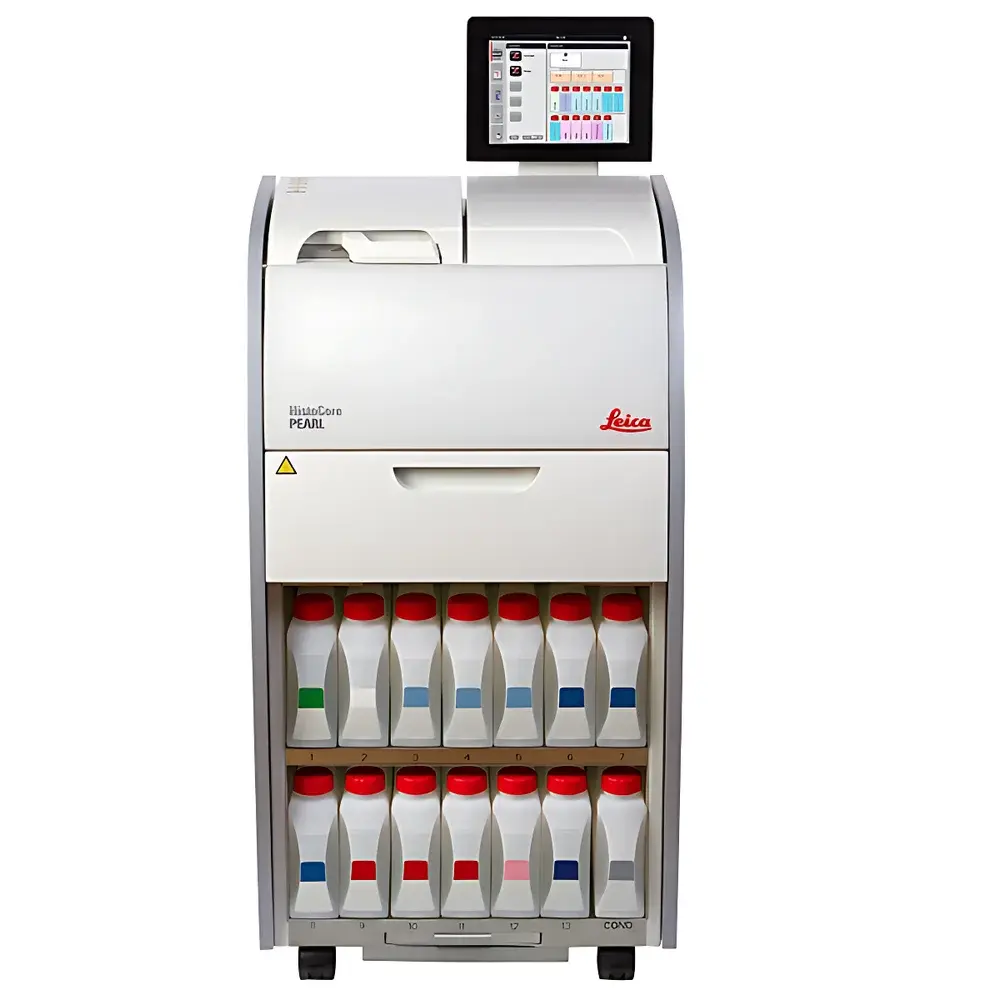
Leica HistoCore PEARL Fully Enclosed Tissue Processor
| Brand | Leica |
|---|---|
| Origin | Germany |
| Model | HistoCore PEARL |
| Enclosed Processing Capacity | 200 cassettes per cycle |
| Safety System | Triple-stage exhaust management (integrated vacuum draw, external venting port, activated carbon filter) |
| User Interface | Xylene-resistant capacitive touchscreen with multilingual support (EN/DE/FR/ES/IT) |
| Data Management | USB-exportable audit-trail log files compliant with GLP documentation requirements |
| Reagent Monitoring | Integrated Reagent Management System (RMS) tracking usage by cassette count, cycle count, or elapsed days |
| Physical Dimensions | Compact footprint optimized for space-constrained histology labs |
| Certified Compliance | CE-marked |
Overview
The Leica HistoCore PEARL Fully Enclosed Tissue Processor is an engineered solution for routine histological tissue processing in diagnostic, research, and academic laboratories. It operates on the principle of automated, sequential solvent exchange—replacing water in fixed biological specimens with graded alcohols, clearing agents (e.g., xylene), and finally molten paraffin wax—to produce tissues suitable for microtomy and downstream staining. Unlike open-basket processors, the PEARL employs a fully sealed reagent chamber architecture that physically isolates operators from volatile organic compounds (VOCs) such as xylene, ethanol, and chloroform throughout all processing stages. Its compact, benchtop form factor supports high-density lab layouts without compromising throughput, delivering consistent dehydration, clearing, and infiltration across up to 200 standard histology cassettes per run.
Key Features
- Fully enclosed processing chamber with positive-pressure sealing and integrated vacuum-assisted vapor extraction to prevent ambient VOC leakage.
- Triple-stage exhaust protection system: (1) internal vapor draw via dedicated suction manifold, (2) configurable external ducting interface for connection to central lab ventilation, and (3) replaceable activated carbon filter cartridge rated for >95% adsorption efficiency against aromatic hydrocarbons and aliphatic solvents.
- Xylene-resistant capacitive touchscreen display with intuitive icon-driven workflow navigation and real-time status indicators (temperature, reagent level, cycle phase).
- Multilingual UI supporting English, German, French, Spanish, and Italian—configured at setup and retained across power cycles.
- Modular drawer-based paraffin reservoir with quick-release mechanism and integrated waste wax collection tray beneath both paraffin and reagent bottles to minimize spill risk and simplify maintenance.
- Preset, pre-validated protocols for biopsy specimens, overnight standard processing, and post-clearing wash cycles—each calibrated using Leica’s standardized tissue equivalence models and traceable to internal validation reports.
Sample Compatibility & Compliance
The HistoCore PEARL accommodates standard 30 × 20 × 7 mm histology cassettes (including Leica’s proprietary SafeLock and EZ-Cassette lines) and is compatible with common formalin-fixed, paraffin-embedded (FFPE) tissue types—including soft tissues, bone biopsies (decalcified prior to loading), and cytology pellets. It does not support frozen or unfixed specimens. The system complies with CE marking requirements under Directive 2014/30/EU (EMC) and 2014/35/EU (LVD), and its electrical safety design conforms to IEC 61010-1:2010. While not classified as a medical device under FDA 21 CFR Part 820, its operational logging and RMS functionality align with GLP principles for record integrity and reagent accountability—supporting internal audit readiness and ISO 15189-accredited pathology lab workflows.
Software & Data Management
No embedded operating system or network connectivity is required; all control logic resides in hardened firmware. Process logs—including start/end timestamps, temperature profiles per station, reagent consumption metrics, and error flags—are stored locally on non-volatile memory and exportable via standard USB-A interface to FAT32-formatted drives. Each log file contains a unique run ID, operator ID (if entered), and digital signature hash to ensure immutability. The Reagent Management System (RMS) calculates remaining reagent volume based on cumulative cassette throughput and average fluid displacement per cycle, triggering visual alerts when thresholds are reached. These logs meet minimum documentation standards for CAP accreditation checklist GEN.41710 and UK NEQAS Histopathology guidelines on reagent traceability.
Applications
The HistoCore PEARL serves core histotechnology functions in clinical pathology departments, contract research organizations (CROs), and university core facilities. Typical use cases include: routine surgical specimen processing for H&E staining; preparation of tissue microarrays (TMAs); batch processing of research biobank samples requiring uniform embedding quality; and high-volume dermatopathology or gastrointestinal lab workflows where reproducible dehydration kinetics directly impact sectioning success rate. Its sealed architecture makes it particularly suitable for labs lacking dedicated fume hoods or centralized exhaust infrastructure.
FAQ
Does the HistoCore PEARL require connection to a building exhaust system?
It can operate standalone using its internal activated carbon filter for low-throughput labs, but connection to external ducting is recommended for >5 runs/week to extend filter service life and ensure long-term VOC retention compliance.
Can third-party reagents be used with the RMS tracking function?
Yes—RMS tracks volume-based consumption regardless of brand, though Leica-validated reagents guarantee full compatibility with preset protocols and thermal stability profiles.
Is remote monitoring or network integration supported?
No—PEARL is a stand-alone instrument with no Ethernet, Wi-Fi, or cloud connectivity; all data transfer occurs via physical USB media to maintain air-gapped security in regulated environments.
What maintenance intervals are specified for the activated carbon filter?
Filter replacement is indicated every 6 months under typical use (≤100 cassettes/week), or sooner if the system displays “Filter Saturation” warning during exhaust calibration.
Are consumables such as reagent bottles and paraffin dispensers interchangeable with older Leica models?
No—PEARL uses proprietary bottle geometry and RFID-tagged wax cartridges to enable RMS recognition; legacy components are mechanically and electronically incompatible.



