
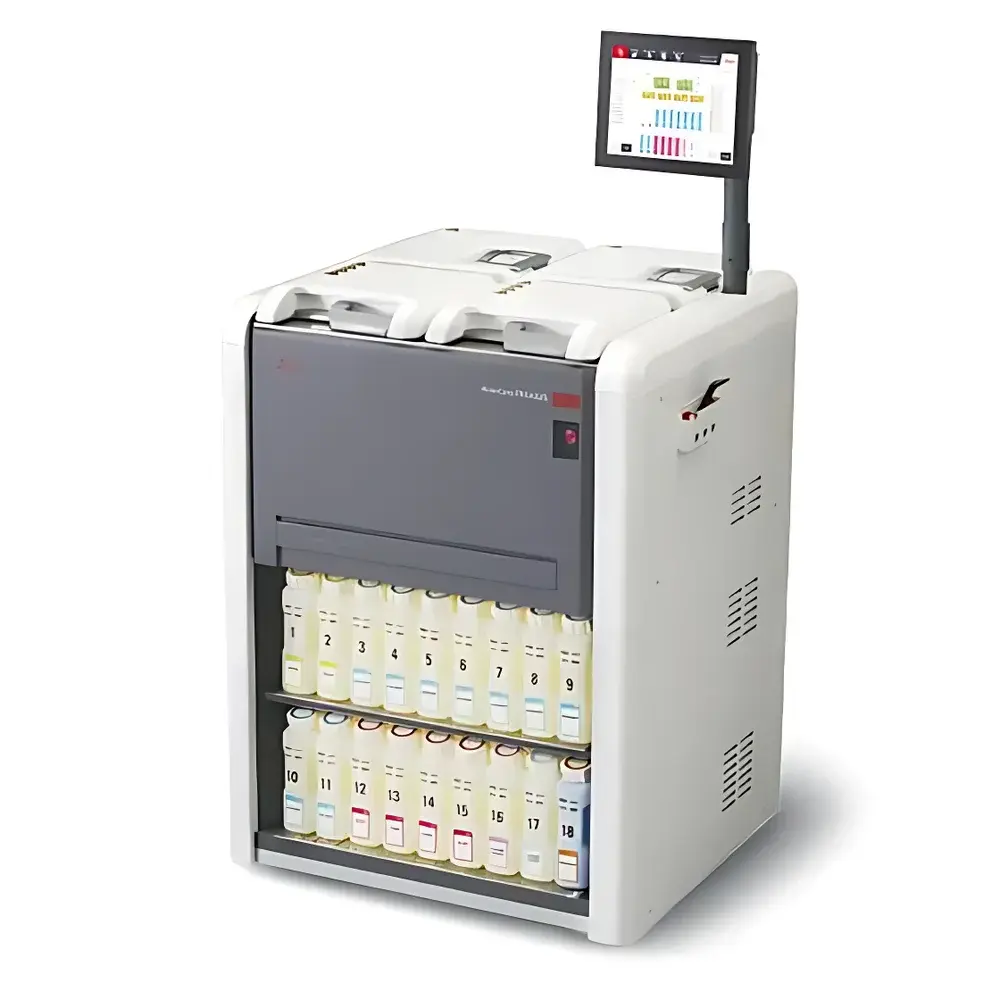
Leica HistoCore PEGASUS Tissue Dehydrator
| Brand | Leica |
|---|---|
| Origin | Germany |
| Model | HistoCore PEGASUS |
| Type | Fully Automated Parallel-Processing Tissue Dehydrator |
| Regulatory Compliance | CE-marked, IVD-compliant (Class B), Designed for ISO 13485 and GLP environments |
| Reagent Management | Integrated color-coded reagent bottle recognition system with level monitoring |
| User Access Control | Three-tier authentication (Operator, Supervisor, Administrator) |
| Data Integrity | Audit-trail enabled, FDA 21 CFR Part 11–ready software logging |
| Display | Backlit LCD with real-time reagent level visualization and connection status feedback |
| Stirring Technology | Electromagnetic stirring for uniform reagent exchange and optimized paraffin infiltration |
| Throughput | Dual independent processing chambers supporting concurrent protocols |
Overview
The Leica HistoCore PEGASUS is a fully automated, dual-chamber tissue dehydrator engineered for high-throughput histopathology laboratories requiring rigorous reproducibility across heterogeneous specimen types. It operates on the principle of graded alcohol-based dehydration followed by xylene or xylene-substitute clearing and paraffin infiltration—core steps in routine formalin-fixed, paraffin-embedded (FFPE) tissue processing. Unlike sequential processors, the PEGASUS implements true parallel processing architecture: two thermally isolated dehydration chambers operate independently under distinct, user-defined protocols—enabling simultaneous processing of delicate biopsies, fatty tissues, and large surgical specimens without cross-contamination or thermal interference. This architecture eliminates workflow bottlenecks while preserving morphological integrity, cellular detail, and antigenicity—critical for downstream immunohistochemistry (IHC) and molecular assays.
Key Features
- Dual Independent Processing Chambers: Each chamber features separate temperature control, reagent delivery, and agitation systems—allowing concurrent execution of up to two different protocols with full parameter isolation.
- Electromagnetic Stirring System: Contactless magnetic agitation ensures homogeneous reagent distribution and accelerated diffusion kinetics within tissue specimens, reducing total processing time by up to 25% compared to gravity-fed or mechanical stirrer systems—particularly beneficial for lipid-rich or fibrous tissues.
- Color-Coded Reagent Recognition & Level Monitoring: Integrated optical sensors detect proprietary Leica reagent bottles via embedded RFID tags and visual color identifiers; real-time liquid-level tracking prevents protocol interruption due to depletion and minimizes manual verification.
- Three-Tier User Authentication: Role-based access control (Operator, Supervisor, Administrator) enforces procedural compliance and supports audit-ready documentation per GLP, CAP, and CLIA requirements.
- Pre-Validated Protocol Library: Factory-installed, application-optimized workflows—including rapid biopsy, fatty tissue, and decalcified bone protocols—validated per ISO 15189 Annex A.3 and Leica’s internal QC standards.
- Backlit Status Display with Fault Diagnostics: Dynamic interface shows chamber status, reagent levels, active step duration, and connection integrity; automatic backlight deactivation signals incorrect bottle installation or sensor misalignment.
Sample Compatibility & Compliance
The HistoCore PEGASUS accommodates standard cassette sizes (e.g., Leica Cassettes 20 × 25 mm, 30 × 40 mm) and supports tissue weights up to 15 g per cassette. It is validated for use with Leica’s full line of certified histology reagents—including ethanol, isopropanol, xylene substitutes (e.g., Clear-Rite 3), and molten paraffins (e.g., Paraplast X-tra). The instrument complies with IEC 61010-1 (safety of laboratory equipment), EN 61326-1 (EMC), and carries CE marking under EU In Vitro Diagnostic Regulation (IVDR) Class B. Its software architecture supports 21 CFR Part 11 compliance through electronic signatures, immutable audit trails, and session-based user activity logs—meeting FDA expectations for regulated diagnostic laboratories.
Software & Data Management
Controlled via Leica’s proprietary HistoCore Software Suite (v4.2+), the system provides intuitive drag-and-drop protocol editing, remote monitoring via Ethernet/Wi-Fi, and export of CSV-formatted processing reports. All user interactions—including login/logout events, protocol modifications, reagent changes, and error acknowledgments—are timestamped and stored locally with optional integration into LIS/HIS platforms via HL7 v2.5 messaging. Data retention policies are configurable to align with institutional archiving standards (e.g., ≥7 years for QA records). Backup and restore functions support disaster recovery without reliance on cloud infrastructure.
Applications
- Routine diagnostic histopathology in academic medical centers and reference labs
- High-volume surgical pathology departments managing mixed specimen loads (e.g., prostate biopsies + mastectomy specimens)
- Research core facilities requiring consistent FFPE preparation for spatial transcriptomics or multiplex IHC
- Contract research organizations (CROs) performing GLP-compliant toxicopathology studies
- Quality assurance units validating new fixation or decalcification methodologies
FAQ
Can the PEGASUS process fatty or calcified tissues without special accessories?
Yes—the dual-chamber design enables dedicated protocols for adipose-rich specimens (using extended low-concentration ethanol gradients) and decalcified samples (with optimized acid-neutralization wash cycles), both pre-validated in the instrument’s protocol library.
Is reagent consumption tracked per protocol or per chamber?
Consumption is monitored independently per chamber and logged alongside each protocol execution event, enabling precise cost-per-specimen analysis and inventory forecasting.
Does the system support third-party reagents?
While Leica recommends its certified reagents for optimal performance and warranty coverage, the instrument accepts standard glass or HDPE reagent bottles with compatible threading; however, color-coding and RFID validation features are only functional with Leica-branded consumables.
How is software validation handled for regulated environments?
Leica provides a comprehensive Installation Qualification (IQ) and Operational Qualification (OQ) package, including test scripts, acceptance criteria, and documentation templates aligned with GAMP 5 principles—facilitating internal validation under ISO/IEC 17025 or CAP accreditation frameworks.





