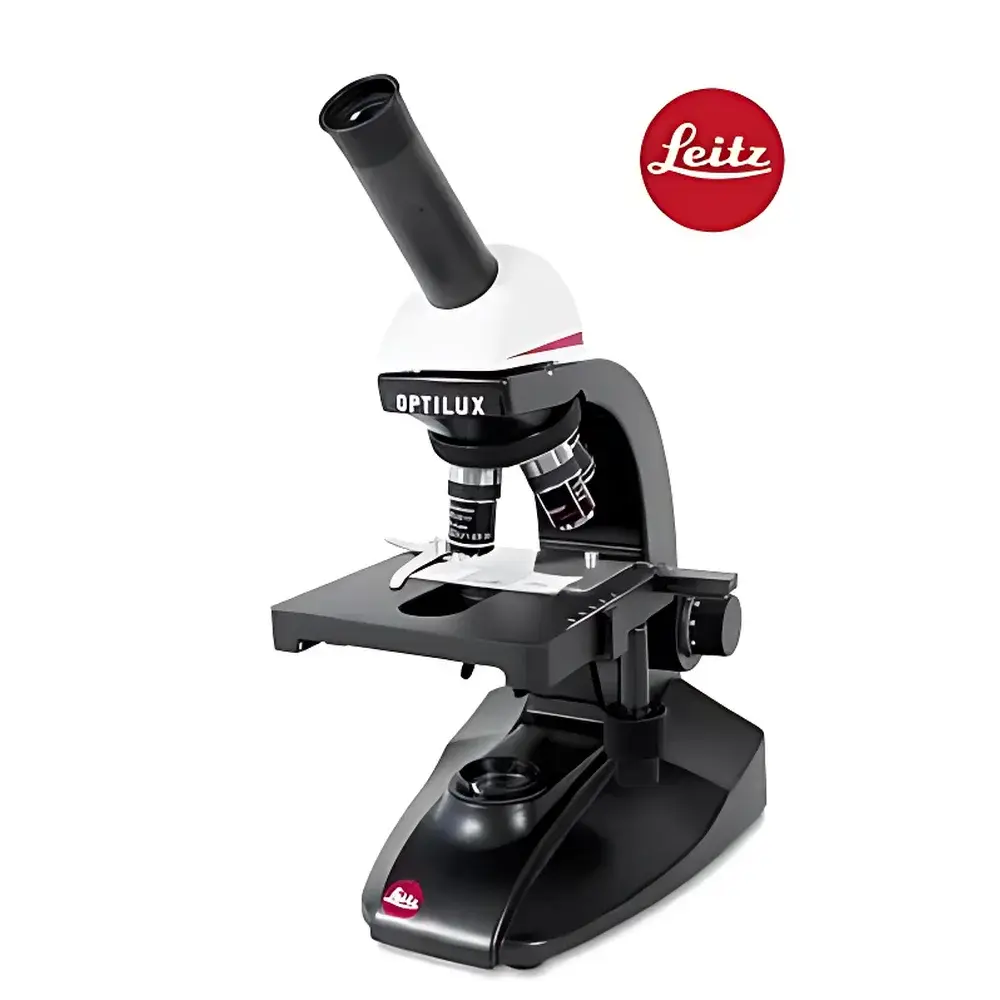
Leica Leitz Optilux Biological Microscope
| Brand | Leica |
|---|---|
| Origin | Germany |
| Model | Leitz Optilux |
| Category | Imported Instrument |
| Manufacturer Type | Authorized Distributor |
| Price Range | USD 2,700 – 6,800 (FOB Hamburg) |
Overview
The Leica Leitz Optilux is a rigorously engineered upright biological microscope developed by Leica Microsystems, rooted in the legacy of Ernst Leitz Wetzlar’s optical heritage. Designed for routine brightfield microscopy in academic teaching labs, clinical histopathology support environments, and industrial quality control settings, the Optilux employs a classical Köhler illumination architecture with a fixed condenser and field diaphragm to ensure uniform, glare-free illumination across the entire field of view. Its mechanical stage, low-positioned coaxial focus controls, and 45° inclined binocular tube reflect decades of ergonomic research—minimizing operator fatigue during extended observation sessions. The instrument operates on fundamental principles of transmitted light microscopy: light passes through a thin, stained or unstained specimen mounted on a glass slide, is collected and magnified by a series of achromat-corrected objectives, and relayed through a fixed 10× wide-field eyepiece pair. While not equipped for fluorescence, phase contrast, or DIC, its optical path is optimized for high-contrast, high-fidelity brightfield imaging of tissue sections, blood smears, microorganisms, and plant specimens.
Key Features
- Ergonomic 45° inclined binocular observation tube with interpupillary distance adjustment (55–75 mm) and diopter compensation (±5 dpt) per eyepiece
- Robust all-metal mechanical stage with low-profile X–Y translation controls (range: 76 × 50 mm), calibrated vernier scales, and anti-slip rubber grips
- Coaxial coarse/fine focusing system with 2 mm coarse travel (20 µm/rev) and 200 µm fine travel (2 µm/rev), featuring tension adjustment and upper limit stop
- Four-position rotating nosepiece with precision-machined brass threads and parfocal alignment (standardized to 45 mm parfocal distance)
- Achromatic objective lens set (4×, 10×, 40×, 100× oil immersion) with DIN-standard thread (RMS 0.796″–36 UNF) and engraved numerical apertures
- Fixed Abbe condenser (NA 1.25) with iris diaphragm and centering screws, compatible with standard 30 mm diameter filter holders
- Halogen illumination (6 V / 20 W) with integrated brightness control and heat-absorbing filter to protect specimens from thermal degradation
Sample Compatibility & Compliance
The Leitz Optilux accommodates standard 1 mm-thick, 24 × 50 mm or 26 × 76 mm glass microscope slides and 18 × 18 mm or 22 × 22 mm coverslips. It supports routine histological preparations (e.g., H&E, Masson’s trichrome), cytological smears, and live unstained specimens up to 1.5 mm in thickness when using long-working-distance objectives. All optical components comply with ISO 8578:2017 (Microscopes — Requirements and tests for optical performance) and DIN EN 61000-6-3:2019 (EMC emission standards). The instrument meets CE marking requirements under Directive 2014/30/EU (EMC) and 2014/35/EU (LVD), and conforms to IEC 61010-1:2010 safety standards for laboratory equipment. No FDA 510(k) clearance or IVDR classification applies, as it is designated for research use only (RUO) and non-diagnostic educational applications.
Software & Data Management
The Leitz Optilux is a standalone optical instrument with no built-in digital imaging or proprietary software stack. It is fully compatible with third-party USB-C or HDMI-enabled microscope cameras (e.g., Leica ICC50 W, AmScope MU1403, or IDS Imaging UI-1220SE) via standard C-mount (1″, 32 TPI) or optional 23.2 mm adapter. Image acquisition, annotation, measurement (length, area, particle count), and report generation are managed through open-platform software such as ImageJ (NIH), CellSens Standard (Olympus), or NIS-Elements (Nikon), all supporting TIFF/PNG export and metadata embedding (EXIF, XMP). Audit trails, user access logs, and electronic signatures are implemented at the host workstation level in GLP/GMP-regulated environments, consistent with 21 CFR Part 11 requirements when paired with validated software configurations.
Applications
- Routine histopathology training: identification of cellular morphology, mitotic figures, and tissue architecture in formalin-fixed paraffin-embedded (FFPE) sections
- Microbiology education: visualization of Gram-stained bacteria, fungal hyphae, and protozoan motility
- Botanical studies: examination of stomatal distribution, vascular bundle arrangement, and pollen grain morphology
- Industrial QC: verification of fiber integrity in textile composites, paper pulp analysis, and coating homogeneity assessment
- Forensic screening: preliminary analysis of hair shafts, textile fibers, and trace particulate evidence
FAQ
Is the Leitz Optilux suitable for fluorescence microscopy?
No. The optical path lacks excitation filters, dichroic mirrors, and barrier filters required for fluorescence. It is strictly configured for transmitted brightfield illumination.
Can oil immersion objectives be used with this model?
Yes. The 100× oil immersion objective is included and fully supported by the NA 1.25 Abbe condenser and halogen illumination system.
Does the microscope include camera integration capability?
It features a standard C-mount port; however, no camera or imaging software is supplied. Integration requires external hardware and third-party software.
What maintenance intervals are recommended for routine operation?
Optical surfaces should be cleaned with lens-grade tissue and xylene-free cleaner every 40 hours of use; mechanical stage lubrication and focus gear inspection are advised annually by certified service personnel.
Is calibration documentation provided with shipment?
A factory-issued Certificate of Conformance (CoC) verifying compliance with ISO 8578 is included. NIST-traceable calibration reports are available upon request at additional cost.