
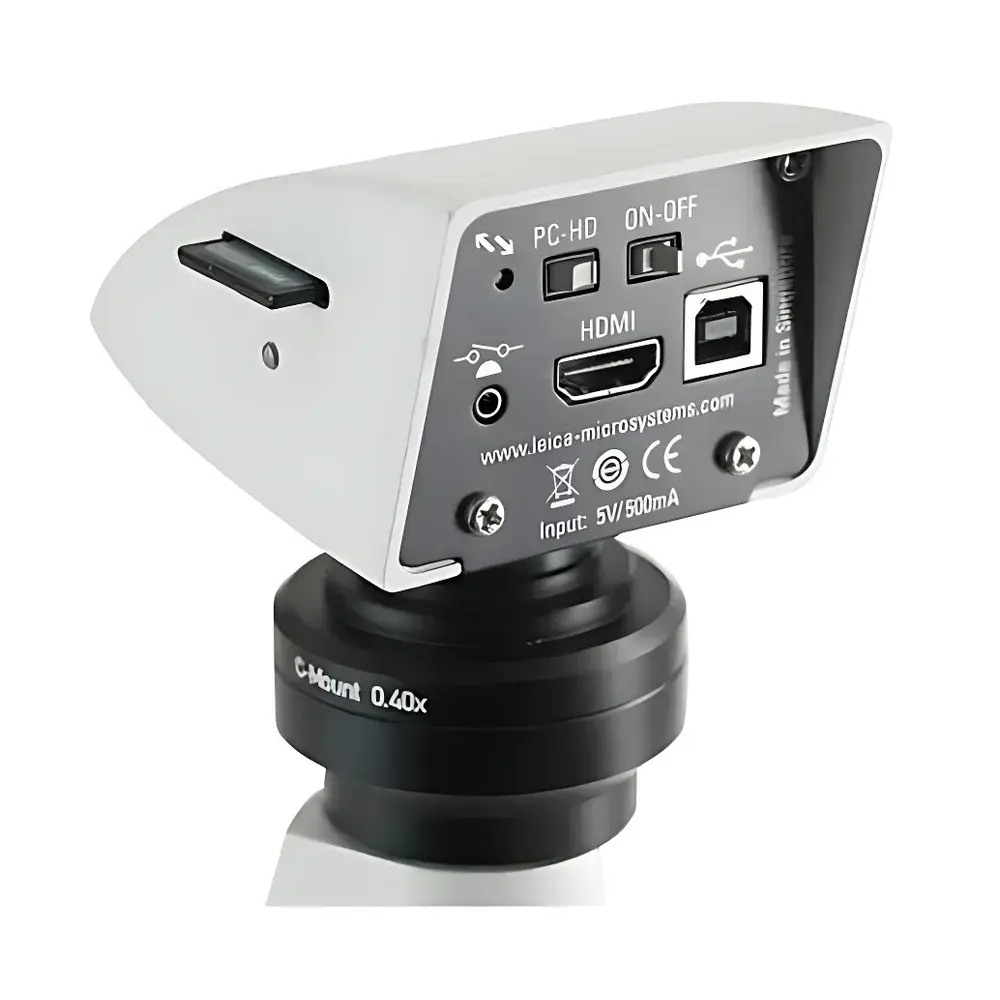
Leica MC120 HD Microscope Camera
| Brand | Leica |
|---|---|
| Origin | Germany |
| Model | MC120HD |
| Sensor Resolution | 2.5 MP (1920 × 1080) |
| Video Output | Full HD (1080p) at 30 fps |
| Interface | C-mount |
| Connectivity | USB 2.0, HDMI, SD card slot |
| Standalone Operation | Yes |
| Remote Control | Wireless |
| Software Compatibility | Leica Application Suite (LAS) |
| Warranty | 2 years |
Overview
The Leica MC120 HD Microscope Camera is a dedicated digital imaging solution engineered for integration with Leica’s broad portfolio of upright, inverted, stereo, and metallurgical microscopes. Built upon a high-sensitivity progressive-scan CMOS sensor, the MC120 HD captures full-color static images and real-time video using standard optical microscopy illumination pathways—without requiring complex alignment or calibration. Its core measurement principle relies on pixel-based spatial encoding calibrated against known stage or objective magnification factors, enabling traceable quantitative imaging in compliance with ISO 10993-12 and ASTM E2877 for dimensional metrology in life science and materials analysis. Designed for laboratory environments where workflow efficiency and regulatory readiness are critical, the camera supports both standalone acquisition and PC-integrated operation—making it suitable for routine quality control, academic teaching, and GLP-compliant documentation.
Key Features
- Standalone imaging capability: Captures 2.5 MP stills and 1080p/30 fps video directly to removable SD card—no host PC required.
- Low-latency dual-stream HDMI output: Simultaneous live preview on external monitors and internal recording, facilitating ergonomic specimen positioning and collaborative review.
- Wireless remote control: Enables one-touch capture, playback, exposure adjustment, white balance, and focus assist—ideal for glove-compatible or vibration-sensitive setups.
- C-mount mechanical interface: Ensures repeatable, parfocal alignment across Leica microscope models including DM750, S8 APO, Z6 APO, DM2700M, and DMI6000B series.
- USB 2.0 interface with native LAS driver support: Fully compatible with Leica Application Suite v4.x and later, including LAS X Core, LAS AF, and LAS EZ modules for annotation, measurement, multi-channel overlay, and report generation.
- On-sensor image annotation: Overlay crosshairs, scale bars, user-defined text, timestamp, and objective identification in real time—configurable via LAS or embedded menu system.
Sample Compatibility & Compliance
The MC120 HD is validated for use with transmitted light (brightfield, phase contrast, DIC), reflected light (epifluorescence, brightfield metallurgy), and stereoscopic illumination systems. It meets CE marking requirements under Directive 2014/30/EU (EMC) and 2014/35/EU (LVD), and conforms to IEC 61000-6-2/6-3 for industrial electromagnetic immunity and emissions. For regulated environments, its firmware supports audit-trail–capable metadata logging—including operator ID, acquisition timestamp, exposure parameters, and calibration history—when used with LAS X in FDA 21 CFR Part 11–configured deployments. The camera complies with ISO/IEC 17025:2017 Annex A.3 for equipment used in accredited testing laboratories.
Software & Data Management
Leica Application Suite (LAS) provides full firmware-level integration, enabling automated batch capture, multi-z-stack acquisition, region-of-interest (ROI) cropping, and calibrated linear measurements (µm/pixel). All captured images embed EXIF-compliant metadata, including magnification, objective ID, illumination intensity, and color profile (sRGB). Data export supports TIFF (uncompressed), JPEG (lossless compression), AVI (uncompressed), and MP4 (H.264) formats—each retaining embedded scale information for downstream analysis in third-party platforms such as ImageJ/Fiji, MATLAB, or HALO. LAS-generated reports adhere to ISO 15189:2022 documentation standards, supporting PDF/A-2b archival compliance.
Applications
- Life sciences: Routine histology slide documentation, cell counting, mitotic index assessment, and educational microscopy demonstrations.
- Materials science: Grain structure analysis in metallography, coating thickness verification, and fracture surface characterization on DM2700M and DM4000M platforms.
- Quality assurance: In-line verification of PCB solder joints, polymer film uniformity, and pharmaceutical tablet coating integrity using stereo systems like S8 APO and Z6 APO.
- Clinical pathology: Dual-monitor digital pathology preview during frozen section evaluation—leveraging HDMI latency <120 ms for real-time diagnostic correlation.
- Academic training: Multi-user shared microscope stations with synchronized HDMI output to classroom displays, eliminating bottlenecks in undergraduate lab instruction.
FAQ
Does the MC120 HD require proprietary drivers to operate with Windows or macOS?
No—basic UVC (USB Video Class) functionality is supported natively on Windows 10/11 and macOS 12+, enabling plug-and-play video streaming. Full feature access (e.g., measurement, annotation, remote control) requires Leica’s certified LAS software stack.
Can the camera be calibrated for quantitative length measurements?
Yes—calibration is performed within LAS using a stage micrometer or certified graticule. Calibration data is stored per objective lens and persists across sessions, satisfying ISO 9001:2015 clause 7.1.5.2 for monitoring and measuring resource validation.
Is the SD card recording format compatible with forensic or regulatory archiving standards?
All recordings include embedded UTC timestamps, sensor temperature logs, and hardware serial identifiers. When paired with LAS X Audit Trail mode, file integrity is verified via SHA-256 hashing—meeting ALCOA+ principles for data reliability in GxP environments.
What is the maximum sustainable frame rate at full resolution?
The camera delivers 30 fps at 1920 × 1080 resolution under optimal lighting conditions (≥200 lux at sample plane); frame rate dynamically adjusts downward under low-light conditions to maintain signal-to-noise ratio.
How is firmware updated, and is version rollback supported?
Firmware updates are delivered via LAS and applied through USB connection. Version history and rollback capability are retained for 12 months post-update, in accordance with IEC 62304 Class B software lifecycle requirements.




