
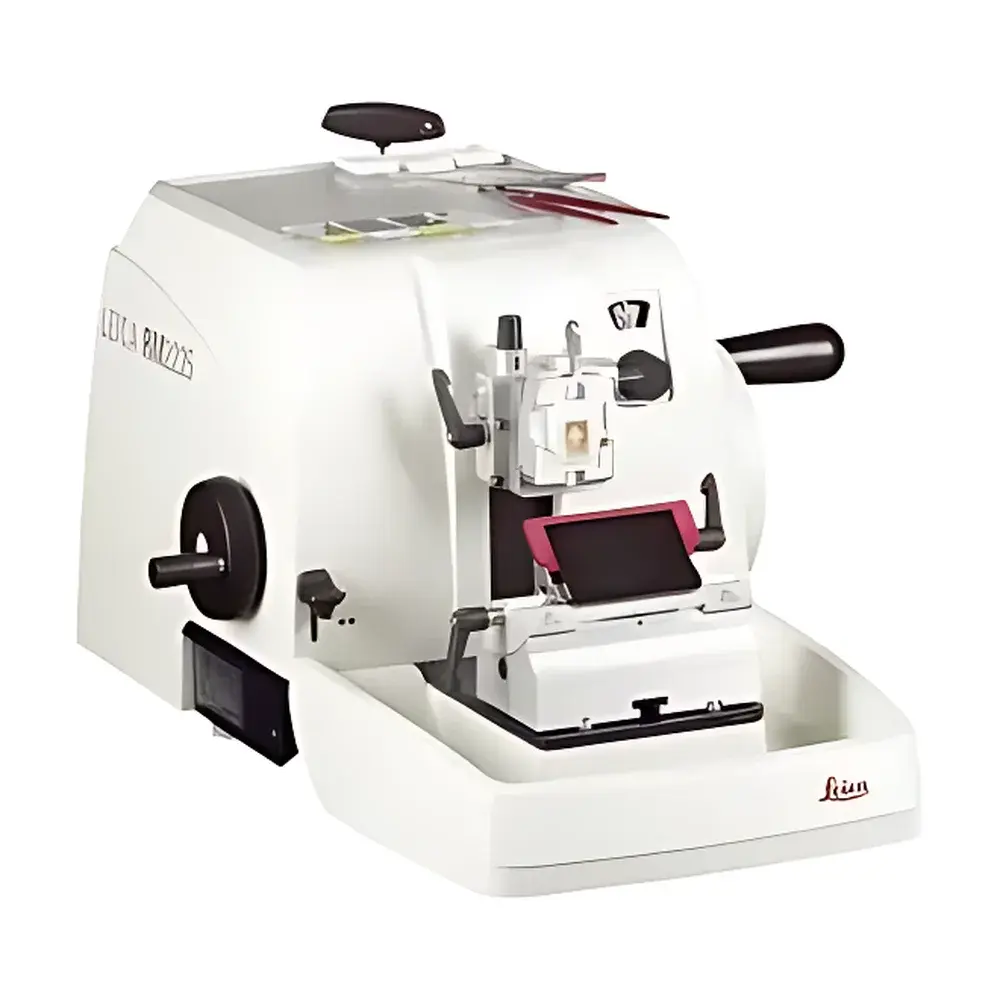
Leica RM2235 Rotary Microtome
| Brand | Leica |
|---|---|
| Origin | Germany |
| Model | RM2235 |
| Max Sample Size | 45 × 50 mm |
| Section Thickness Range | 1–60 µm |
| Minimum Increment | 1 µm |
| Vertical Stroke | 70 mm |
| Specimen Retraction | 200 µm |
| Horizontal Translation | 30 mm |
| Roughing Steps | 10 µm / 50 µm |
| Dimensions (W×D×H) | 490 × 520 × 305 mm |
| Weight | 37 kg |
Overview
The Leica RM2235 Rotary Microtome is a precision-engineered, manually operated rotary microtome designed for high-reproducibility sectioning of paraffin-embedded and semi-hard biological specimens. Built on Leica Biosystems’ decades-long heritage in histopathology instrumentation, the RM2235 employs a robust mechanical architecture grounded in classical rotary microtomy principles—where controlled specimen advancement via a calibrated micrometer feed mechanism enables consistent section thickness generation through precise blade-sample interaction. Its core function relies on the coordinated motion of a vertically reciprocating specimen holder and a stationary horizontal knife edge, with feed accuracy maintained by a backlash-free gear train and spring-balanced handwheel system. Unlike motorized or cryo-optimized platforms, the RM2235 prioritizes tactile control, ergonomic stability, and mechanical reliability—making it especially suited for routine histology laboratories requiring long-term operational consistency, GLP-compliant manual workflows, and integration into ISO 15189-accredited pathology environments.
Key Features
- Ergonomic handwheel placement—positioned 80 mm closer to the operator than conventional models—to reduce wrist flexion and muscular fatigue during extended sectioning sessions.
- Patented spring-based balancing system replacing traditional counterweights, ensuring smooth, vibration-dampened rotation and eliminating specimen head sag upon handwheel stop.
- Dual independent handwheel locks: one fixed-top lock for uppermost position retention; a secondary adjustable lock enabling secure immobilization at any rotational angle—critical for resection alignment and safety during knife changes.
- E-type knife holder with full-length red safety guard, covering the entire cutting edge during both sectioning and block exchange to comply with IEC 61000-1-2 occupational safety directives.
- Magnetically secured waste tray with wide aperture and corrosion-resistant stainless-steel lining, facilitating rapid debris removal without tool intervention.
- Modular sample stage with 30 mm horizontal translation and 70 mm vertical stroke—accommodating oversized embedding cassettes (up to 45 × 50 mm) while increasing clearance between blade and specimen for safer handling.
- Optional 8° X/Y precision positioning system with dual red reference markers and calibration-adjustable zero-reset functionality—enabling repeatable resection targeting and alignment verification across serial sections.
- Universal knife base compatible with steel knives, disposable blades, and specialized holders—including lateral knife translation capability to maximize usable blade length and extend service life.
Sample Compatibility & Compliance
The RM2235 supports standard formalin-fixed, paraffin-embedded (FFPE) tissue blocks as well as harder materials including decalcified bone, resin-embedded plant tissues, and certain polymer composites. Its 1–60 µm section thickness range—with 1 µm incremental adjustment—meets ASTM E112-22 requirements for grain size analysis preparation and aligns with USP recommendations for pharmaceutical tablet cross-sectioning. The instrument’s mechanical design conforms to EN 61000-3-2 (harmonic current emissions) and EN 61000-3-3 (voltage fluctuations), though no electrical drive components are present. All surface materials—including housing, stage, and waste tray—are chemically resistant to xylene, ethanol, and chloroform, supporting compliance with CLIA and CAP pre-analytical standards. No firmware or digital controls are embedded, thus exempting the device from FDA 21 CFR Part 11 electronic record requirements—ideal for labs maintaining fully auditable paper-based SOPs.
Software & Data Management
As a purely mechanical instrument, the Leica RM2235 does not incorporate onboard software, firmware, or digital interfaces. All operational parameters—including section thickness, coarse advance settings, and stage coordinates—are set manually using calibrated dials and vernier scales. This analog architecture eliminates cybersecurity vulnerabilities, ensures deterministic repeatability unaffected by software updates or OS dependencies, and simplifies validation under GMP Annex 15 and ISO/IEC 17025 clause 5.5.2 (equipment verification). Laboratories may integrate the RM2235 into broader digital pathology workflows by pairing it with third-party barcode tracking systems or LIMS-compatible embedding cassette labeling protocols—though such integrations remain external to the microtome itself.
Applications
- Routine histopathology: serial sectioning of FFPE tissue blocks for H&E and immunohistochemical staining in clinical diagnostic labs.
- Academic research: preparation of serial sections for neuronal tracing, tumor margin mapping, and developmental biology studies requiring precise orientation control.
- Materials science: sectioning of epoxy-embedded composite samples, mineralized tissue scaffolds, and thermoset polymers for SEM/EDS analysis.
- Pharmaceutical QA: cross-sectional evaluation of coated tablets, transdermal patches, and lyophilized dosage forms per USP and Ph. Eur. 2.9.40.
- Veterinary diagnostics: processing of dense connective tissues and calcified lesions where motorized microtomes risk chatter or compression artifacts.
FAQ
Is the Leica RM2235 suitable for frozen sectioning?
No—the RM2235 is not equipped with cryogenic cooling capabilities or anti-static features required for optimal frozen sectioning. It is optimized for room-temperature paraffin and semi-hard resin blocks.
Can the handwheel rotation direction be customized?
Yes—rotation direction (clockwise or counterclockwise) is configurable at time of order to accommodate regional operator preference or lab ergonomics standards.
Does the RM2235 meet ISO 13485 requirements for medical device manufacturing environments?
While the RM2235 itself is not a medical device, its mechanical construction, material certifications (e.g., RoHS-compliant housing alloys), and traceable manufacturing origin (Germany) support use in ISO 13485-certified facilities performing histological release testing.
What maintenance intervals are recommended for long-term reliability?
Leica recommends biannual lubrication of the feed mechanism with ISO VG 10 oil and annual inspection of gear meshing and handwheel spring tension—documented in accordance with ISO/IEC 17025 clause 6.4.6.
Is the optional X/Y positioning system factory-calibrated?
Yes—each unit ships with NIST-traceable calibration documentation, and the dual red zero-reference markers are pre-aligned to within ±0.5° angular tolerance.



