
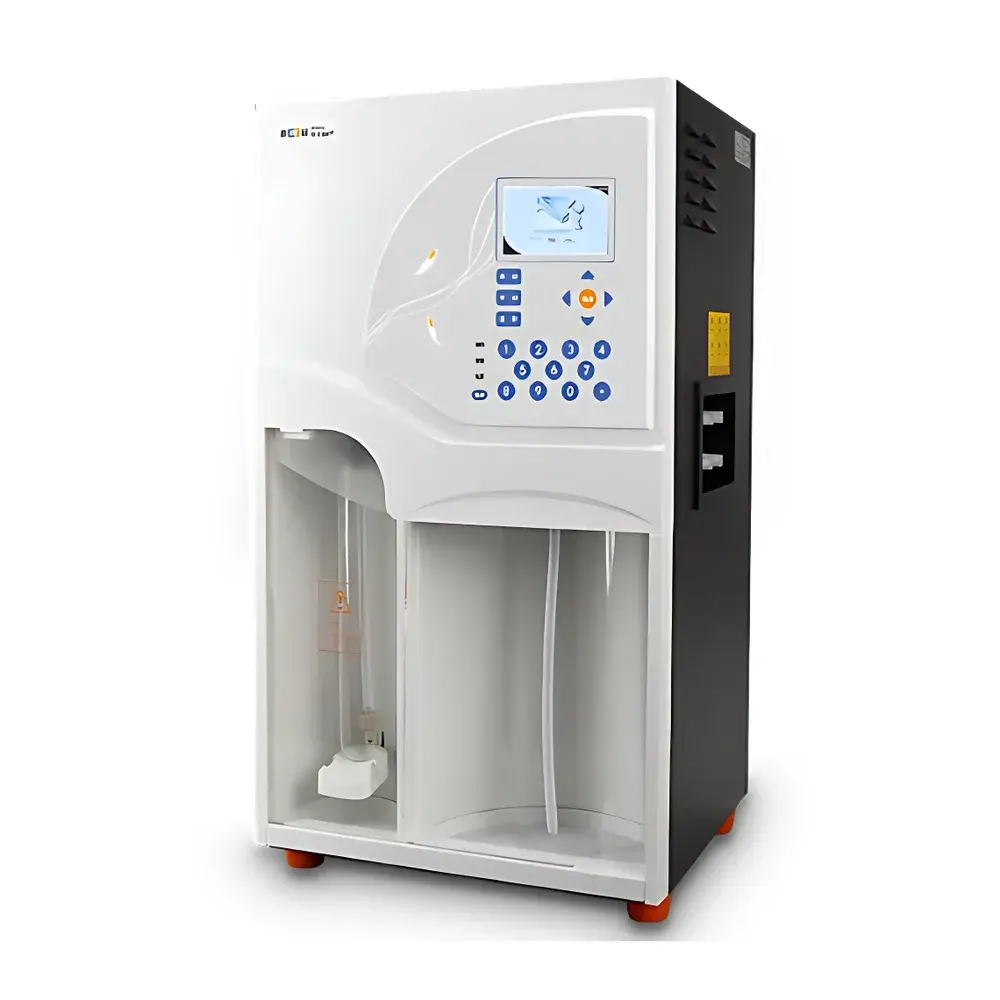
Leichi KDN-1 Automatic Kjeldahl Nitrogen Determinator
| Brand | Leichi |
|---|---|
| Origin | Shanghai, China |
| Manufacturer Type | Authorized Distributor |
| Country of Origin | China |
| Model | KDN-1 |
| Instrument Type | Kjeldahl Nitrogen Determinator |
| Measurement Range | 0.1–240 mg N |
| Nitrogen Recovery Rate | ≥99.5% |
| Sample Weight Capacity | ≤6 g (solid) / ≤16 mL (liquid) |
| Distillation Speed | 3–6 min/sample |
| Adjustable Distillation Time | Up to 60 min |
| Cooling Water Consumption | 1.5 L/min |
| Operating Modes | Automatic & Manual |
| Display | 4.3-inch high-resolution color LCD |
| Power Supply | 220 VAC ±10%, 50 Hz |
| Rated Power | 1.3 kW |
| Dimensions (W×D×H) | 400 × 385 × 735 mm |
| Net Weight | 30 kg |
Overview
The Leichi KDN-1 Automatic Kjeldahl Nitrogen Determinator is a benchtop analytical system engineered for precise, reproducible quantification of total nitrogen content in organic and inorganic samples via the classical Kjeldahl digestion–distillation–titration method. It implements standardized wet-chemical decomposition (acid digestion with concentrated H2SO4 and catalyst), followed by alkaline distillation under controlled thermal conditions and automatic boric acid trapping. The instrument complies with core international methodologies including ISO 8968-1 (milk and dairy), ISO 1871 (cereals and animal feed), AOAC 984.13 (food), and USP 〈461〉 (pharmaceutical excipients), enabling traceable, GLP-aligned nitrogen analysis across QC laboratories in food, agriculture, environmental, and pharmaceutical sectors.
Key Features
- Integrated dual-mode operation: seamless switching between fully automated sequence control and manual step-by-step intervention for method development or troubleshooting.
- Programmable reagent delivery: precision peristaltic pumps enable accurate, repeatable dosing of NaOH solution and boric acid absorbent—critical for minimizing titration endpoint variability.
- Intelligent dilution management: user-selectable auto/manual addition of distilled water ensures optimal matrix dilution prior to distillation, accommodating viscous or high-salt samples.
- Adaptive distillation control: adjustable time-based termination (0–60 min) coupled with real-time temperature monitoring of the heating mantle prevents over-distillation and ensures complete ammonia liberation without carryover.
- Automated post-distillation rinse cycle: dedicated wash protocol for condenser outlet tubing eliminates cross-contamination between runs and sustains long-term measurement fidelity.
- Enhanced safety architecture: position-sensing detection for digestion tube placement, thermal cutoff at critical mantle temperatures (>450 °C), and emergency stop button with hardware-level power interruption.
- Real-time system diagnostics: embedded flow sensor monitors cooling water pressure and continuity; audible/visual alerts trigger on low-flow, overheating, or reagent depletion conditions.
Sample Compatibility & Compliance
The KDN-1 supports routine analysis of diverse sample matrices—including cereal grains, meat products, soil extracts, wastewater sludge, and pharmaceutical raw materials—within defined mass/volume limits (≤6 g solids or ≤16 mL liquids). Its ≥99.5% nitrogen recovery rate meets the performance threshold specified in ISO 5983-1 and AOAC Official Method 960.42 for validation of nitrogen determination workflows. All operational logs—including distillation start/end timestamps, reagent volumes dispensed, and alarm events—are timestamped and stored locally, supporting internal audit trails. While the system does not natively implement FDA 21 CFR Part 11 electronic signature controls, its deterministic process logic and hardware-enforced interlocks align with GMP Annex 11 principles for instrument qualification (IQ/OQ/PQ).
Software & Data Management
The KDN-1 operates via an embedded firmware platform accessible through its 4.3-inch color LCD interface. No external PC connection is required for standard operation; all method parameters (alkali volume, boric acid volume, distillation duration, rinse duration) are configured directly on-device and saved to non-volatile memory. System status—including heating element temperature, coolant flow confirmation, digestion tube presence, and active alarm codes—is continuously displayed. Data export is not supported via USB or network interface; however, results (nitrogen mass, %N, protein conversion factor applied) can be manually recorded or integrated into lab notebooks using standardized reporting templates compliant with ISO/IEC 17025 documentation requirements.
Applications
- Protein content estimation in food and feed using standard conversion factors (e.g., 6.25 for cereals, 6.38 for dairy).
- Regulatory compliance testing for nitrogen load in municipal and industrial wastewater effluents (EPA Method 351.2).
- Quality control of nitrogen fertilizers and soil amendments per ISO 11261.
- Stability-indicating assays for nitrogen-containing APIs during accelerated degradation studies.
- Research-scale optimization of digestion catalyst formulations and sulfuric acid concentration gradients.
FAQ
Does the KDN-1 include built-in titration capability?
No—the KDN-1 performs only the digestion and distillation steps. Titration must be conducted separately using either manual burette titration or an external automatic titrator.
Is the instrument compatible with digestion blocks from other manufacturers?
Yes, provided the digestion tubes conform to standard 250–300 mL Kjeldahl tube dimensions (outer diameter ~45 mm) and are rated for temperatures up to 450 °C.
What maintenance intervals are recommended for the peristaltic pump tubing?
Leichi recommends inspecting and replacing alkali and boric acid delivery tubing every 6 months under daily use, or after 500 cycles—whichever occurs first—to ensure volumetric accuracy.
Can the distillation time be adjusted mid-run?
Yes—distillation duration is modifiable in real time via the front-panel interface without interrupting the current cycle.
Is calibration verification required before each analysis batch?
While no daily calibration is mandated, Leichi advises running a certified reference material (e.g., glycine or ammonium sulfate) at least once per 20 samples to confirm recovery performance remains within ≥99.5% tolerance.
Related Products





