
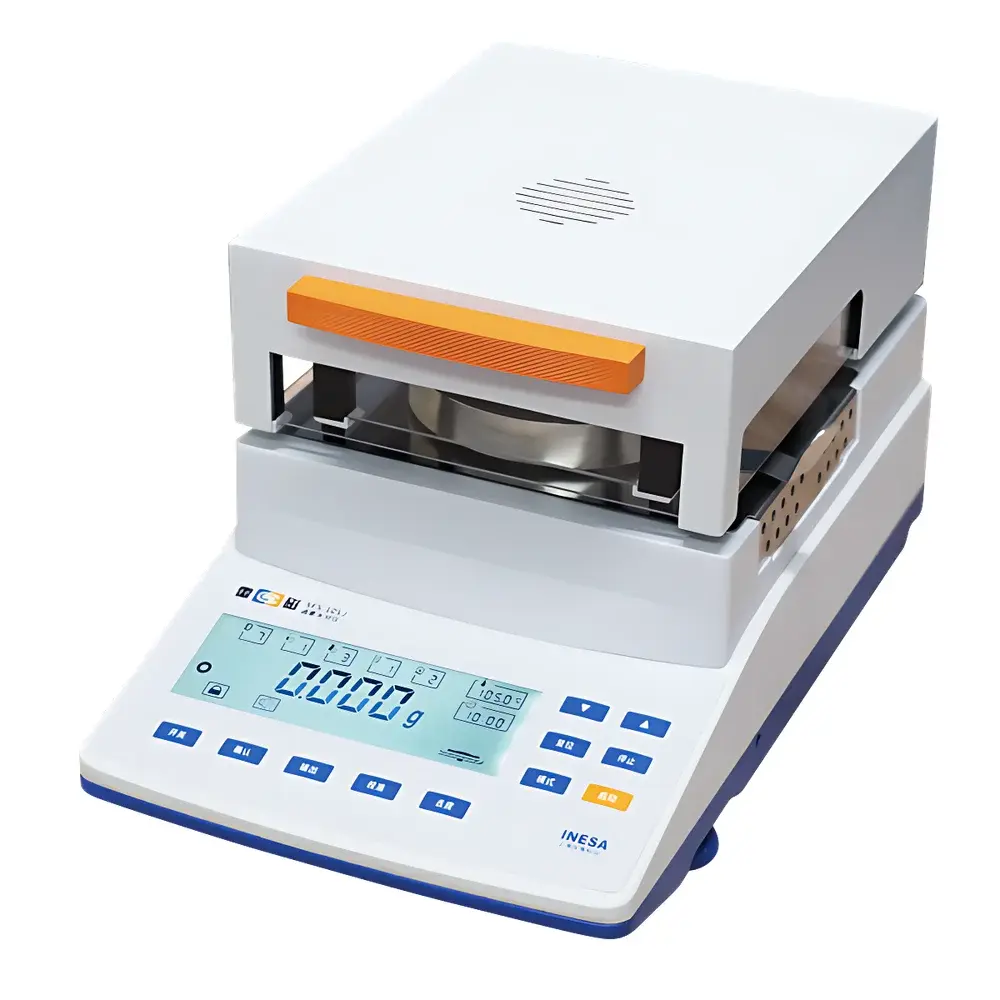
Leichi SFS-105J Halogen Moisture Analyzer
| Brand | Leichi |
|---|---|
| Origin | Shanghai, China |
| Manufacturer Type | Authorized Distributor |
| Country of Origin | China |
| Model | SFS-105J |
| Price | USD 658 (FOB Shanghai) |
| Weighing Range | 0.2 g to 110 g |
| Readability (d) | 5 mg |
| Verification Scale Interval (e) | 10 mg |
| Moisture Readability | 0.02 % |
| Accuracy Class | OIML Class II |
| Minimum Sample Mass | 1 g |
| Heating Source | Circular Halogen Lamp |
| Temperature Control Range | Ambient to 200 °C |
| Sample Pan Diameter | 90 mm |
| Real-time Display | Temperature, Elapsed Heating Time, Dynamic Moisture %, Dry Weight %, ATRO Dry Basis %, ATRO Wet Basis % |
| Drying Modes | Standard, Rapid, and Gradual |
| Endpoint Detection | Auto, Manual, and Semi-Automatic |
| Communication Interface | RS-232 for Thermal Printer Output |
| Power Supply | 220 V ± 10 %, 50/60 Hz |
| Dimensions (W×D×H) | 330 × 200 × 200 mm |
| Net Weight | 5.8 kg |
Overview
The Leichi SFS-105J Halogen Moisture Analyzer is a precision laboratory instrument engineered for rapid, reproducible determination of moisture content in solid and semi-solid materials using loss-on-drying (LOD) methodology. It operates on the principle of controlled thermal dehydration: a high-intensity circular halogen lamp delivers uniform radiant heat across the sample surface, minimizing thermal gradients and ensuring consistent drying kinetics. Unlike infrared or convection-based systems, halogen heating provides faster response time, superior temperature stability, and improved energy efficiency—critical for routine QC testing in pharmaceutical, food, chemical, and polymer laboratories. The instrument complies with fundamental requirements of ASTM D4442, ISO 712, and USP <731> for moisture determination, and its design supports GLP-compliant workflows through traceable calibration, user-accessible diagnostics, and audit-ready operational logs.
Key Features
- High-resolution 4.3-inch TFT LCD display with intuitive icon-driven interface, supporting multilingual menu navigation (English, Spanish, French, Chinese)
- Circular halogen heating system delivering uniform thermal distribution and precise temperature control from ambient to 200 °C in 1 °C increments
- Integrated real-time monitoring of chamber temperature, elapsed heating time, and dynamic moisture loss curve visualization
- Three configurable drying protocols: Standard (optimized for general-purpose analysis), Rapid (for low-moisture, thermally stable matrices), and Gradual (for heat-sensitive or heterogeneous samples)
- Four independent reporting modes: Moisture % (w/w), Dry Weight %, ATRO Dry Basis %, and ATRO Wet Basis % — fully configurable per method
- Three endpoint detection strategies: Fully automatic (based on mass stabilization threshold), manual (user-defined stop time), and semi-automatic (pre-set time + mass drift verification)
- Built-in safety interlocks: Audible and visual alerts for lid-open detection, overtemperature condition, and underweight sample (<1 g)
- RS-232 serial port compliant with standard ESC/POS printer protocols for direct hardcopy output of measurement reports including timestamp, operator ID, and method name
Sample Compatibility & Compliance
The SFS-105J accommodates a broad range of sample types—including powders, granules, pastes, tablets, pellets, and thin films—with minimal preparation. Its 90 mm stainless-steel weighing pan ensures mechanical stability and thermal inertia suitable for both high- and low-mass applications (minimum 1 g recommended). The instrument meets OIML R76-1 Class II accuracy requirements for non-automatic weighing instruments and adheres to ISO/IEC 17025 metrological traceability principles when used with certified reference standards (e.g., sodium tartrate dihydrate). While not intrinsically certified for FDA 21 CFR Part 11 compliance, its firmware architecture supports secure user access levels (admin/operator), electronic signature prompts, and exportable CSV data files—enabling integration into validated LIMS or ELN environments under client-defined SOPs.
Software & Data Management
No proprietary PC software is bundled; however, the SFS-105J outputs ASCII-formatted data streams via RS-232, compatible with third-party laboratory informatics platforms (e.g., LabWare LIMS, Thermo Fisher SampleManager, or custom Python/Node.js parsers). Each measurement record includes: date/time stamp, operator code, method ID, initial mass, final mass, temperature profile summary, moisture result, and status flags (e.g., “ENDPOINT_REACHED”, “LID_OPEN_ABORT”). Internal memory retains up to 100 method configurations and 200 measurement histories, all accessible via front-panel navigation. Calibration routines (linearity, repeatability, eccentricity) follow manufacturer-recommended intervals and are documented in the included calibration logbook template.
Applications
This analyzer is routinely deployed in quality control laboratories for moisture specification testing of active pharmaceutical ingredients (APIs), excipients, and finished dosage forms per ICH Q5C guidelines. In food manufacturing, it verifies compliance with Codex Alimentarius moisture limits for flour, spices, dairy powders, and pet food. Industrial users apply it to monitor drying endpoints in catalyst synthesis, battery electrode coating slurries, and ceramic green bodies. Research labs utilize its programmable ramp-and-hold capability to study desorption isotherms and thermal degradation onset points in hygroscopic polymers and biomaterials.
FAQ
What calibration standards are recommended for daily verification?
Sodium tartrate dihydrate (15.66 % nominal moisture) and anhydrous calcium sulfate are recommended for performance checks at 105 °C and 130 °C, respectively.
Can the SFS-105J be connected to a networked printer or LIMS?
It supports only point-to-point RS-232 communication; Ethernet or Wi-Fi connectivity requires external serial-to-Ethernet converters configured as virtual COM ports.
Is the halogen lamp replaceable by the end user?
Yes—the lamp module is field-replaceable using standard Torx T10 tools; replacement part number is HAL-LAMP-SFS105J.
Does the instrument support method validation per USP <1251>?
It provides the necessary raw data (mass vs. time), repeatability testing capability, and environmental monitoring functions required for validation protocols—but full validation must be executed per site-specific IQ/OQ/PQ procedures.
What is the typical warm-up time before first measurement?
Less than 60 seconds after power-on; however, thermal equilibrium of the weighing cell is achieved within 3 minutes under ambient lab conditions (20–25 °C, <60 % RH).





