
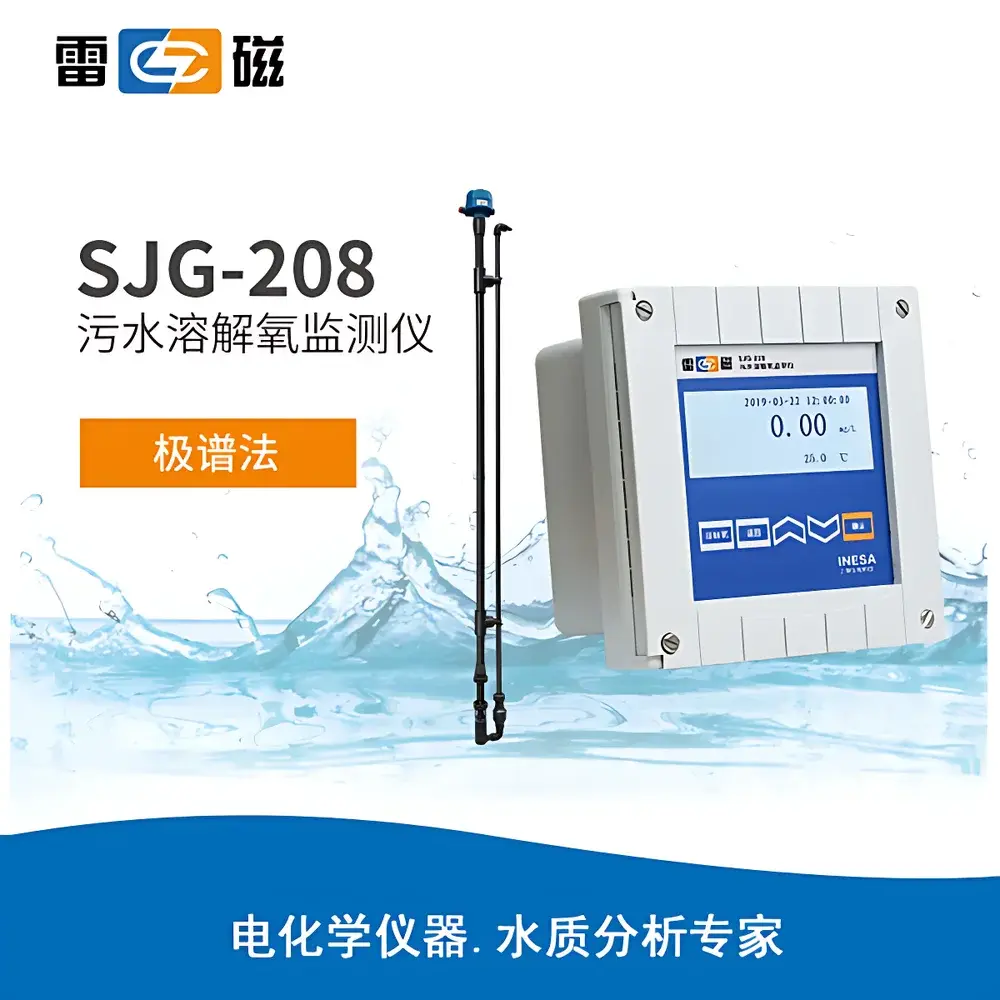
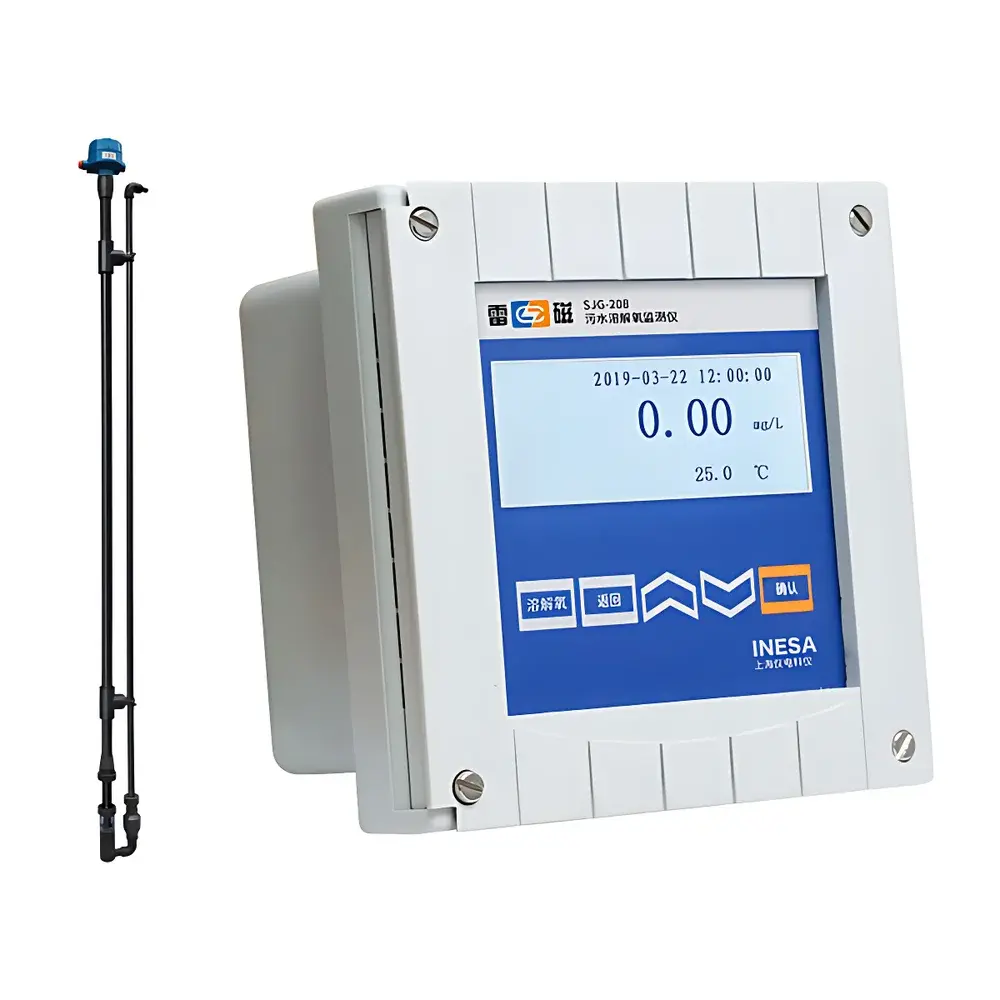
Leichi SJG-208 Online Dissolved Oxygen Monitor
| Brand | Leichi |
|---|---|
| Origin | Shanghai, China |
| Model | SJG-208 |
| Instrument Type | Online DO Monitor |
| Measurement Range | (0.0–20.0) mg/L DO, (0.0–200.0)% saturation |
| Temperature Range | (−10.0–120.0) °C |
| Resolution | 0.01 mg/L (DO), 0.1% (saturation), 0.1 °C (temp) |
| Repeatability | ≤0.20 mg/L |
| Basic Error (Instrument) | ±0.50 mg/L (DO), ±10.0% (saturation), ±1.0 °C (temp) |
| Basic Error (Electronics Unit) | ±0.20 mg/L (DO), ±5.0% (saturation), ±0.3 °C ±1 digit |
| Stability | (±0.20 mg/L)/24 h (instrument), (±0.10 mg/L)/24 h (electronics) |
| T90 Response Time | ≤2 min at 20 °C |
| Output | Isolated 4–20 mA DC (configurable upper/lower limits), RS-232 or RS-485 (user-selectable) |
| Relay Outputs | 4 programmable control relays |
| Data Storage | 400 measurement records |
| Calibration | Zero-oxygen and full-scale calibration supported |
| Enclosure Rating | IP65 |
| Power Supply | AC (220 ± 22) V, (50 ± 0.5) Hz |
| Dimensions | 144 × 144 × 160 mm |
| Weight | 2.5 kg |
Overview
The Leichi SJG-208 Online Dissolved Oxygen Monitor is an industrial-grade, wall-mountable process analyzer engineered for continuous, real-time measurement of dissolved oxygen (DO) concentration and saturation in aqueous environments. It operates on the principle of electrochemical amperometric detection using a polarographic Clark-type sensor (sensor not included; compatible with standard 12-mm threaded DO probes). The instrument integrates a microprocessor-controlled electronics unit with built-in temperature compensation and pressure-aware calibration logic to ensure stable, traceable measurements across dynamic operational conditions—particularly critical in wastewater treatment processes where DO levels directly govern nitrification efficiency and energy consumption in aeration basins. Designed for unattended 24/7 operation, the SJG-208 meets fundamental requirements for regulatory compliance in municipal and industrial effluent monitoring, including alignment with ISO 5814:2012 (water quality — determination of dissolved oxygen — electrochemical probe method) and supports data integrity practices consistent with GLP and basic GMP environmental monitoring frameworks.
Key Features
- High-contrast dot-matrix LCD display showing simultaneous real-time readings of DO concentration (mg/L), DO saturation (%), and temperature (°C)
- Integrated microprocessor with embedded firmware for precise signal conditioning, linearization, and drift correction
- Dual-point calibration support: zero-oxygen (e.g., sodium sulfite solution) and air-saturated water (full-scale) calibration routines
- Automatic temperature compensation (ATC) across −10.0 to 120.0 °C, plus manual barometric pressure input for altitude- or weather-adjusted saturation calculations
- Non-volatile memory storing up to 400 timestamped measurement records with retrieval via front-panel navigation
- Four independent programmable relay outputs enabling direct integration with aeration blowers, alarm panels, or automatic probe cleaning systems
- Isolated 4–20 mA analog output with user-configurable scaling—supports connection to DCS, PLC, or SCADA systems without external signal isolators
- Standard serial communication interface: selectable RS-232 or RS-485 (Modbus RTU protocol support recommended for system integration)
- Robust IP65-rated enclosure suitable for indoor control room mounting or protected outdoor enclosures near process piping
Sample Compatibility & Compliance
The SJG-208 is intended for use with standard membrane-covered polarographic DO sensors (e.g., Leichi DO-958 series or equivalent 12-mm thread sensors). It is validated for continuous monitoring in municipal wastewater streams, activated sludge basins, oxidation ditches, and secondary clarifiers. While not certified for hazardous area installation (e.g., ATEX or IECEx), its design conforms to IEC 61000-6-2 (immunity) and IEC 61000-6-4 (emissions) for industrial environments. The instrument supports routine verification per ASTM D888-22 (Standard Test Methods for Dissolved Oxygen in Water), and its documented repeatability (≤0.20 mg/L) and stability specifications align with QA/QC expectations for Class II environmental monitoring per US EPA guidance for wastewater treatment plant reporting.
Software & Data Management
The SJG-208 operates as a standalone field transmitter without proprietary PC software. All configuration—including calibration constants, relay thresholds, alarm hysteresis, output scaling, and date/time settings—is performed locally via intuitive keypad navigation. Measurement data are stored in non-volatile memory with time stamps (year/month/day/hour/minute); no external database or cloud upload capability is provided. For audit-trail requirements under FDA 21 CFR Part 11 or ISO/IEC 17025, users must implement external logging via the 4–20 mA output or Modbus interface connected to validated historian systems. The device does not feature electronic signature, user role management, or encrypted data storage—thus suited for applications where basic operational continuity and local alarm response are prioritized over full digital compliance documentation.
Applications
- Real-time DO control in activated sludge aeration tanks to optimize blower energy use and maintain nitrification kinetics
- Process monitoring in sequencing batch reactors (SBRs) and membrane bioreactors (MBRs)
- Intake and effluent monitoring at municipal wastewater treatment plants (WWTPs) for regulatory discharge reporting
- Source water quality surveillance at drinking water intake stations, especially during algal bloom events
- Environmental monitoring in aquaculture facilities where hypoxia risk demands rapid DO trend detection
- Industrial cooling tower water management to assess corrosion potential and biocide dosing efficacy
FAQ
Does the SJG-208 include a dissolved oxygen sensor?
No—the SJG-208 is a dedicated transmitter/controller unit only. A compatible polarographic DO sensor (e.g., Leichi DO-958 or third-party 12-mm threaded probe) must be purchased separately and installed in-line or immersed in the sample stream.
Can the device perform automatic temperature compensation without external input?
Yes—integrated Pt1000 or thermistor-based temperature sensing is built into the electronics unit. Automatic compensation applies across the full −10.0 to 120.0 °C range using NIST-traceable polynomial algorithms.
Is Modbus communication natively supported?
The RS-485 interface supports Modbus RTU protocol when configured via DIP switches or menu settings; register maps and command syntax are documented in the English-language technical manual supplied with the unit.
What is the maximum cable length between the transmitter and the DO sensor?
For optimal signal integrity with standard shielded twisted-pair cable, the recommended maximum distance is 30 meters. Longer runs require low-noise cabling and may necessitate signal conditioning per manufacturer guidelines.
How frequently should calibration be performed in continuous wastewater monitoring?
Best practice recommends daily zero-point verification and weekly two-point calibration (zero + air-saturation) in high-fouling environments; intervals may extend to biweekly in clean-water applications, contingent upon documented performance validation per internal SOPs.
Related Products







