
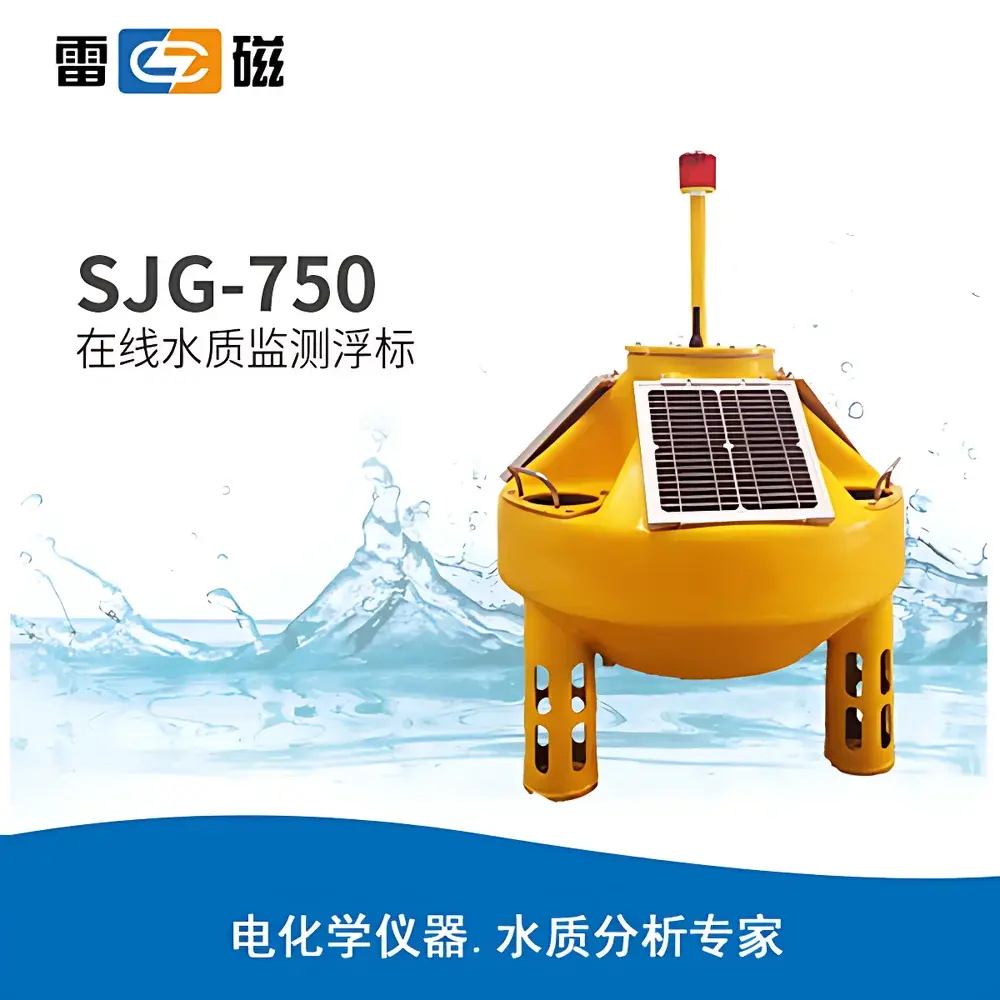
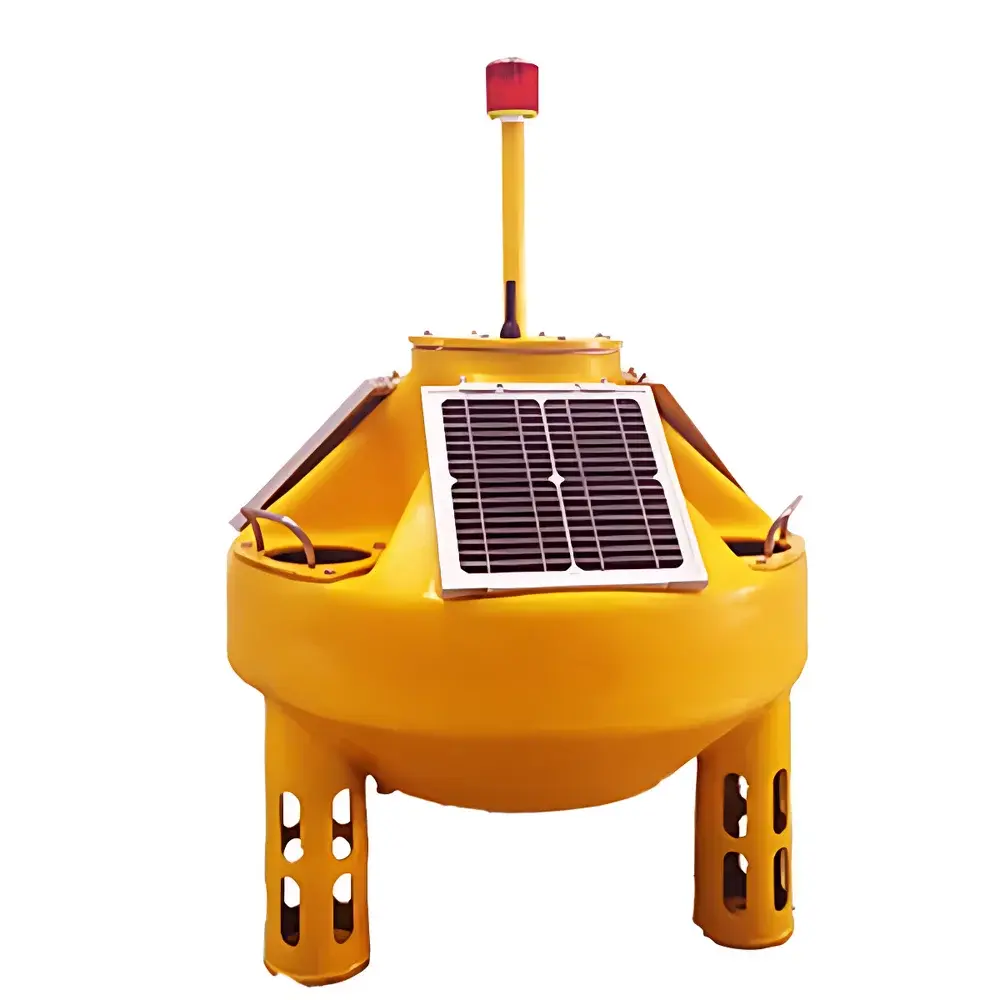
Leichi SJG-750 In-Situ Surface Water Quality Monitoring Buoy
| Brand | Leichi |
|---|---|
| Origin | Shanghai, China |
| Manufacturer Type | Authorized Distributor |
| Country of Origin | China |
| Model | SJG-750 |
| Pricing | Available Upon Request |
| pH Range | 0–14 pH, Resolution: 0.01 pH, Accuracy: ±0.05 pH ±1 digit |
| Conductivity Range | 0–200.0 mS/cm, Accuracy: ±1.5% FS |
| Dissolved Oxygen Range | 0.00–20.00 mg/L, Resolution: 0.01 mg/L, Sensor Error: ±0.2 mg/L |
| Turbidity Range | 0–1000 NTU, Resolution: 0.1 NTU, Linearity Error: ±5% |
| Temperature Range | 0.0–60.0 °C, Resolution: 0.1 °C, Accuracy: ±0.5 °C ±1 digit |
| Power Supply | AC 220 V ±10%, 50 Hz ±2% |
| Dimensions | 285 × 205 × 97 mm, Weight: 3 kg |
Overview
The Leichi SJG-750 In-Situ Surface Water Quality Monitoring Buoy is an autonomous, solar-ready, multi-parameter water quality monitoring platform engineered for long-term deployment on rivers, lakes, reservoirs, and estuarine environments. Designed around a robust buoyant housing with marine-grade corrosion resistance, the system operates continuously without requiring shoreline infrastructure or permanent civil works. It employs electrochemical (pH, conductivity, dissolved oxygen) and optical (turbidity) sensing principles—each sensor calibrated per ISO 7027 (turbidity), ISO 5667-22 (field measurement protocols), and ASTM D1293 (pH in natural waters)—to deliver traceable, field-validated data. Unlike reagent-based analyzers, the SJG-750 utilizes maintenance-free, membrane-covered amperometric DO sensors, solid-state pH electrodes, and digital conductivity cells—eliminating chemical consumption, waste generation, and associated regulatory reporting burdens. Its embedded microcontroller synchronizes all measurements at user-defined intervals (1 min to 24 h), ensuring temporal coherence across parameters critical for trend analysis and early anomaly detection.
Key Features
- Floating buoy architecture with low-drag hydrodynamic profile—enables stable station-keeping in currents up to 1.5 m/s without anchoring hardware.
- Modular sensor tray design: supports interchangeable probe modules for pH, conductivity, DO, turbidity, and temperature—allowing configuration optimization per site-specific regulatory requirements (e.g., EPA Method 180.1 for turbidity, APHA 4500-DO B for dissolved oxygen).
- Integrated LoRaWAN® and optional 4G LTE-M wireless telemetry—transmits encrypted sensor data, diagnostic logs, and battery status to cloud platforms via TLS 1.2; supports MQTT and RESTful API integration with SCADA and EMS systems.
- Automatic ultrasonic probe cleaning cycle (configurable frequency)—reduces biofouling impact on optical and electrochemical surfaces, extending calibration stability to ≥90 days under typical inland water conditions.
- Dual-power architecture: rechargeable lithium iron phosphate (LiFePO₄) battery (12 Ah nominal) provides ≥6 months autonomy at 15-min sampling; optional monocrystalline solar panel (10 W) enables indefinite operation in >2.5 kWh/m²/day insolation zones.
- Zero-reagent operation—complies with ISO 14001 environmental management criteria and avoids hazardous substance handling per EU REACH Annex XVII.
- Compact footprint (285 × 205 × 97 mm) and lightweight construction (3 kg dry weight)—facilitates rapid deployment by single technician using inflatable boat or drone-assisted placement.
Sample Compatibility & Compliance
The SJG-750 is validated for continuous immersion in freshwater, brackish water, and low-salinity estuarine matrices (≤15 ppt). All wetted materials—including POM housing, EPDM O-rings, and Pt1000 temperature elements—meet NSF/ANSI Standard 61 for drinking water system components. Sensor outputs conform to IEC 61290-1 for electrical safety in outdoor environments and IP68 ingress protection (submersible to 5 m for 72 h). Data integrity meets GLP audit requirements through onboard time-stamped logging (RTC with ±2 s/month drift), cyclic redundancy check (CRC-32) validation, and non-volatile memory retention (>10 years at 25 °C). Firmware complies with IEC 62443-3-3 SL2 for secure device development lifecycle.
Software & Data Management
Leichi AquaLink™ Desktop Suite (v3.2+) and Cloud Dashboard provide end-to-end data governance. The software enables remote firmware updates, sensor calibration certificate import (NIST-traceable reference standards), and automated report generation aligned with China’s HJ/T 91–2019 surface water monitoring guidelines and EU WFD Annex V QA/QC templates. Audit trails record every configuration change, calibration event, and data transmission attempt—supporting FDA 21 CFR Part 11 electronic record compliance when deployed in regulated watershed stewardship programs. Raw CSV and NetCDF exports include metadata headers compliant with IOOS CDL conventions.
Applications
- Real-time compliance monitoring for municipal wastewater discharge points under local environmental protection bureau mandates.
- Early warning detection of algal bloom precursors via coordinated pH–DO–turbidity deviation thresholds.
- Long-term trend analysis for climate-driven shifts in river thermal regimes and baseflow conductivity.
- Supporting ISO 5667-3-compliant sampling campaign planning through spatial-temporal gap identification.
- Calibration verification for fixed-station laboratory analyzers using co-located buoy data as field reference.
FAQ
What is the recommended recalibration interval for field-deployed units?
For regulatory-grade reporting, perform two-point pH and DO calibration and conductivity standard verification every 90 days; turbidity zero-check with deionized water weekly.
Can the buoy operate in tidal zones with salinity fluctuations?
Yes—conductivity cell auto-range switching and temperature-compensated DO algorithms maintain accuracy across 0–15 ppt salinity; however, turbidity compensation requires site-specific suspended solids correlation curves.
Is raw sensor output accessible via Modbus RTU?
No—serial interface is reserved for diagnostics only; all operational data is exposed exclusively via encrypted wireless protocols to ensure cybersecurity compliance.
Does the system support external auxiliary sensors (e.g., nitrate, chlorophyll)?
Not natively—the current hardware architecture reserves analog/digital I/O for internal diagnostics only; future firmware releases may enable CAN bus expansion for third-party OEM modules.
How is data timestamp accuracy maintained during extended GPS signal loss?
Onboard high-stability TCXO (±0.5 ppm) maintains sub-second timekeeping for ≥72 h without GPS lock; full synchronization resumes automatically upon signal reacquisition.
Related Products







