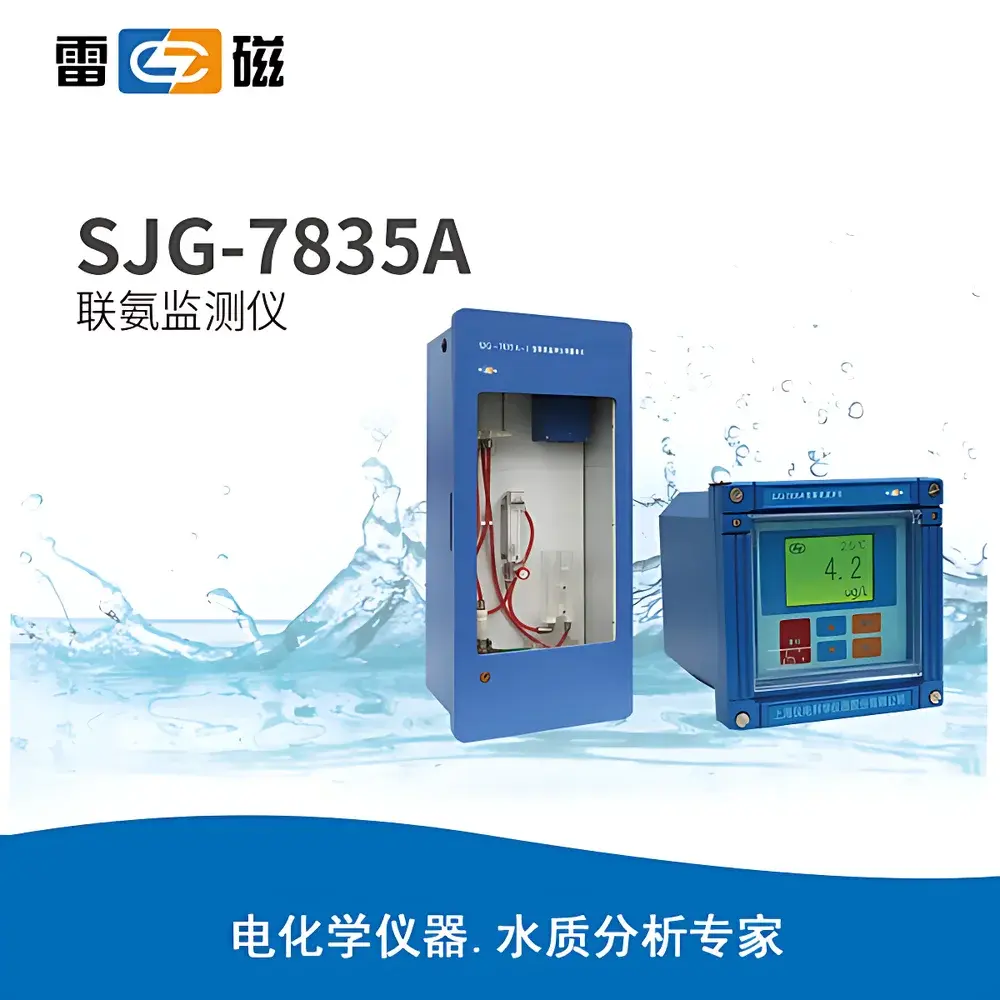
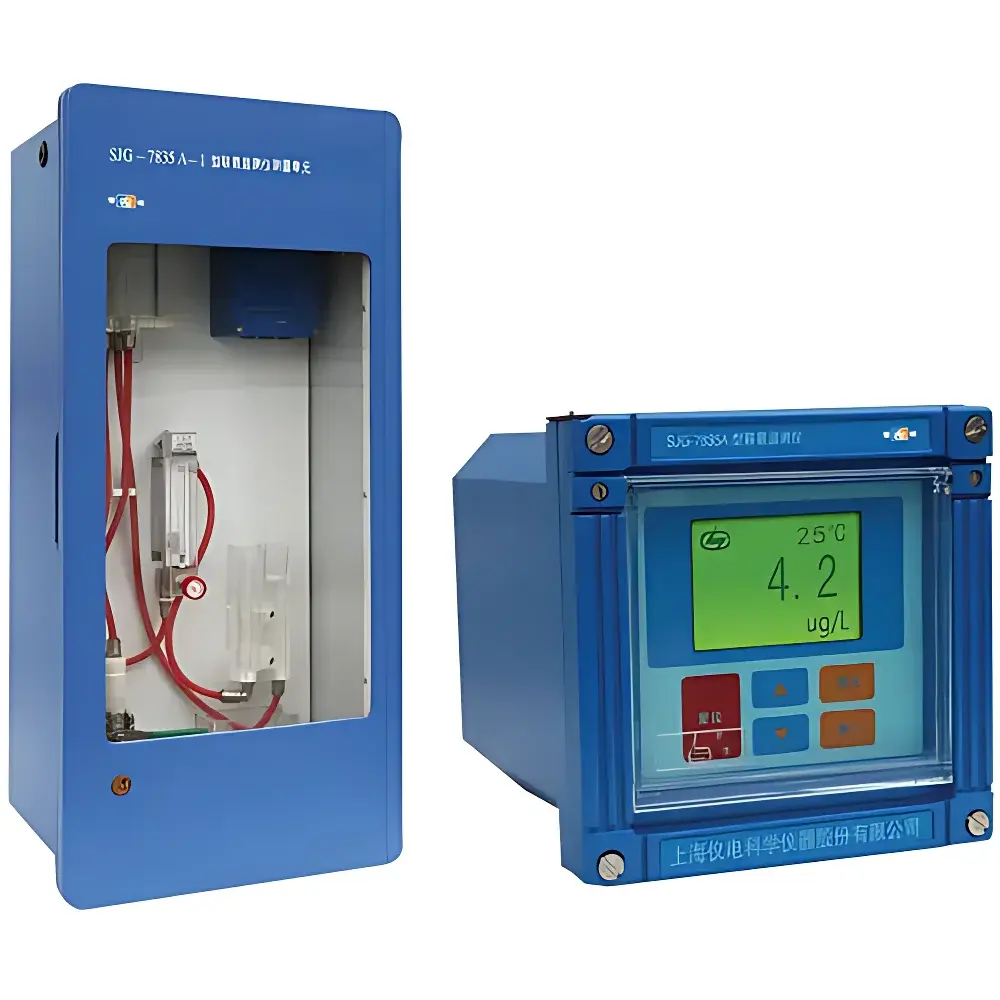
Leichi SJG-7835A Hydrazine Online Monitor
| Brand | Leichi |
|---|---|
| Model | SJG-7835A |
| Measurement Range | N₂H₄ (0–199.9) µg/L |
| Temperature | (−10.0–120.0) °C |
| Resolution | N₂H₄ 0.1 µg/L |
| Basic Instrument Error | N₂H₄ ±5.0 µg/L |
| Electronic Unit Error | N₂H₄ ±2.0 µg/L |
| Repeatability | ≤2.5 µg/L |
| Stability | (±2.0 µg/L)/24 h |
| 90% Response Time | 3 min |
| Enclosure Rating | IP65 |
| Power Supply | AC (220 ± 22) V, (50 ± 0.5) Hz |
| Dimensions & Weight | Electronics Unit 144 × 144 × 150 mm, 2 kg |
| Output | Isolated 4–20 mA DC (user-configurable span) |
| Auto Temperature Compensation | Yes |
| Alarm Functions | Adjustable high/low limit alarms with latching |
Overview
The Leichi SJG-7835A Hydrazine Online Monitor is a dedicated electrochemical process analyzer engineered for continuous, real-time measurement of hydrazine (N₂H₄) concentration in high-purity water streams—specifically targeting boiler feedwater systems in fossil-fueled power generation facilities. It operates on the principle of amperometric detection using a selective membrane-covered sensor, where hydrazine diffuses through a gas-permeable membrane and undergoes oxidation at a working electrode under controlled potential. The resulting current is linearly proportional to dissolved hydrazine concentration in the (0–199.9) µg/L range. Integrated temperature sensing enables automatic compensation based on the Arrhenius-type dependence of electrode kinetics and diffusion coefficients, ensuring measurement integrity across operational temperatures from −10.0 °C to 120.0 °C. Designed for integration into distributed control systems (DCS) and programmable logic controllers (PLC), the SJG-7835A supports closed-loop chemical dosing control to maintain optimal oxygen scavenging without overfeed—a critical requirement for minimizing corrosion in high-pressure steam cycles and complying with ASTM D4688 and IAPWS guidelines for boiler water chemistry.
Key Features
- Microcontroller-based embedded architecture with intuitive Chinese-language menu interface—optimized for plant technician operation without specialized training
- Simultaneous dual-parameter display: hydrazine concentration (µg/L) and process temperature (°C) on a backlit LCD screen
- Automatic temperature compensation algorithm compliant with NIST-traceable thermal response models for aqueous hydrazine solutions
- Configurable high/low concentration alarm thresholds with visual indicators and relay dry-contact outputs for interlock integration
- Non-volatile memory with power-loss retention ensures parameter settings and last-measured values persist after mains interruption
- Isolated 4–20 mA analog output with fully adjustable zero/span calibration—supports connection to legacy DCS analog input cards without signal conditioning
- Selectable digital communication interface: either RS-232 (for local configuration and diagnostics) or RS-485 (for multi-drop Modbus RTU networks up to 1,200 m)
- IP65-rated enclosure for electronics unit and sensor housing—certified for indoor panel mounting or outdoor sheltered installation per IEC 60529
Sample Compatibility & Compliance
The SJG-7835A is validated for use in ultrapure water matrices with conductivity < 0.2 µS/cm and silica < 20 µg/L—typical of deaerated, mixed-bed polished boiler feedwater. It exhibits minimal interference from common co-occurring species including dissolved oxygen (< 10 µg/L), ammonia (< 1 mg/L), and residual chloride (< 5 µg/L), as confirmed by interference testing per ISO 15195:2018 Annex B. While not certified to IEC 61508 SIL levels, its fault-detection logic, watchdog timer, and hardware redundancy in critical signal paths support use in safety-related monitoring loops when integrated with external SIS. The instrument meets CE marking requirements for EMC Directive 2014/30/EU and Low Voltage Directive 2014/35/EU. Its measurement methodology aligns with the technical basis of ASTM D129-19 (Standard Test Method for Sulfur in Petroleum Products) adapted for hydrazine via amperometric endpoint validation.
Software & Data Management
Configuration and diagnostics are performed locally via front-panel keypad or remotely using Leichi’s proprietary PC-based utility (Windows 10/11 compatible), which logs timestamped measurements, alarm events, and calibration history in CSV format. The software enforces audit-trail functionality—including user ID tagging, change timestamps, and immutable record retention—for alignment with GLP documentation practices. Though not natively 21 CFR Part 11 compliant, the system supports integration with third-party SCADA platforms that provide electronic signature, role-based access control, and secure data archiving—enabling compliance in regulated utility environments subject to ISO 55001 or NERC CIP standards.
Applications
- Continuous hydrazine monitoring in drum-type and once-through boiler feedwater systems to optimize reductant dosing and prevent under-dosing (risk of oxygen pitting) or over-dosing (risk of carburization and copper alloy degradation)
- Commissioning and performance verification of hydrazine injection skids during plant start-up and post-maintenance outages
- Trend analysis of deaerator efficiency and condensate polishing system integrity through long-term hydrazine residual profiling
- Supporting chemistry control programs aligned with EPRI TR-102220 and IAPWS RP-7 guidelines for cycle chemistry monitoring
- Integration into automated water treatment dashboards for predictive maintenance of feedwater heaters and economizers
FAQ
What is the recommended calibration frequency for the SJG-7835A in continuous operation?
Calibration is advised every 7 days under stable operating conditions, or immediately following sensor cleaning, membrane replacement, or any observed drift exceeding ±3 µg/L against a traceable standard solution prepared per ASTM D1129.
Can the sensor be installed in-line or only in bypass configurations?
The measurement cell is rated for direct in-line installation at flow velocities ≤ 1.5 m/s and pressures ≤ 10 MPa; however, a bypass loop with laminar flow regulator is recommended to ensure consistent residence time and minimize particulate fouling.
Does the instrument support Modbus TCP/IP or only serial protocols?
No. The SJG-7835A provides RS-232 or RS-485 physical layers only; Modbus TCP/IP requires an external protocol converter or gateway device.
Is the temperature sensor Pt100 or thermistor-based?
It employs a Class B platinum resistance thermometer (Pt100) conforming to IEC 60751, embedded within the flow cell body adjacent to the hydrazine sensing element.
What maintenance tasks require trained personnel versus routine operator intervention?
Membrane replacement, electrolyte refill, and zero/span calibration require certified field service technicians; daily verification of alarm status, analog output verification, and cleaning of the sensor housing exterior may be performed by qualified plant operators.
Related Products