
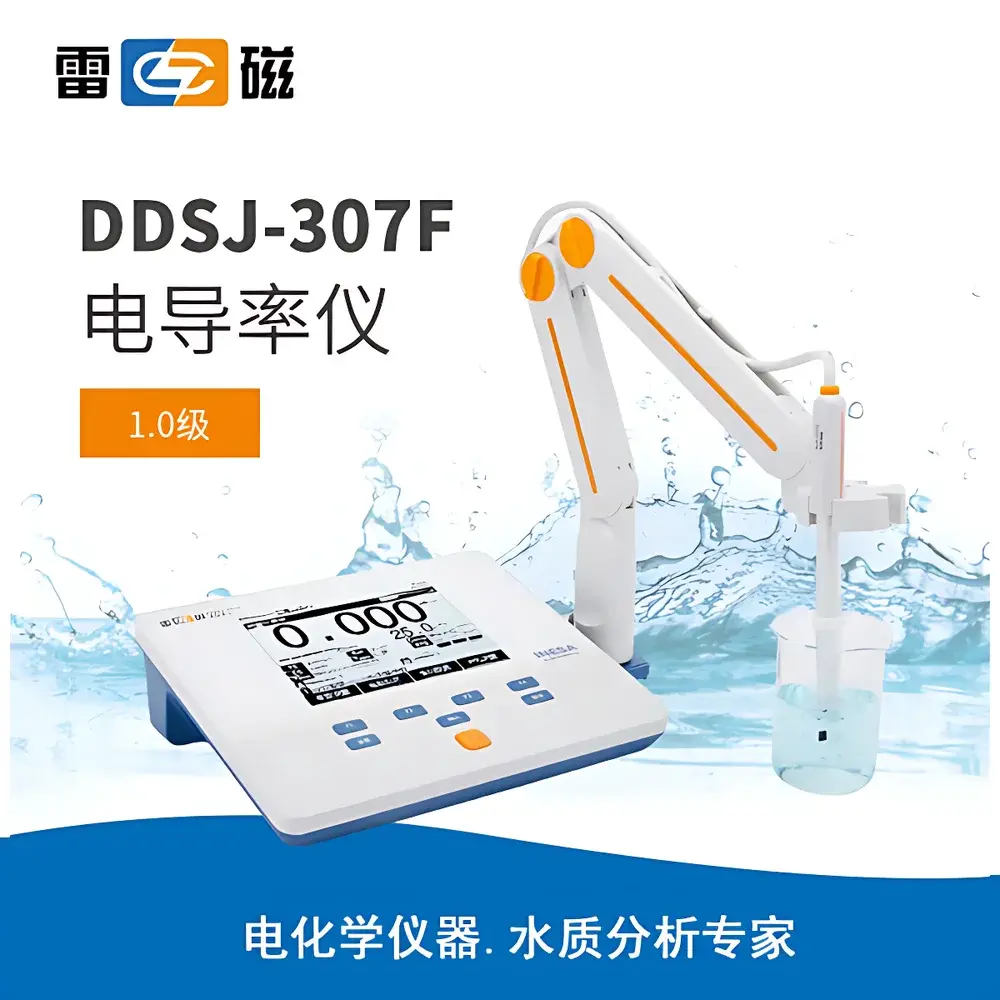
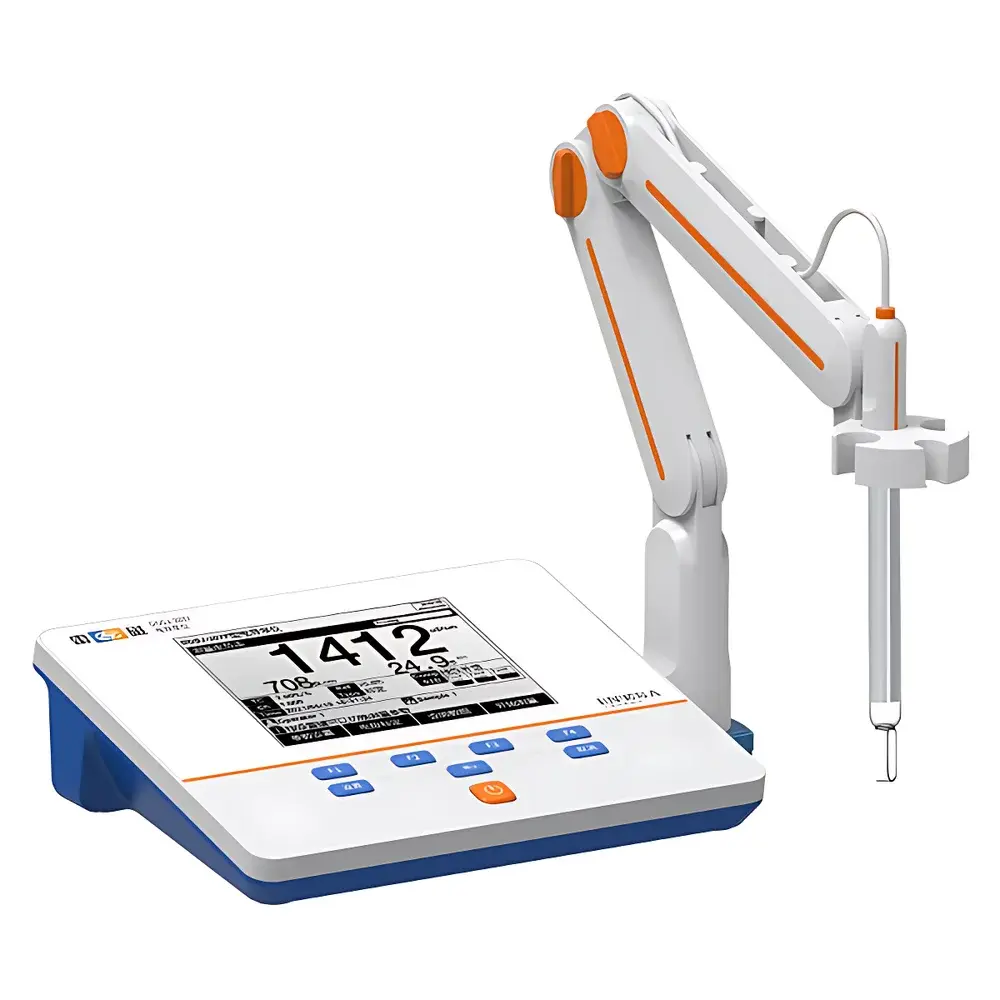
Leici DDSJ-307F Benchtop Conductivity Meter
| Brand | Leici |
|---|---|
| Origin | Shanghai, China |
| Model | DDSJ-307F |
| Instrument Class | 1.0 |
| Measurement Parameters | Conductivity, Resistivity, TDS, Salinity, Temperature |
| Conductivity Range | 0.000 µS/cm to 1000 mS/cm |
| TDS Range | 0.00 mg/L to 300 g/L |
| Resistivity Range | 5.00 Ω·cm to 20.00 MΩ·cm |
| Salinity Range | (0.00–8.00)% |
| Temperature Range | (−5.0–110.0) °C / (23.0–230.0) °F |
| Minimum Conductivity Resolution | 0.001 µS/cm (auto-ranging) |
| Temperature Resolution | 0.1 °C / 0.1 °F |
| Conductivity Accuracy | ±1.0% FS |
| Temperature Accuracy | ±0.2 °C |
| Input Power | AC 100–240 V → DC 9 V |
| Dimensions | 242 × 195 × 68 mm |
| Weight | 0.9 kg |
| Protection Rating | IP54 |
| Data Storage | 500 datasets per parameter |
| Interface | RS-232, USB |
| Compliance | GLP-compliant data logging with audit trail support |
Overview
The Leici DDSJ-307F is a high-precision benchtop conductivity meter engineered for routine and quality-critical electrochemical analysis in regulated laboratory environments. It operates on the principle of two-electrode or four-electrode conductometric measurement—applying an alternating current (AC) voltage across a pair of inert electrodes immersed in solution and measuring the resulting current to determine electrical conductivity. This fundamental parameter serves as a direct indicator of total dissolved ionic concentration, enabling rapid assessment of water purity, electrolyte strength, process stream consistency, and formulation integrity. The instrument supports simultaneous quantification of derived parameters—including resistivity, total dissolved solids (TDS), and salinity—each calculated using standardized conversion algorithms aligned with ISO 7888 and ASTM D1125 conventions. Its dual-temperature scale (°C/°F), selectable reference temperatures (20 °C or 25 °C), and multiple compensation models (non-compensated, linear, and pure-water modes) ensure traceable, application-specific reporting across diverse sample matrices—from ultrapure water to concentrated brines.
Key Features
- High-resolution graphical LCD display with intuitive icon-based navigation and real-time parameter overlay
- Auto-ranging conductivity detection with 0.001 µS/cm minimum resolution at low ranges and seamless switching across seven decades (0.000 µS/cm to 1000 mS/cm)
- Intelligent endpoint detection: supports auto-read, timed-read, interval-read, and manual acquisition modes
- Multi-mode temperature compensation: user-selectable linear coefficient (α = 0.020–0.025/°C), pure-water mode (non-linear, ISO 7888 Annex B), or no compensation
- Automatic recognition of four standard GB/T 6682-grade KCl calibration solutions (e.g., 1413 µS/cm, 12.88 mS/cm); up to three-point electrode calibration with slope and offset validation
- IP54-rated enclosure for dust resistance and limited water ingress protection—suitable for general lab benches near sinks or humidified zones
- Firmware-upgradable architecture via USB; field-deployable configuration updates and feature enhancements without hardware modification
Sample Compatibility & Compliance
The DDSJ-307F accommodates aqueous samples spanning deionized water (≥5 MΩ·cm), pharmaceutical buffers, wastewater effluents, seawater analogs, and industrial cleaning solutions. Its integrated electrode holder accepts standard DIN-type conductivity cells with cell constants of 0.01, 0.1, or 1.0 cm⁻¹—enabling optimized sensitivity for ultra-low-conductivity applications (e.g., USP purified water testing) or high-salt media. All measurements adhere to Good Laboratory Practice (GLP) requirements: each stored record includes timestamp, operator ID (user-definable), electrode ID, calibration history, temperature, and environmental conditions. Audit trails are preserved locally and exportable in CSV format, satisfying internal QA protocols and preparatory documentation for ISO/IEC 17025 accreditation or FDA 21 CFR Part 11 readiness (when paired with validated PC software).
Software & Data Management
- Onboard storage capacity: 500 entries each for conductivity, resistivity, TDS, salinity, and temperature—with searchable indexing by date, parameter, or batch ID
- RS-232 interface supports direct connection to serial printers; configurable print templates include header metadata, raw values, units, and calibration status flags
- USB port enables bidirectional communication with Windows-based Leici LabLink software for secure data export, trend visualization, statistical summary (mean, SD, RSD), and PDF report generation
- Exported datasets retain full GLP context: calibration certificates, electrode drift logs, and system diagnostic snapshots (e.g., self-test results upon power-on)
- No cloud dependency: all data remains under user control; no telemetry, remote access, or third-party hosting
Applications
This instrument is routinely deployed in environmental monitoring labs for surface water profiling and wastewater compliance testing (e.g., EPA Method 120.1); in pharmaceutical QC laboratories for USP water conductivity verification and cleaning validation; in food & beverage facilities for brine concentration control and CIP rinse monitoring; and in academic research for electrolyte characterization in battery material development. Its wide dynamic range eliminates the need for multiple dedicated meters—reducing capital expenditure and cross-contamination risk during multi-sample workflows. When used with a 0.01 cm⁻¹ cell, it meets the sensitivity threshold for pharmacopeial purified water testing (≤1.3 µS/cm at 25 °C). With a 1.0 cm⁻¹ cell and automatic frequency switching, it maintains accuracy across high-conductivity regimes typical of electroplating baths or desalination reject streams.
FAQ
Does the DDSJ-307F support ASTM D1125-compliant TDS calculation?
Yes—it applies the default 0.64–0.71 conversion factor range per ASTM D1125, with user-adjustable coefficients for matrix-specific calibration.
Can I use non-Leici conductivity electrodes with this meter?
Yes, provided they conform to DIN 19263 or ASTM D1125 physical and electrical specifications (BNC or DIN connector, impedance <100 kΩ, compatible cell constant range).
Is the temperature sensor integrated into the conductivity electrode or separate?
The standard supplied composite electrode integrates a Pt1000 thermistor; optional separate temperature probes (e.g., for immersion in viscous or particulate-laden samples) are supported via the auxiliary input.
What happens during a power interruption?
Built-in capacitor-based power-loss protection retains calibration settings, user preferences, and unsaved measurements for up to 10 seconds—allowing graceful shutdown and recovery without data corruption.
How often should I calibrate the instrument?
Daily calibration is recommended for GMP-regulated environments; weekly calibration suffices for routine academic or environmental screening—always before first use and after electrode cleaning or replacement.




