
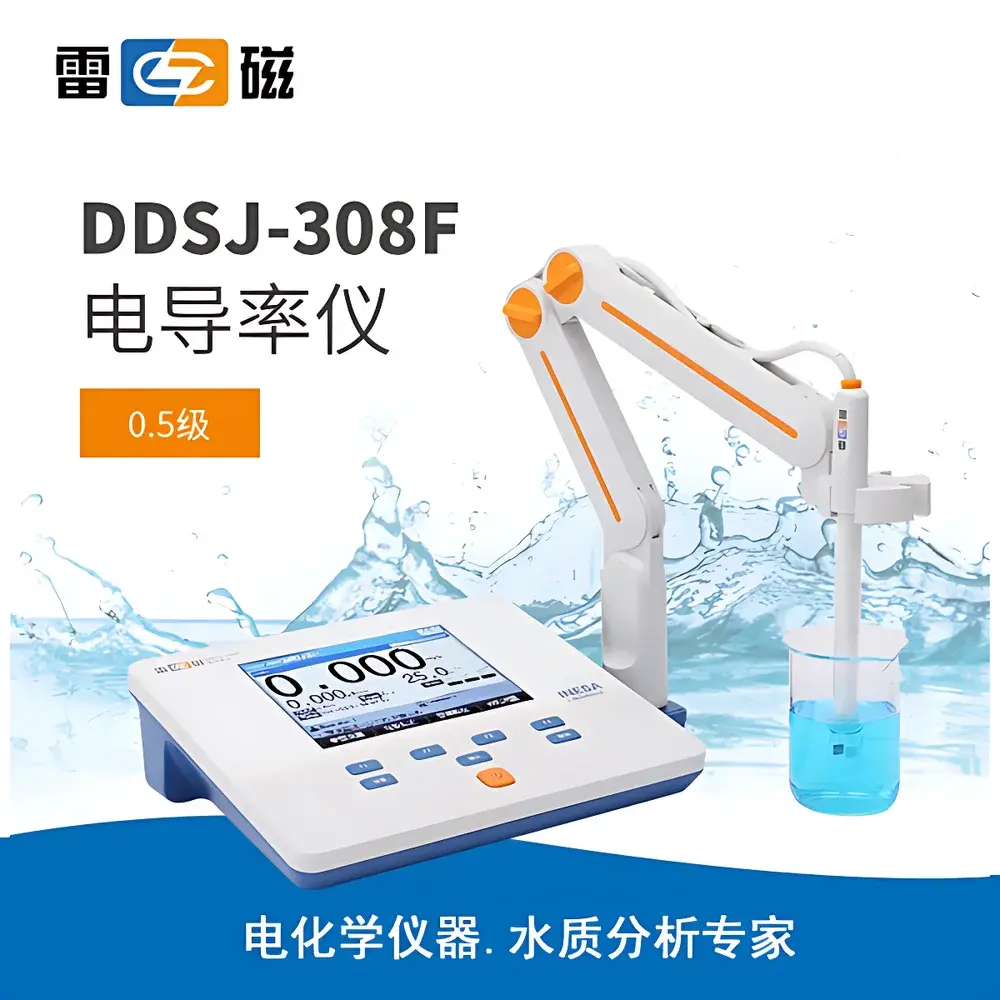
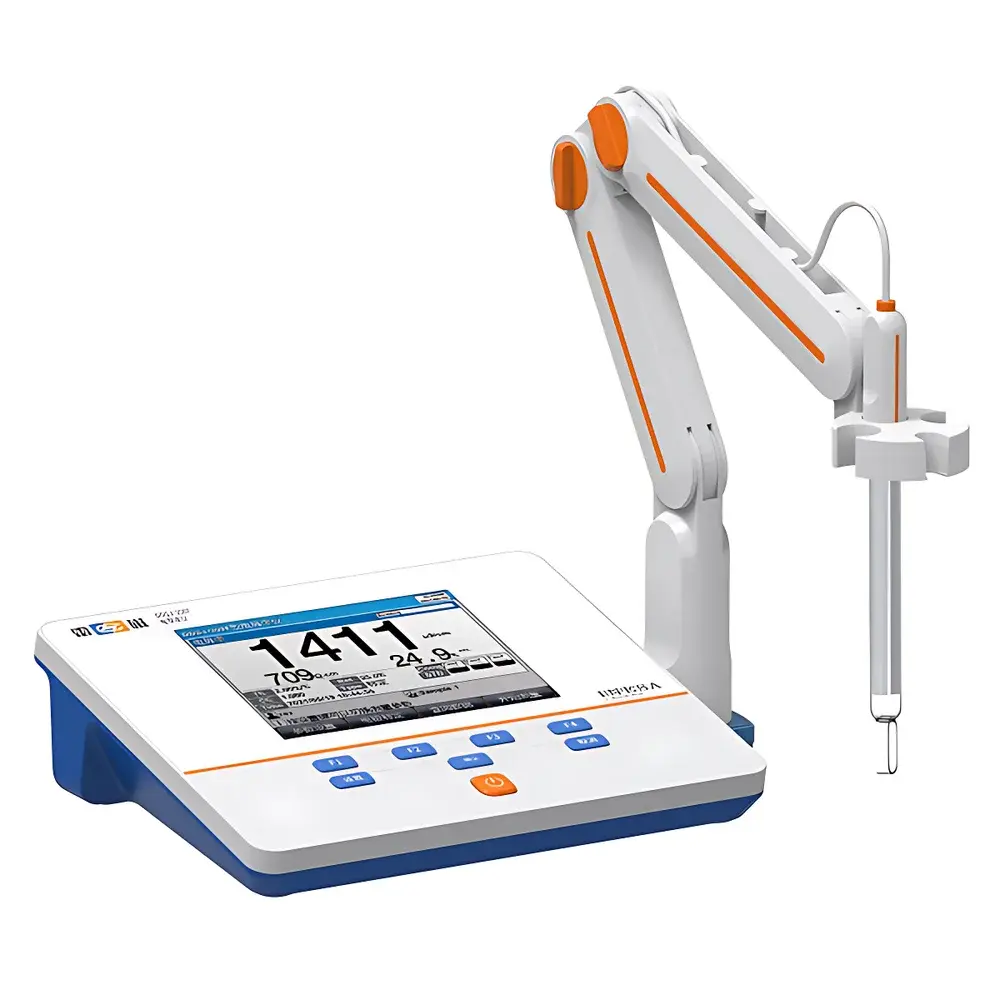
Leici DDSJ-308F Benchtop Conductivity Meter
| Key | Brand: Leici |
|---|---|
| Origin | Shanghai, China |
| Model | DDSJ-308F |
| Form Factor | Benchtop |
| Application | Laboratory |
| Conductivity Range | 0.000 µS/cm to 1000 mS/cm |
| TDS Range | 0.000 mg/L to 1000 g/L |
| Resistivity Range | 5.00 Ω·cm to 100.00 MΩ·cm |
| Salinity Range | 0.00–8.00 % |
| Temperature Range | −10.0 to 135.0 °C |
| Accuracy | ±0.5% FS (conductivity/resistivity/TDS), ±0.1% FS (salinity), ±0.1 °C (temperature) |
| Resolution | 0.001 µS/cm (conductivity), 0.01 Ω·cm (resistivity), 0.001 mg/L (TDS), 0.01% (salinity), 0.1 °C/°F (temperature) |
| Compensation Modes | Non-compensated, Linear, Pure Water |
| Auto-Calibration | Supports 1–3 point calibration with automatic recognition of four GB-standard conductivity solutions |
| Interface | RS-232, USB |
| Data Storage | 500 sets per parameter |
| Compliance | GLP-compliant data logging with audit trail support |
| Enclosure Rating | IP54 |
| Power | DC 9 V (AC 100–240 V input adapter) |
| Dimensions | 242 × 195 × 68 mm |
| Weight | 0.9 kg |
Overview
The Leici DDSJ-308F Benchtop Conductivity Meter is a high-precision, multi-parameter electrochemical analyzer engineered for routine and regulatory laboratory environments. It operates on the principle of two-electrode or four-electrode conductometric measurement—applying an alternating current across a conductive cell to determine solution conductivity based on Ohm’s law and cell constant correction. Designed to meet ISO/IEC 17025-aligned operational rigor, the instrument simultaneously quantifies conductivity, resistivity, total dissolved solids (TDS), salinity, and temperature—each traceable to NIST-traceable reference standards. Its dual-temperature scale support (°C/°F), selectable reference temperatures (20 °C or 25 °C), and configurable compensation algorithms—including linear, non-compensated, and pure-water-specific models—enable accurate interpretation across diverse sample matrices: ultrapure water, pharmaceutical buffers, industrial process streams, and environmental aqueous extracts.
Key Features
- High-resolution 4.3-inch color TFT LCD with intuitive icon-driven interface and adjustable backlight for optimal readability under varied lab lighting conditions
- Automatic endpoint detection with multiple read modes: auto-hold, timed reading, interval logging, and manual capture—reducing operator variability and improving inter-laboratory reproducibility
- Intelligent electrode recognition system that identifies and validates four GB-standard conductivity reference solutions (e.g., 1413 µS/cm, 12.88 mS/cm) during calibration, ensuring metrological integrity
- Adaptive frequency switching (1 kHz / 10 kHz) synchronized with electrode constant selection—enabling full-range coverage (0.000 µS/cm to 1000 mS/cm) using a standard K = 1.0 cell; low-conductivity samples (<20 µS/cm) are recommended for measurement with K = 0.1 or K = 0.01 cells to minimize polarization error
- Robust benchtop architecture with IP54-rated enclosure—providing protection against dust ingress and incidental water splashes during daily operation
- Firmware-upgradable platform supporting functional enhancements, language localization, and future protocol integration without hardware modification
- Comprehensive power management: auto-shutdown, brownout recovery, and factory reset—all accessible via front-panel navigation without service intervention
Sample Compatibility & Compliance
The DDSJ-308F accommodates a broad spectrum of aqueous samples—from deionized water (≥10 MΩ·cm resistivity) to concentrated brines and aggressive industrial effluents. Its resistivity range (5.00 Ω·cm to 100.00 MΩ·cm) and extended temperature capability (−10.0 to 135.0 °C) permit direct analysis of sterilized media, hot process streams, and cryogenic dilutions. All measurements adhere to internationally recognized electrochemical standards: conductivity results conform to ASTM D1125 and ISO 7888; TDS conversion follows EPA Method 120.1; salinity calculations align with PSS-78 (Practical Salinity Scale). The instrument’s GLP-compliant data structure includes timestamped entries, operator ID fields (via optional login configuration), calibration history with solution lot tracking, and electronic signatures—fully supporting FDA 21 CFR Part 11 readiness when deployed with validated PC software and access-controlled network environments.
Software & Data Management
Data integrity is maintained through dual-channel export: RS-232 output enables direct printing to ANSI-standard serial printers with user-selectable report formats (summary, full trace, or calibration log); USB connectivity facilitates secure transfer to Windows-based workstations using Leici’s certified communication suite—supporting CSV, TXT, and XML export with embedded metadata (date, time, electrode ID, calibration status). Stored datasets (500 per parameter type) retain full contextual information: raw analog readings, applied compensation settings, ambient temperature, and user-defined sample IDs. Audit trails record all critical events—including calibration edits, parameter changes, and data deletions—with immutable timestamps—meeting ISO/IEC 17025 clause 7.7 and EU Annex 11 requirements for analytical instrument data governance.
Applications
- Pharmaceutical QC labs: USP compliant water conductivity testing for Purified Water (PW) and Water for Injection (WFI)
- Environmental monitoring: Field-deployable verification of drinking water compliance with WHO and EU Directive 98/83/EC limits
- Power generation: Boiler feedwater and condensate purity assessment per ASTM D4582 and IAPWS guidelines
- Food & beverage R&D: Salt content validation in brines, dairy permeates, and fermentation broths
- Academic research: Electrolyte characterization in battery electrolyte development and membrane transport studies
- Chemical manufacturing: In-process control of acid/base concentration, rinse bath conductivity, and cleaning validation endpoints
FAQ
What electrode constants are compatible with the DDSJ-308F?
The meter supports K = 0.01, 0.1, 1.0, and 10.0 cm⁻¹ electrodes; automatic frequency adjustment ensures optimal signal-to-noise ratio across all ranges.
Does the instrument support temperature compensation for ultrapure water?
Yes—it implements a non-linear pure-water compensation algorithm per ISO 3696 and ASTM D1193, correcting for anomalous temperature dependence below 10 µS/cm.
Can calibration data be exported for external audit review?
Calibration logs—including date, standard used, slope, offset, and acceptance criteria—are exportable via USB in human-readable format with cryptographic hash integrity verification.
Is the RS-232 interface opto-isolated?
No; however, the interface meets EIA/TIA-232-E electrical specifications and includes software-configurable baud rates (1200–115200 bps) and parity settings for legacy system integration.
How is measurement uncertainty calculated and reported?
Uncertainty budgets incorporate manufacturer-specified accuracy (±0.5% FS), temperature probe error (±0.1 °C), and electrode calibration drift—automatically annotated in printed reports when enabled in setup mode.





