
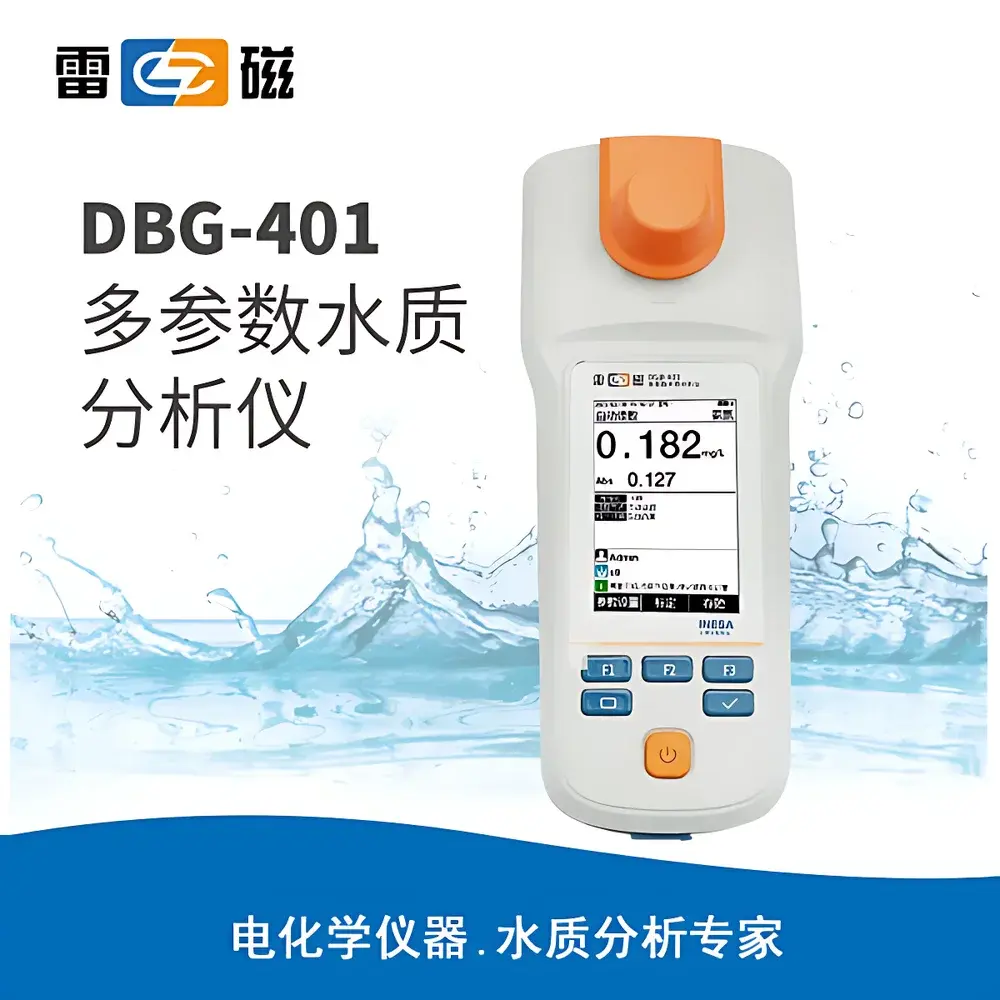
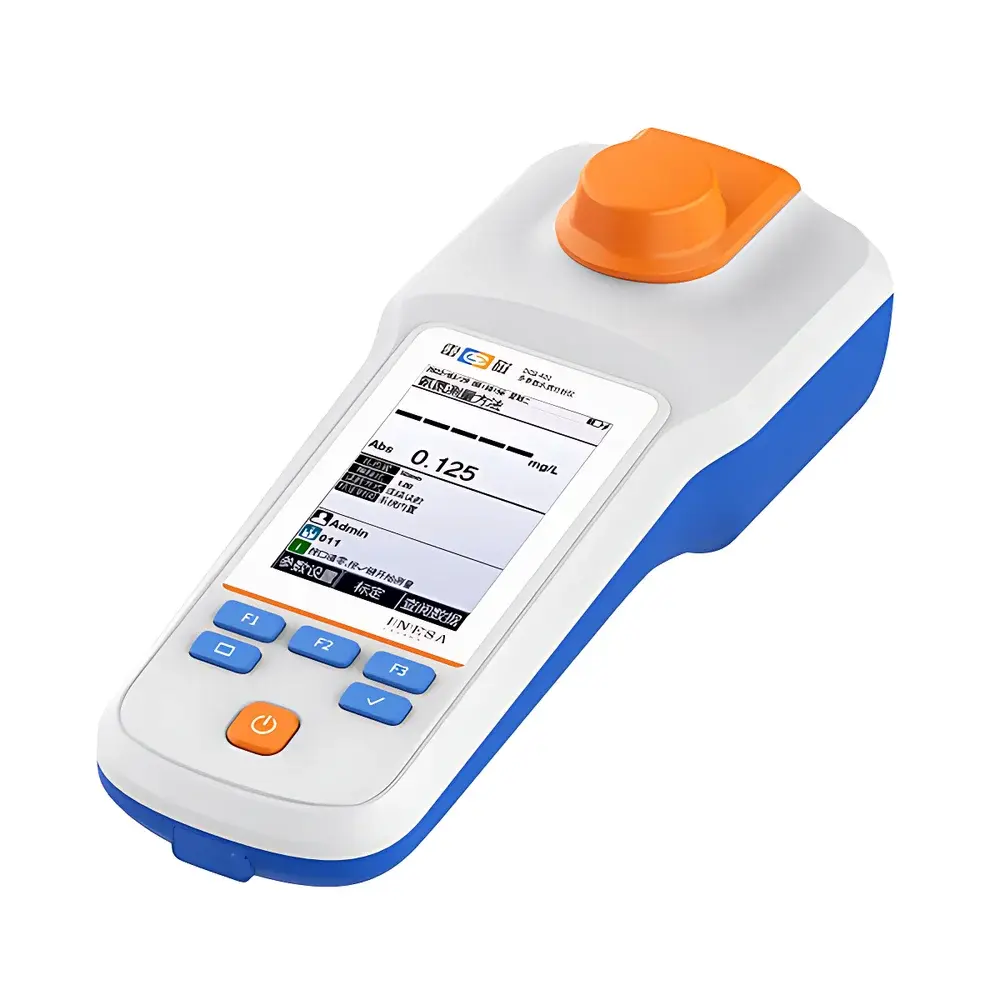
Leici DGB-401 Portable Multi-Parameter Water Quality Analyzer
| Brand | Leici |
|---|---|
| Origin | Shanghai, China |
| Model | DGB-401 |
| Instrument Type | Portable/Handheld Water Quality Analyzer |
| Measurable Parameters | Ammonia-N, Low-Range COD, High-Range COD, Total Phosphorus (TP), Total Nitrogen (TN) |
| Measurement Principles | Nesslerization (NH₃-N), Dichromate Oxidation (COD), Molybdate Blue Spectrophotometry (TP), Persulfate Digestion + UV Absorption or Colorimetry (TN) |
| Wavelengths | 420 nm, 470 nm, 620 nm, 650 nm (LED sources) |
| Detection Range (NH₃-N) | 0.000–10.00 mg/L (extendable to 300 mg/L) |
| (Low-COD) | 0.000–150.0 mg/L |
| (High-COD) | 150.0–1500 mg/L |
| (TP) | 0.000–1.000 mg/L (extendable to 25 mg/L) |
| (TN) | 0.000–30.00 mg/L (extendable to 300 mg/L) |
| Accuracy | ±5% (NH₃-N), ±8% (COD), ±10% (TP), ≤10 mg/L: ±1 mg/L |
| >10 mg/L | ±5% (TN) |
| Repeatability | 2–3% RSD |
| Calibration | 2–6 point user-defined or built-in calibration curves |
| Data Storage | 200 groups per parameter (1000 total) |
| Cuvette Types | 16 mm and 25 mm round tubes |
| Power Supply | Rechargeable Li-ion battery |
| AC/DC adapter (Input | AC 100–240 V |
| Output | DC 5 V) |
| Protection Rating | IP65 |
| Dimensions (L×W×H) | 100 × 240 × 80 mm |
| Weight | 0.6 kg |
| Packaging Dimensions | 490 × 410 × 220 mm |
| Gross Weight | 4.5 kg |
| Compliance | GLP-compliant data logging with audit trail support |
Overview
The Leici DGB-401 Portable Multi-Parameter Water Quality Analyzer is an engineered field-deployable spectrophotometric instrument designed for on-site quantification of critical water quality parameters in environmental monitoring, wastewater treatment, drinking water distribution, and regulatory compliance applications. It operates on standardized colorimetric and oxidation-based analytical principles: ammonia-nitrogen (NH₃-N) is determined via Nesslerization at 420 nm; chemical oxygen demand (COD) is measured using dichromate digestion followed by absorbance detection at 620 nm (low range) or 650 nm (high range); total phosphorus (TP) employs molybdate blue formation at 650 nm; and total nitrogen (TN) is quantified after alkaline persulfate digestion and subsequent detection—either via UV absorption or chromogenic reaction at 420 nm. The system integrates four high-stability LED light sources (420 nm, 470 nm, 620 nm, 650 nm), eliminating lamp drift and ensuring long-term photometric reproducibility without warm-up delays. Its compact form factor (100 × 240 × 80 mm), IP65-rated enclosure, and integrated Li-ion power system enable reliable operation in humid, dusty, or intermittently wet field environments—including riverbanks, effluent discharge points, and decentralized treatment facilities.
Key Features
- Four-wavelength LED optical system with fixed, factory-aligned photodiodes—no moving parts, no alignment drift, and >50,000-hour source lifetime
- Intelligent endpoint detection algorithm that dynamically identifies reaction completion for each assay, minimizing operator-dependent timing errors
- Auto-read and continuous-read modes with configurable sampling intervals; supports user-defined dilution factors and automatic back-calculation of original sample concentration
- GLP-compliant data management: timestamped entries, operator ID tagging (optional), and immutable storage of raw absorbance values, calibration history, and measurement metadata
- Dual-cuvette compatibility (16 mm and 25 mm round tubes) for flexibility across standard EPA, ISO, and HJ methods
- On-device firmware upgradability via USB—enabling method updates, new parameter modules, and enhanced algorithm logic without hardware replacement
- Integrated power management with low-battery warning, real-time charging status feedback, and adjustable backlight intensity for low-light field use
Sample Compatibility & Compliance
The DGB-401 accommodates aqueous samples from surface water, groundwater, municipal wastewater, industrial effluents, and potable water systems. Sample preparation follows established regulatory protocols: NH₃-N requires pH adjustment and filtration; COD analysis mandates pre-digestion using an optional portable digester (COD-401-1, compliant with HJ 828–2017); TP and TN require acid hydrolysis or alkaline persulfate oxidation prior to color development. The instrument’s measurement ranges align with common environmental thresholds: NH₃-N (0.000–10.00 mg/L, extendable), low-COD (0.000–150.0 mg/L), high-COD (150–1500 mg/L), TP (0.000–1.000 mg/L), and TN (0.000–30.00 mg/L). All reported accuracy and repeatability specifications meet the performance criteria outlined in ISO 8466-1 (calibration functions), ISO 7027 (turbidity interference mitigation), and Chinese Environmental Monitoring Standards (HJ 535–2009, HJ 399–2007, HJ 671–2013, HJ 636–2012). Data export formats comply with ASTM D5116 for traceability, and audit logs satisfy internal GLP requirements for laboratory accreditation.
Software & Data Management
Data handling is structured around traceability and interoperability. Each measurement stores full context: parameter ID, wavelength used, cuvette type, calibration curve ID, dilution factor, date/time stamp, and operator code (if enabled). A total of 1000 measurements are retained locally—200 per parameter—with overwrite protection for flagged “QC” or “Standard” runs. USB connectivity enables bidirectional communication with Windows-based Leici DataLink software, supporting batch export to CSV or Excel-compatible XML, spectral review, calibration curve visualization, and QC chart generation (e.g., control charts per CLSI EP23). RS-232 output permits direct printing to serial thermal printers using customizable templates (e.g., inclusion of site ID, analyst initials, and method reference). No cloud dependency: all data remains under user control, with optional encryption during transfer per ITAR/EAR guidelines.
Applications
- Routine surveillance of municipal wastewater influent/effluent for NH₃-N, COD, TP, and TN compliance with national discharge limits
- Field verification of decentralized treatment units (e.g., MBRs, constructed wetlands) where lab turnaround time exceeds process control requirements
- Source water assessment during drought or algal bloom events—rapid TP/TN screening to inform coagulant dosing
- Environmental impact assessments (EIA) requiring spatially dense, time-resolved nutrient profiling across watersheds
- Educational laboratories performing AP Environmental Science or undergraduate water chemistry experiments under standardized protocols
- Third-party verification audits where portable, GLP-traceable instrumentation replaces benchtop alternatives for rapid site qualification
FAQ
Does the DGB-401 require external digestion equipment for all parameters?
Only COD, TP, and TN measurements require pre-digestion; NH₃-N and low-range COD (under 150 mg/L) may be measured directly after filtration and pH adjustment.
Can calibration curves be imported from external laboratories?
Yes—the instrument accepts user-defined 2–6 point calibration tables via USB; slope, intercept, and correlation coefficient are stored with each curve.
Is the device compatible with international standards such as ISO or ASTM?
While not certified to ISO/IEC 17025, its optical architecture, reagent protocols, and validation procedures conform to ISO 6060 (COD), ISO 7150-1 (NH₃-N), ISO 6878 (TP), and ISO 11905-1 (TN) measurement principles.
What is the expected service life of the LED light sources?
Rated minimum operational life is 50,000 hours under continuous use—equivalent to >5 years of daily field deployment without measurable intensity decay.
How is data integrity ensured during power loss?
The system implements non-volatile memory write buffering and automatic save-on-interrupt; unsaved measurements are retained in RAM until confirmation or timeout (default: 30 seconds).







