
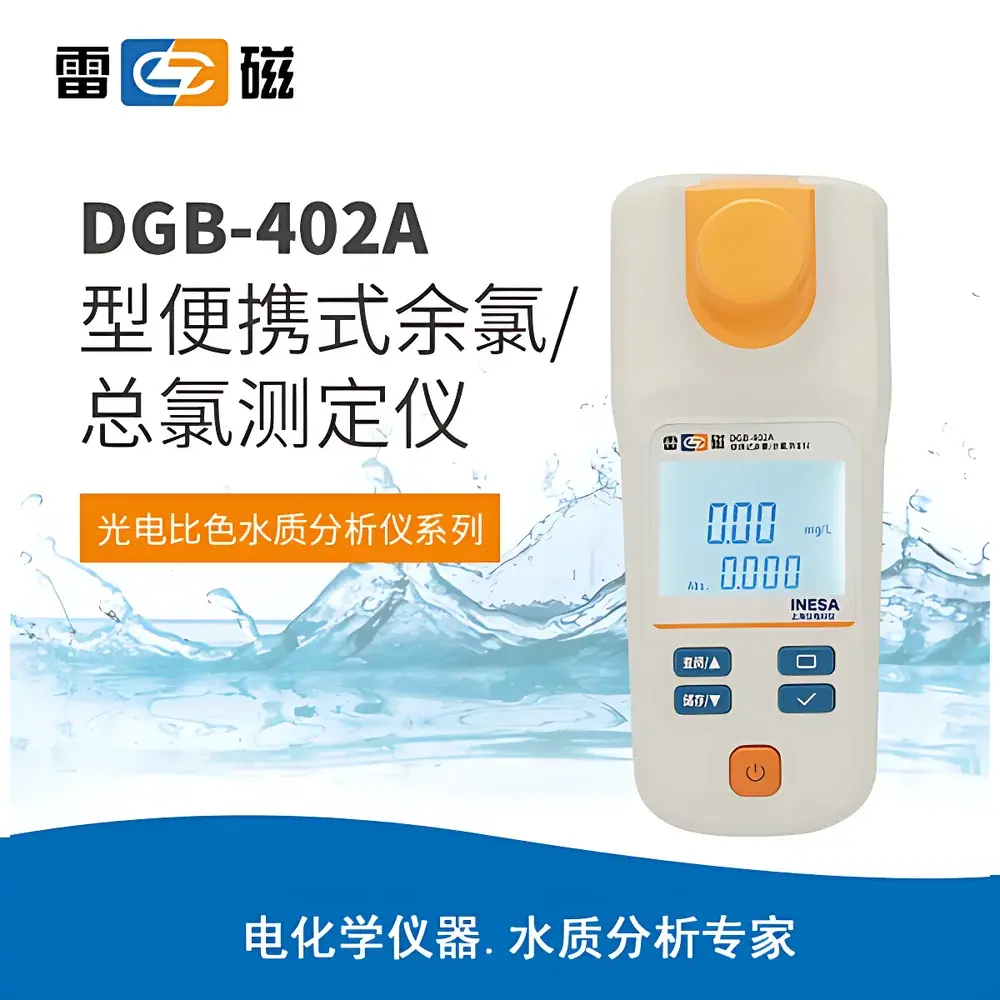
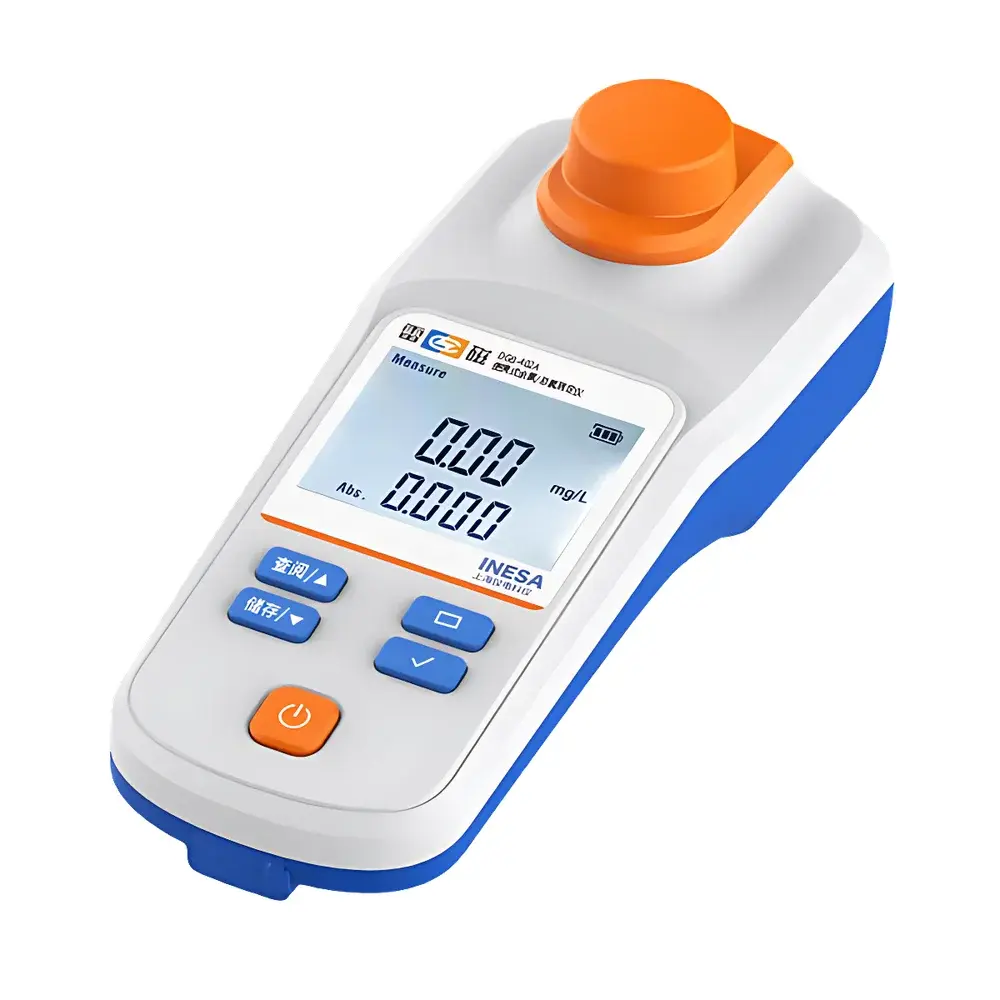
Leici DGB-402A Portable Residual and Total Chlorine Analyzer
| Brand | Leici |
|---|---|
| Origin | Shanghai, China |
| Model | DGB-402A |
| Instrument Type | Portable Colorimeter |
| Measurement Principle | DPD Spectrophotometric Method |
| Measured Parameters | Residual Chlorine, Total Chlorine |
| Range | (0.02–3.00) mg/L |
| Accuracy | ±3% or ±0.02 mg/L |
| Repeatability | ≤1% |
| Resolution | 0.01 mg/L |
| Detection Limit | ≤0.02 mg/L |
| Light Source | 515 nm LED |
| Wavelength Accuracy | Fixed at 515 nm |
| Cuvette Size | 25 mm diameter |
| Data Storage | 200 measurement records |
| Power Supply | Rechargeable Li-ion battery |
| AC/DC adapter (Input | AC 100–240 V, Output: DC 5 V) |
| Protection Rating | IP65 |
| Dimensions (L×W×H) | 80 × 200 × 75 mm |
| Weight | 0.4 kg |
Overview
The Leici DGB-402A Portable Residual and Total Chlorine Analyzer is a compact, field-deployable spectrophotometric instrument engineered for rapid, on-site quantification of free residual chlorine and total chlorine in drinking water, wastewater effluents, swimming pools, and disinfection process streams. It operates on the standardized N,N-diethyl-p-phenylenediamine (DPD) colorimetric method—fully compliant with ISO 7393-2, APHA Standard Methods 4500-Cl G, and EPA Method 334.1. The analyzer employs a stable, temperature-compensated 515 nm LED light source to excite the pink-colored DPD-chlorine complex, enabling precise absorbance measurement without spectral drift. Its single-wavelength, direct-read optical architecture eliminates mechanical filter wheels or monochromators, enhancing long-term reliability and minimizing maintenance requirements in demanding environmental monitoring environments.
Key Features
- Integrated 515 nm high-stability LED light source with >100,000-hour operational lifetime and minimal thermal drift
- Dedicated DPD-based photometric detection optimized for chlorine oxidation states (free Cl₂, HOCl, OCl⁻, and combined chloramines)
- Pre-loaded calibration curves for both residual and total chlorine—enabling immediate measurement without manual curve generation
- Flexible calibration support: one-point standard calibration using user-prepared DPD standard solutions (e.g., 0.5 mg/L or 1.0 mg/L Cl₂ equivalents)
- 200-measurement internal memory with timestamp, sample ID, and operator tag fields—exportable via USB interface (not included) for traceability
- Adjustable LED backlight with three intensity levels for operation under low-light or outdoor conditions
- Ruggedized housing rated IP65 for dust-tight and water-jet resistant performance—suitable for field use in rain, humidity, or splashing environments
- Lightweight design (0.4 kg) with ergonomic form factor for extended handheld operation and integration into mobile lab kits
Sample Compatibility & Compliance
The DGB-402A accepts standard 25 mm round glass or disposable plastic cuvettes filled with filtered or clarified aqueous samples. It supports both raw and treated water matrices, including chlorinated surface water, groundwater, potable distribution systems, and recirculated pool water—provided turbidity remains below 5 NTU to avoid scattering interference. All measurements adhere to internationally recognized protocols: calibration verification aligns with ISO/IEC 17025 quality system requirements, while reporting formats accommodate GLP-compliant documentation workflows. Though not certified for regulatory submission under US EPA or EU Drinking Water Directive Annexes, its performance specifications meet the technical acceptability criteria outlined in ISO 7393-2:2018 for portable chlorine analyzers used in routine surveillance and operational control.
Software & Data Management
The instrument operates autonomously without external software dependency. All data—including absorbance values, concentration results, calibration history, and measurement metadata—are stored in non-volatile flash memory. Timestamping follows ISO 8601 (YYYY-MM-DD HH:MM:SS) format. Data retrieval requires optional Leici USB-to-serial adapter and proprietary Leici DataLink v2.1 desktop application (Windows 10/11 compatible), which enables CSV export, batch report generation, and audit trail review. The firmware implements basic data integrity safeguards: write-protection for calibration coefficients, automatic checksum validation on power-up, and sequential record indexing to prevent overwrites. While not compliant with FDA 21 CFR Part 11 for electronic signatures, it supports ALCOA+ principles (Attributable, Legible, Contemporaneous, Original, Accurate) through immutable timestamped entries and user-defined sample identifiers.
Applications
- Field verification of chlorine residual at water treatment plant exit points and distribution network sampling stations
- Real-time monitoring of disinfectant decay during pipeline transport and storage
- Compliance checks for municipal and private swimming pool operators per WHO Guidelines for Safe Recreational Water Environments
- Emergency response testing following natural disasters or infrastructure failures affecting water safety
- Educational laboratory instruction on redox titration principles and spectrophotometric assay development
- QA/QC screening in food processing facilities where chlorine-based sanitizers are employed on contact surfaces
FAQ
What sample preparation is required prior to analysis?
Samples should be free of visible particulates; filtration through a 0.45 µm membrane is recommended if turbidity exceeds 2 NTU. No pH adjustment is needed—the DPD reaction proceeds optimally between pH 6.2–6.5, and the reagent buffer maintains suitable conditions.
Can the DGB-402A distinguish between free chlorine and combined chlorine?
Yes—by performing two sequential measurements: first with DPD reagent alone (free chlorine), then after addition of potassium iodide (total chlorine). Combined chlorine is calculated by difference, per APHA 4500-Cl G protocol.
Is the instrument suitable for seawater or high-salinity samples?
Not recommended for undiluted seawater due to potential interferences from bromide oxidation; however, diluted samples (<1000 mg/L TDS) may yield acceptable accuracy with matrix-matched calibration.
How often does the LED light source require recalibration?
None—the 515 nm LED is factory-aligned and thermally stabilized; no user recalibration is specified. Annual verification against NIST-traceable standards is advised for QA-critical applications.
Does the device support Bluetooth or Wi-Fi connectivity?
No—data transfer is limited to USB interface only. Wireless transmission is omitted to preserve battery life, electromagnetic compatibility, and intrinsic safety in potentially hazardous locations.







