
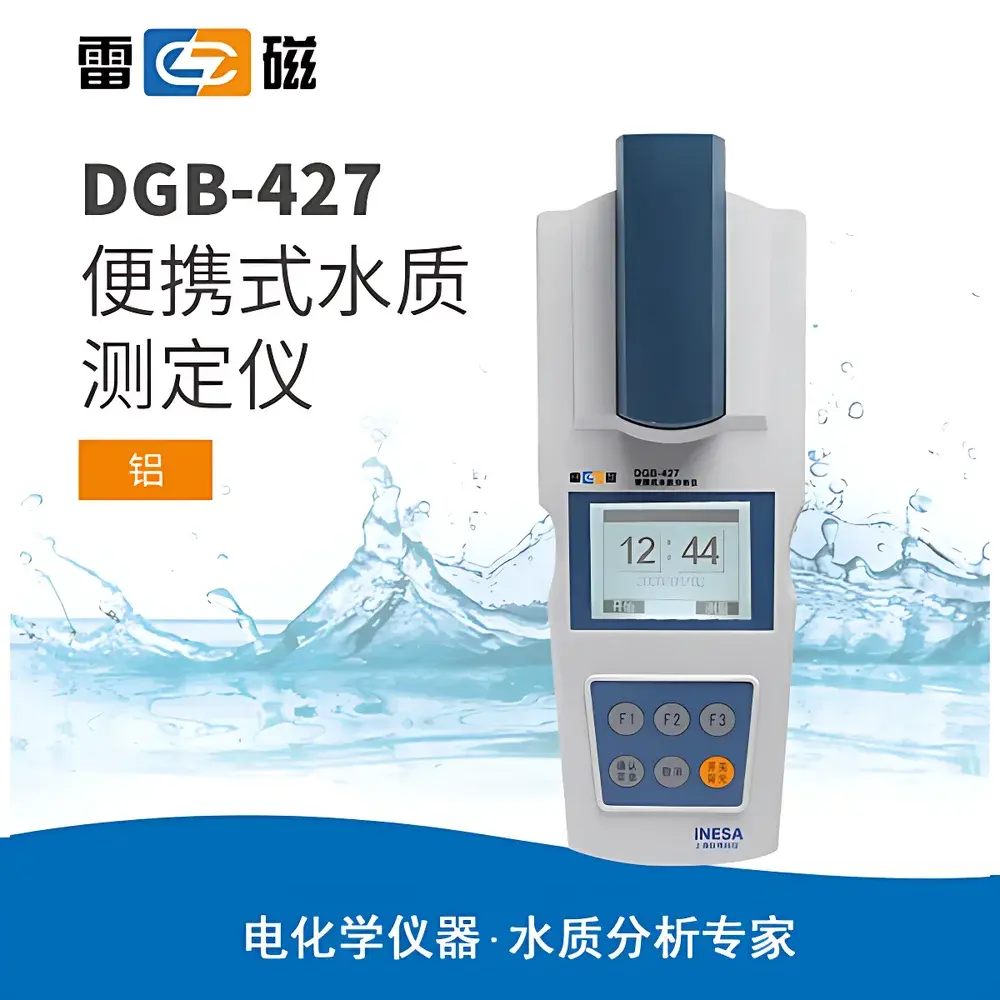
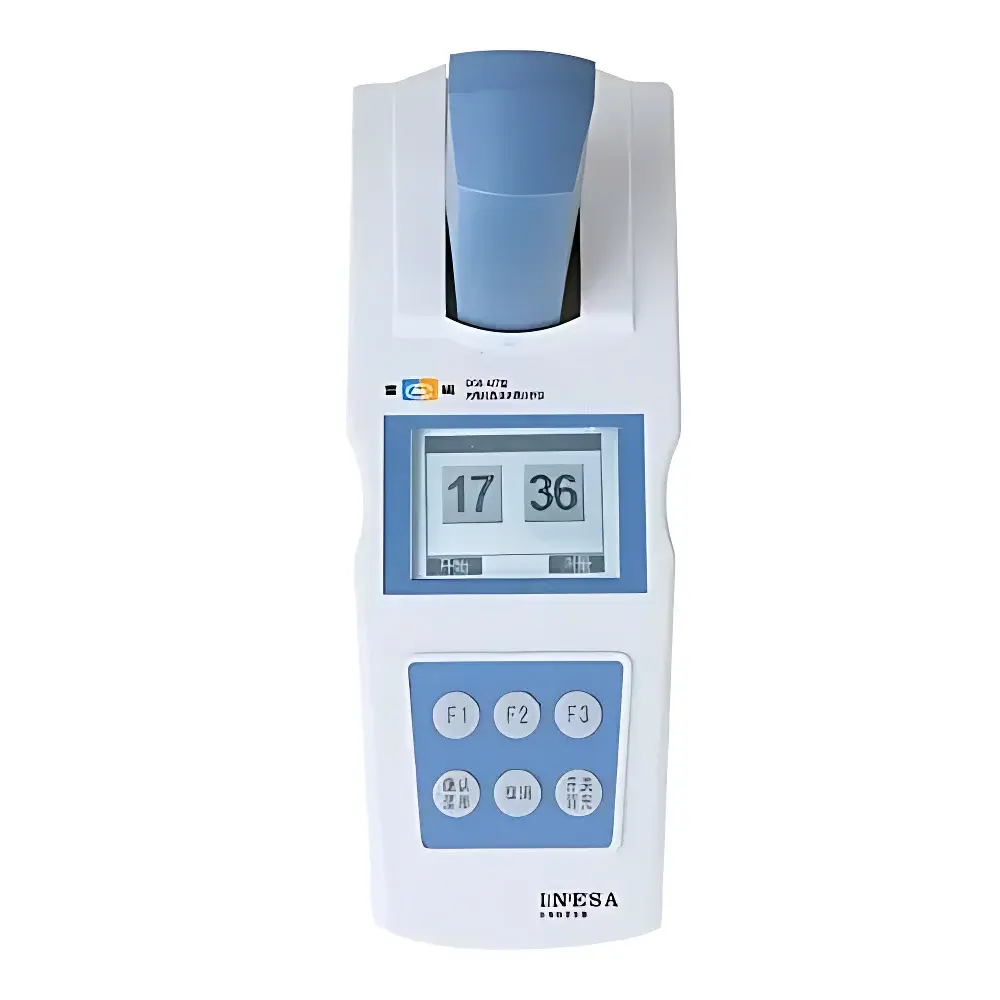
LeiCi DGB-427 Portable Water Quality Analyzer
| Brand | LeiCi |
|---|---|
| Model | DGB-427 |
| Measurement Parameter | Aluminum (Al) |
| Method | Chromazurol S Spectrophotometry |
| Light Source | 620 nm LED |
| Range | 0.000–0.300 mg/L |
| Accuracy | ±0.015 mg/L |
| Repeatability | ≤0.005 mg/L |
| Sample Vessel | 10 mL, Ø16 mm × 100 mm glass cuvette |
| Dimensions | 220 × 85 × 50 mm |
| Weight | 0.4 kg |
| Operating Temperature | 5–35 °C |
| Relative Humidity | 0–85 % RH (non-condensing) |
| Power Supply | 4 × AA alkaline batteries or USB 5 V DC |
| IP Rating | IP65 |
| Data Compliance | GLP-compliant data logging with timestamp, operator ID, and calibration history |
| Connectivity | USB interface for PC communication and printer output |
| Calibration | Up to 5-point user-defined calibration |
| Display | Backlit LCD with adjustable contrast and backlight timeout |
Overview
The LeiCi DGB-427 Portable Water Quality Analyzer is a compact, field-deployable spectrophotometric instrument engineered for rapid, on-site quantification of dissolved aluminum in aqueous matrices. It operates on the principle of Chromazurol S (CAS) complexation spectrophotometry — a well-established colorimetric method standardized under ISO 8692 and ASTM D3557 for trace aluminum determination in natural and treated waters. The analyzer integrates a precision 620 nm monochromatic LED light source, optimized for maximum sensitivity at the absorption peak of the Al–CAS complex, eliminating spectral interference from common co-ions (e.g., Fe³⁺, Cu²⁺) when used with appropriate masking agents. Its optical path is calibrated using factory-installed reference curves stored in non-volatile memory, enabling direct concentration readout without manual calculation. Designed for rugged field use, the DGB-427 meets IP65 ingress protection requirements, ensuring reliable operation in humid, dusty, or splash-prone environments typical of wastewater treatment plants, drinking water distribution networks, and environmental monitoring stations.
Key Features
- LED-based photometric detection system with stable 620 nm emission — no warm-up time, minimal drift, and extended lamp lifetime (>100,000 measurements)
- Integrated 10 mL glass cuvette holder accommodating standard Ø16 mm × 100 mm tubes — eliminates need for sample transfer or flow cells
- Backlit LCD display with user-adjustable contrast and programmable backlight timeout (1–60 s) for optimal readability under variable ambient lighting
- GLP-compliant data management: each measurement record includes date/time stamp, operator ID (user-definable), calibration status, and measurement mode identifier
- Dual power architecture: operates continuously on four AA alkaline batteries (typical runtime >20 h) or via USB 5 V DC input — ideal for mobile labs or remote sampling campaigns
- Five-point calibration capability with linear or polynomial curve fitting — supports trace-level accuracy across the full 0.000–0.300 mg/L range
- Automatic endpoint detection and value locking — reduces operator variability and improves measurement reproducibility
- Firmware upgradeable via USB — enables future expansion to additional parameters (e.g., ammonia nitrogen, total phosphorus, residual chlorine) without hardware modification
Sample Compatibility & Compliance
The DGB-427 is validated for analysis of aluminum in diverse water types including surface water, potable water (per WHO Guideline Limits and GB 5749–2022), swimming pool water (per CDC Model Aquatic Health Code), industrial effluents, hospital wastewater, and reclaimed landscape irrigation water. Sample pretreatment follows EPA Method 200.7 and ISO 11969 protocols: acid digestion is not required for soluble Al; turbid or particulate-rich samples must be filtered through 0.45 µm membrane prior to analysis. The instrument complies with GLP documentation requirements per OECD Principles of Good Laboratory Practice and supports audit-ready data export (CSV format) for regulatory reporting. While not certified under FDA 21 CFR Part 11, its timestamped, immutable measurement logs and calibration traceability meet baseline data integrity expectations for environmental QA/QC programs.
Software & Data Management
Data generated by the DGB-427 is stored internally (up to 1,000 records) with full metadata: sample ID, measurement value, unit, method ID, calibration curve ID, operator code, and timestamp. USB connectivity allows direct transfer to Windows-based PCs using bundled LeiCi DataLink software — enabling batch export, trend visualization, statistical summary (mean, SD, CV%), and PDF report generation. All stored data retains original acquisition context; deletion requires password authentication. Firmware updates are delivered as signed binary packages to ensure integrity and prevent unauthorized modification. No cloud dependency or proprietary subscription model is involved — all functionality remains fully operational offline.
Applications
- Field verification of aluminum coagulant dosing efficiency in drinking water treatment plants
- Routine monitoring of aluminum leaching from aging distribution system pipes and storage tanks
- Compliance testing for aluminum discharge limits in industrial wastewater permits (e.g., EPA NPDES, EU Urban Wastewater Directive Annex I)
- Quality control of dialysis water in clinical settings (per AAMI/ISO 13959:2014 limits of ≤0.01 mg/L)
- Environmental impact assessment of bauxite mining runoff and downstream aquatic ecosystems
- Educational use in university environmental science laboratories for teaching spectrophotometric principles and water chemistry fundamentals
FAQ
What is the detection limit for aluminum using the DGB-427?
The practical quantitation limit is 0.005 mg/L based on repeatability performance (≤0.005 mg/L) and method sensitivity under controlled laboratory conditions.
Can the DGB-427 measure other parameters besides aluminum?
Yes — the platform supports firmware-upgradable modules. Pre-validated methods for ammonia nitrogen, total phosphorus, and free chlorine are available as optional application kits (part numbers DGB-427-AMN, DGB-427-TPH, DGB-427-CLF).
Is the instrument suitable for use in high-humidity tropical environments?
Yes — its IP65-rated enclosure and operating humidity range (0–85% RH, non-condensing) make it suitable for deployment in equatorial field sites and coastal monitoring stations.
How is calibration traceability maintained?
Each calibration session is logged with date, operator ID, standard concentrations used, and R² value; calibration curves are digitally signed and cannot be altered post-creation.
Does the DGB-427 require annual recalibration by the manufacturer?
No — users perform routine calibration using NIST-traceable aluminum standards (e.g., Sigma-Aldrich CRM 427-AL-100); factory recalibration is recommended only after physical shock or optical component replacement.







