
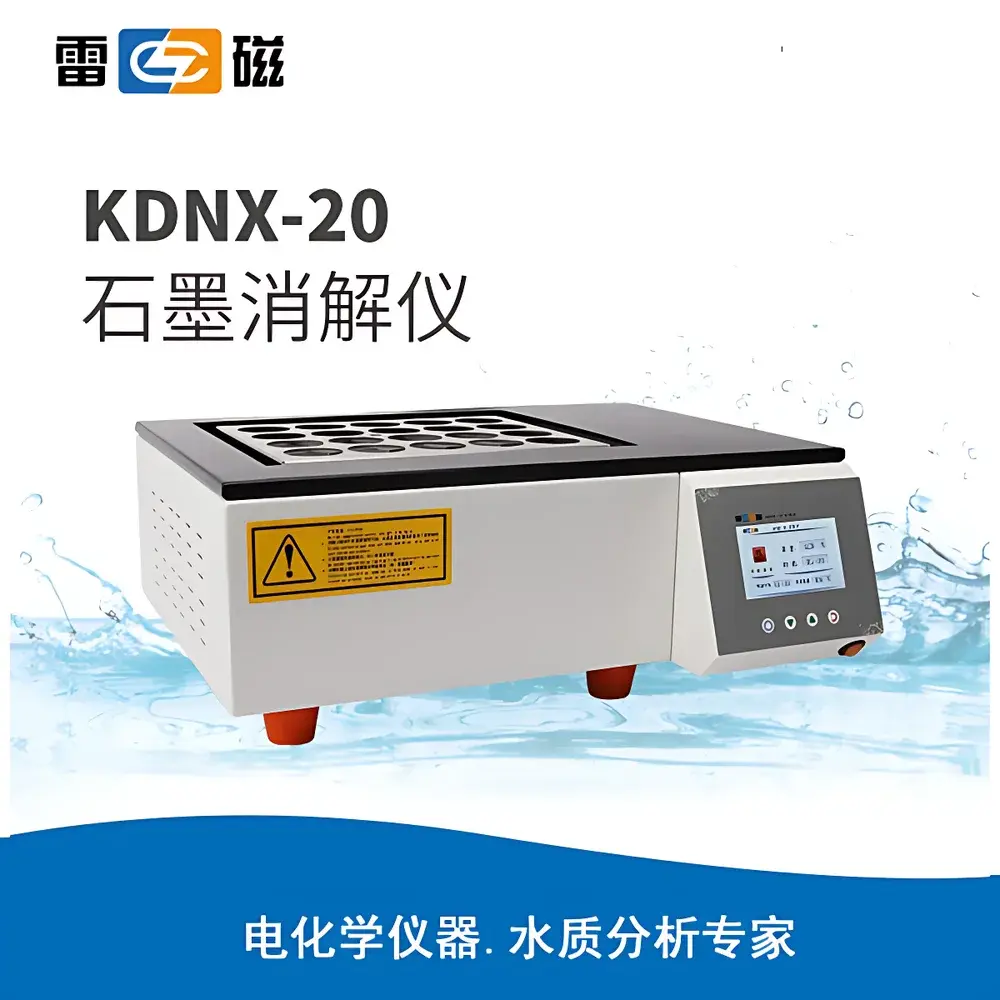
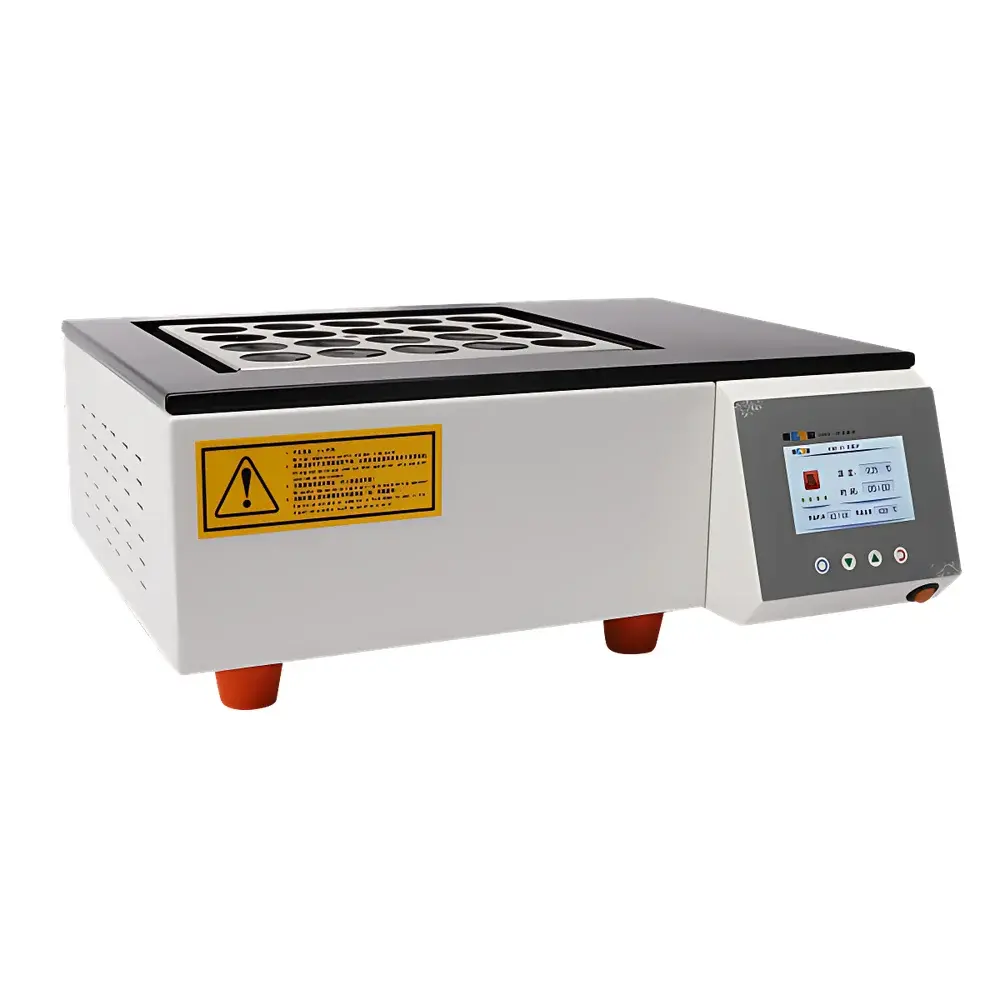
Leici KDNX-20 Graphite Block Digestion System
| Brand | Leici |
|---|---|
| Origin | Shanghai, China |
| Manufacturer Type | Authorized Distributor |
| Country of Origin | China |
| Model | KDNX-20 |
| Price | USD 1,530 (approx.) |
| Heating Temperature Range | Ambient +5°C to 450°C |
| Temperature Control Accuracy | ±1°C |
| Digestion Vessel Capacity | 280 mL (water at 20°C) |
| Sample Throughput | 20 samples per run |
| Power Supply | 220 VAC ±10%, 50 Hz |
| Dimensions (W×D×H) | 515 × 421 × 211 mm |
| Weight | 25 kg |
Overview
The Leici KDNX-20 Graphite Block Digestion System is a benchtop, programmable thermal digestion platform engineered for reproducible, high-throughput sample preparation in regulated and research laboratory environments. It operates on the principle of conductive heating via a monolithic high-purity graphite block, which ensures uniform thermal distribution across all sample positions—critical for achieving consistent acid digestion outcomes in elemental analysis workflows. Unlike open-flame or hotplate-based methods, the KDNX-20 eliminates convective heat loss and minimizes temperature gradients, enabling precise control over digestion kinetics for matrices such as soils, plant tissues, foodstuffs, pharmaceutical excipients, and geological samples. Its design aligns with standardized wet digestion protocols referenced in ISO 11047 (soil cadmium determination), EPA Method 3050B (acid digestion of sediments and soils), and AOAC 999.10 (total metal content in feedstuffs), supporting trace-level ICP-OES, ICP-MS, and AAS quantification.
Key Features
- Monolithic high-purity graphite heating block with proprietary anti-oxidation surface treatment—enhances thermal stability and extends service life under prolonged exposure to HNO₃, HCl, HF, and H₂O₂ mixtures.
- Precise digital PID temperature control with real-time feedback, maintaining ±1°C accuracy across the full operating range (ambient +5°C to 450°C).
- Simultaneous processing of up to 20 samples using standard 280 mL digestion tubes—optimized for compatibility with borosilicate glass and PTFE-lined vessels.
- Uniform inter-hole temperature deviation ≤1.5°C at 300°C—verified per ASTM E220 calibration practice—ensuring batch-to-batch repeatability in multi-sample runs.
- Integrated safety architecture including over-temperature cutoff, over-current protection, and short-circuit monitoring compliant with IEC 61010-1:2010 for laboratory electrical equipment.
- Corrosion-resistant housing with electrophoretically coated steel chassis and chemically inert front-panel controls—rated for continuous operation in fume hood environments exposed to aggressive vapors.
- Programmable time-temperature profiles with auto-shutdown upon cycle completion—supports unattended overnight digestion without operator intervention.
Sample Compatibility & Compliance
The KDNX-20 accommodates a broad spectrum of solid and semi-solid matrices requiring total digestion prior to elemental analysis. Validated applications include soil (clay, loam, contaminated sediment), botanical materials (leaves, seeds, roots), animal feed, dairy powders, and mineral ores. It supports digestion protocols using HNO₃/H₂O₂, HNO₃/HF, and aqua regia mixtures—compatible with subsequent dilution and filtration steps required for USP and elemental impurities testing. The system meets general requirements for GLP-compliant sample prep environments, and its stable thermal output facilitates audit-ready documentation when paired with external data loggers meeting FDA 21 CFR Part 11 criteria.
Software & Data Management
While the KDNX-20 operates via an embedded LCD interface with manual parameter entry, it supports external integration through RS-232 or optional USB-to-serial adapters for connection to LIMS or laboratory data management systems. Users may record setpoints, ramp rates, hold times, and end-cycle timestamps in CSV format for traceability. Though not equipped with native audit-trail software, its deterministic thermal behavior and hardware-based safety interlocks ensure process integrity—making it suitable for QA/QC labs where procedural adherence is verified via SOP-driven operator logs rather than electronic records.
Applications
- Preparation of environmental samples for heavy metal screening (Pb, Cd, As, Cr, Hg) per ISO 17294-2 and EN 13656.
- Digestion of agricultural products (grains, forage, fertilizers) prior to macro/micronutrient profiling by ICP-OES.
- Pharmaceutical raw material testing for catalyst residues (Pd, Pt, Ni) in accordance with ICH Q2(R2) validation guidelines.
- Food safety laboratories performing multi-element analysis of infant formula, spices, and seafood per EU Regulation (EC) No 1881/2006.
- University teaching labs conducting quantitative gravimetric and volumetric analyses requiring standardized digestion reproducibility.
FAQ
What types of digestion vessels are compatible with the KDNX-20?
Standard 280 mL borosilicate glass digestion tubes (e.g., Pyrex-type) and PTFE-lined vessels with outer diameters between 48–52 mm are fully supported. Quartz and ceramic tubes are not recommended due to differential thermal expansion risks.
Can the KDNX-20 be used for microwave-assisted digestion protocols?
No—it is a conductive-heating graphite block system only. It does not generate microwaves and is not intended as a replacement for closed-vessel microwave digestion systems.
Is calibration verification included with the instrument?
The unit ships with a factory calibration certificate referencing NIST-traceable thermocouples. Users are advised to perform periodic verification using a calibrated reference thermometer per ISO/IEC 17025 internal calibration procedures.
Does the system meet CE or UL certification requirements?
It complies with CE marking directives (EMC Directive 2014/30/EU and Low Voltage Directive 2014/35/EU) and carries the CE mark. UL listing is not applicable, as it is supplied for use within CE-regulated markets.
What maintenance is required to sustain long-term performance?
Annual inspection of graphite block integrity, cleaning of vent channels with non-metallic brushes, and verification of thermal insulation integrity are recommended. Avoid direct contact with liquid acids on the block surface—always use properly fitted digestion tubes.



