
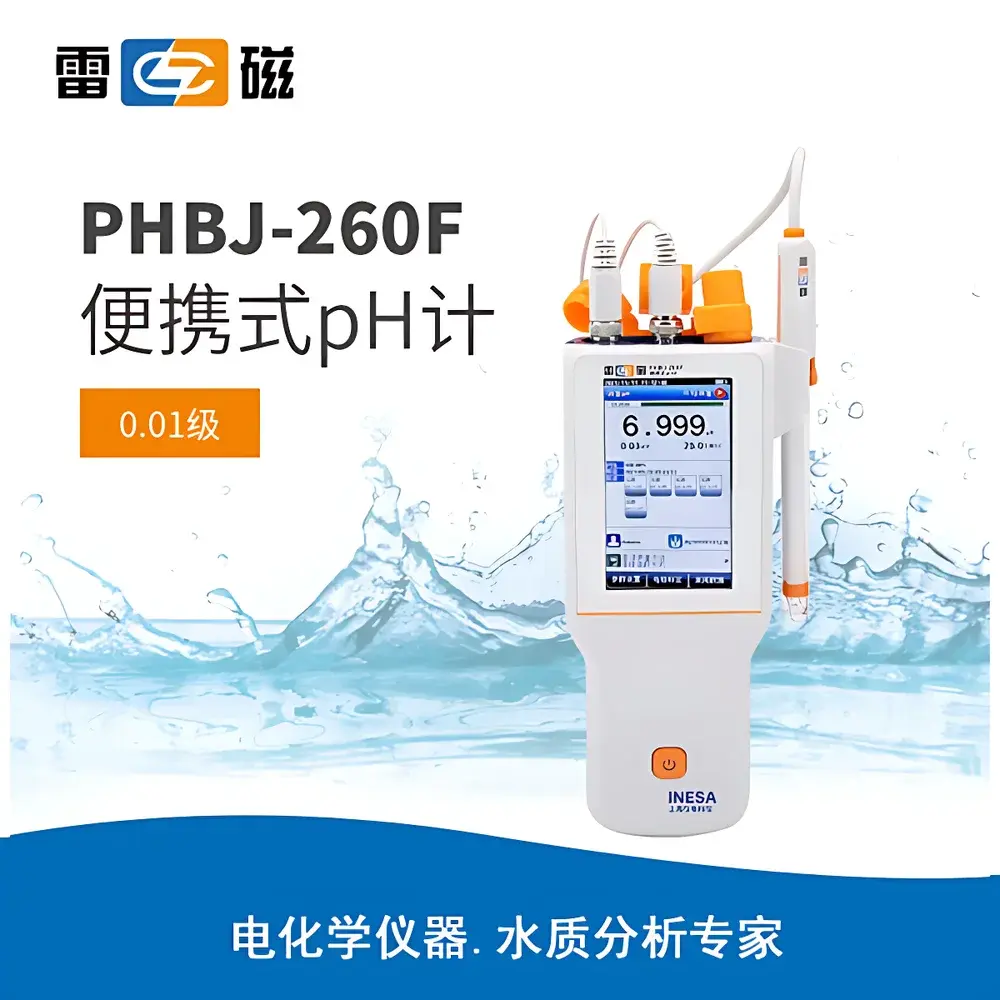
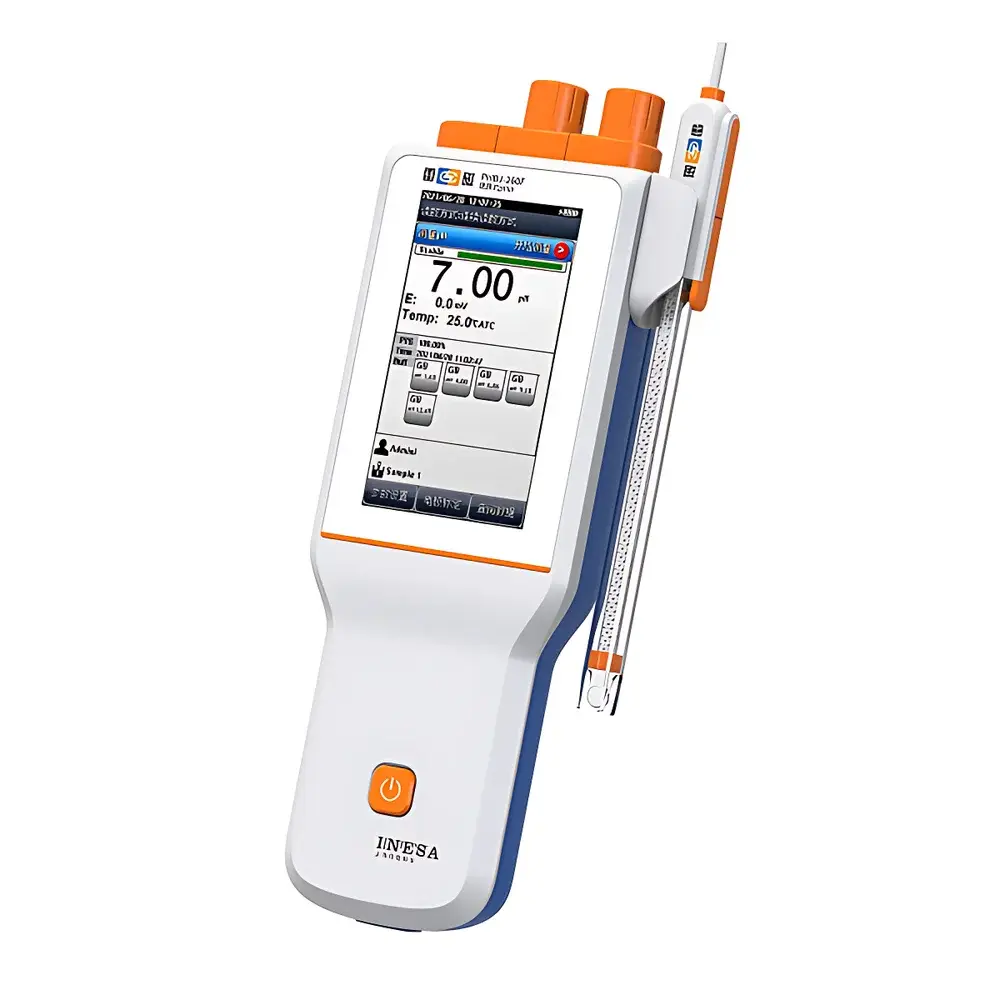
Leici PHBJ-260F Portable pH Meter
| Brand | Leici |
|---|---|
| Origin | Shanghai, China |
| Model | PHBJ-260F |
| Instrument Type | Portable |
| Parameter Types | Multi-parameter (pH, mV, Temperature) |
| Measurement Accuracy | ±0.01 pH |
| pH Range | −2.00 to 20.00 pH |
| pH Resolution | 0.01 pH |
| mV Range | −2000.0 to 2000.0 mV |
| mV Resolution | 0.1 mV |
| Temperature Range | −5.0 to 110.0 °C |
| Temperature Resolution | 0.1 °C |
| Temperature Accuracy | ±0.2 °C |
| Calibration Standards Supported | GB, DIN, NIST |
| Protection Rating | IP65 |
| Data Storage Capacity | 1000 datasets |
| Power Supply | Rechargeable Li-ion battery (DC5V input compatible) |
| Dimensions | 90 × 255 × 40 mm |
| Weight | 0.5 kg |
Overview
The Leici PHBJ-260F Portable pH Meter is a high-precision, field-deployable electrochemical instrument engineered for reliable pH, mV, and temperature measurements in diverse environmental, industrial, and educational settings. Based on potentiometric measurement principles—utilizing the Nernst equation to quantify hydrogen ion activity—the PHBJ-260F delivers laboratory-grade accuracy in a rugged, handheld form factor. Its 0.01-pH resolution and ±0.01-pH accuracy meet the requirements of ISO 8655-2 (volumetric calibration standards), ASTM D1293 (standard test method for pH of water), and USP (pH measurement guidance for pharmaceutical preparations). Designed for operational continuity in variable ambient conditions, the device features an IP65-rated enclosure, enabling dust-tight operation and resistance to low-pressure water jets—critical for outdoor sampling, wastewater monitoring, aquaculture, and field-based QA/QC workflows.
Key Features
- High-resolution 4.3-inch color TFT touchscreen with adjustable backlight for legibility under direct sunlight or low-light conditions
- Multi-language interface supporting English and Simplified Chinese—configured via system settings without firmware reinstallation
- Selectable resolution modes: pH (0.01 or 0.1), mV (0.1 or 1), and temperature (0.1 °C/°F)
- Intelligent endpoint detection algorithm with configurable reading modes: auto-hold, timed reading (1–120 s intervals), fixed-interval logging, and manual capture
- Comprehensive temperature compensation: automatic (via integrated Pt1000 sensor or external probe) and manual input options
- Up to five-point pH calibration with real-time slope and offset diagnostics; supports simultaneous storage of multiple calibration profiles
- Automated buffer recognition across three internationally referenced standard sets (GB, DIN, NIST); enables user-defined buffer groups with customizable pH values and tolerances
- Integrated power management: rechargeable lithium-ion battery (typical 100+ hours continuous use), USB-C charging compatibility, low-battery warning, and charge-status indicator
Sample Compatibility & Compliance
The PHBJ-260F is compatible with standard tri-combination pH electrodes (e.g., Leici E-201-F), including gel-filled, refillable, and low-ionic-strength variants. It accommodates aqueous samples across wide ionic strength ranges—from deionized water (conductivity ≥2 µS/cm) to high-salinity brines—when paired with appropriate electrode configurations. The instrument complies with GLP (Good Laboratory Practice) data integrity requirements: each stored measurement includes timestamp, electrode ID (if encoded), calibration history, temperature at time of reading, and operator-defined sample ID. Audit trails are exportable in CSV format, supporting traceability per FDA 21 CFR Part 11 when used with validated PC software and controlled user access protocols.
Software & Data Management
Data handling is facilitated through dual communication interfaces: isolated RS-232 (for direct connection to serial printers compliant with ESC/P or PCL command sets) and USB 2.0 (for PC synchronization via Leici’s proprietary L-Solution software). The onboard memory retains up to 1000 complete measurement records—including raw mV, compensated pH, temperature, date/time stamp, and calibration metadata—with selective delete, batch export, and PDF report generation capabilities. L-Solution software provides advanced functions such as statistical analysis (mean, SD, RSD), calibration curve visualization, drift monitoring over time, and automated compliance reporting templates aligned with ISO/IEC 17025 documentation requirements.
Applications
The PHBJ-260F serves critical roles in municipal water quality surveillance (drinking water, effluent discharge, stormwater runoff), food and beverage process control (dairy pasteurization, brewing mash pH, juice acidification), soil slurry testing in agronomy labs, educational chemistry laboratories, and field-based environmental impact assessments. Its extended pH range (−2.00 to 20.00) permits accurate measurement of strongly acidic leachates (e.g., mining runoff) and highly alkaline industrial cleaners or caustic scrubber solutions—scenarios where conventional 0–14 pH meters exhibit nonlinearity or electrode poisoning. The IP65 rating and ergonomic carry case with wrist strap further enable sustained use during riverbank surveys, reservoir profiling, and mobile lab deployments.
FAQ
What calibration standards does the PHBJ-260F recognize automatically?
The meter auto-identifies standard buffers from GB (China), DIN (Germany), and NIST (USA) series. Users may also define custom buffer groups with user-specified pH values and acceptance tolerances.
Is the device suitable for measuring pH in non-aqueous or low-conductivity samples?
It is optimized for aqueous solutions. For low-conductivity samples (<50 µS/cm), use a dedicated low-resistance pH electrode and enable “non-aqueous mode” if supported by firmware version 2.1 or later.
Does the instrument support regulatory audit trails required for ISO 17025 or GMP environments?
Yes—each measurement record includes immutable metadata (timestamp, calibration ID, operator tag, electrode serial number), and full export logs meet ALCOA+ (Attributable, Legible, Contemporaneous, Original, Accurate) principles when managed within validated software workflows.
Can the battery be replaced in the field?
No—the sealed Li-ion battery is not user-replaceable; however, it supports >500 charge cycles and maintains ≥80% capacity after two years of typical use.
What is the operating temperature limit for continuous measurement?
The electronics operate reliably from −10 °C to 50 °C ambient; electrode performance remains stable from −5 °C to 110 °C, though extended exposure above 60 °C requires thermal shielding per IEC 60746-2 guidelines.
Related Products





