
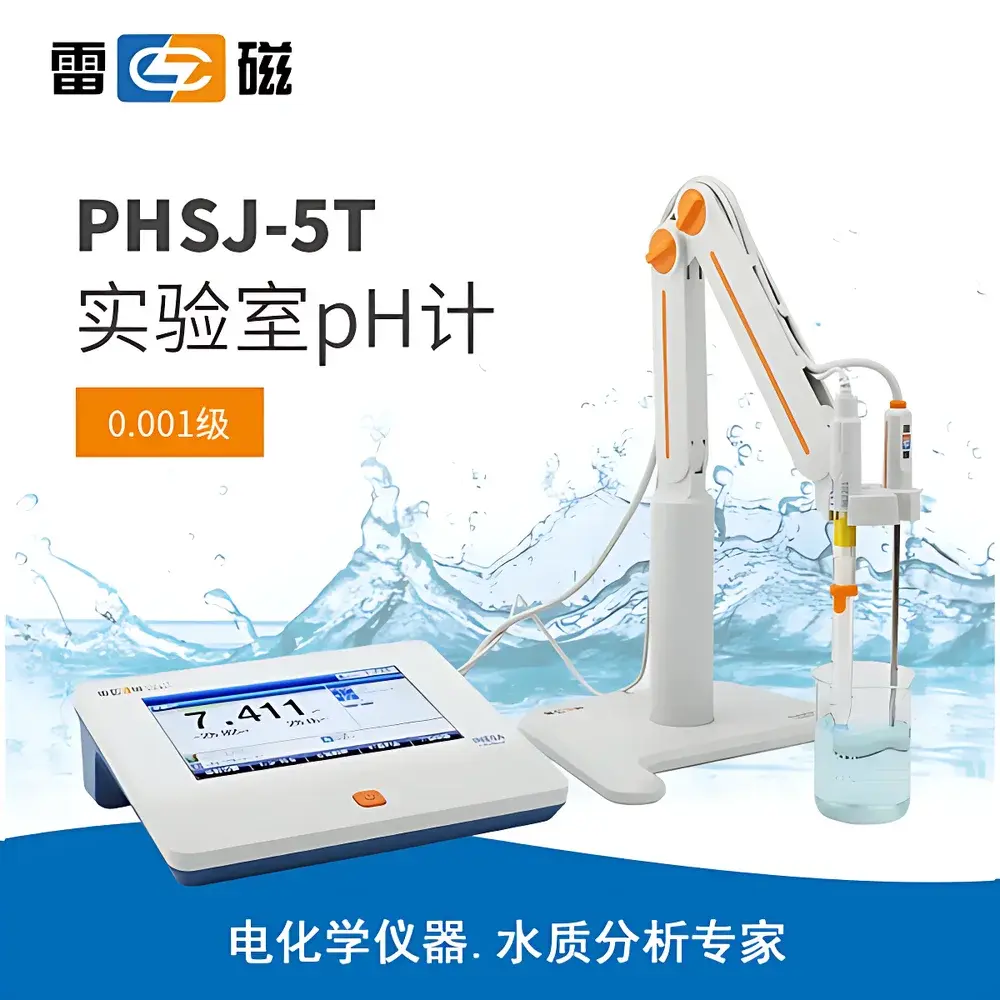
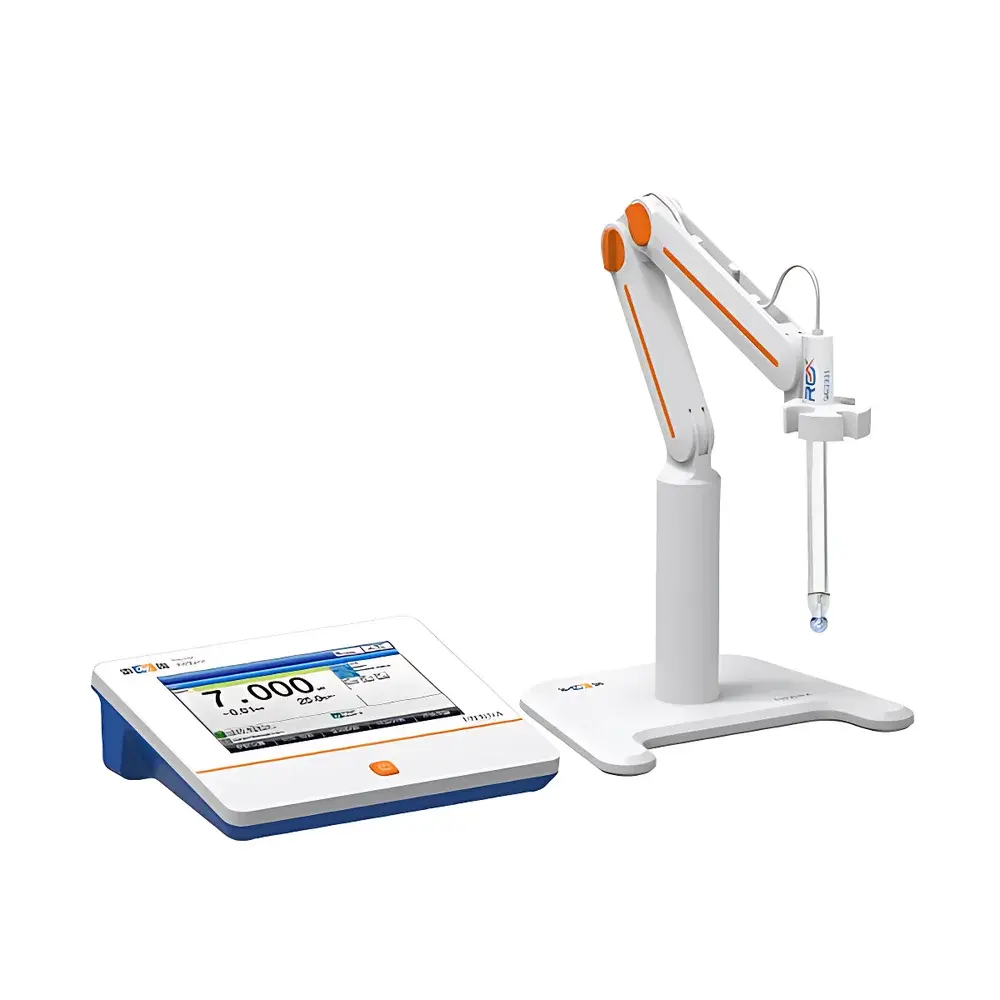
Leici PHSJ-5T Benchtop pH Meter
| Brand | Leici |
|---|---|
| Origin | Shanghai, China |
| Model | PHSJ-5T |
| Instrument Type | Benchtop |
| Parameter Type | Single-Parameter (pH/mV/ORP/Temperature) |
| Measurement Accuracy | ±0.002 pH |
| pH Range | −2.000 to 20.000 pH |
| Resolution | 0.001 pH / 0.01 mV / 0.1 °C |
| Temperature Compensation | Automatic (−10.0 to 135.0 °C) |
| Calibration Standards | NIST, GB, DIN, USA, MERK, JIS (6 pre-programmed sets + custom buffer definition) |
| Data Storage | 1000 measurement records with GLP/GMP-compliant metadata |
| Compliance | GLP, GMP-ready with audit trail, user-level permissions, and electronic signature support |
| Connectivity | RS-232, USB, U-disk interface, optional autosampler integration |
| IP Rating | IP54 |
| Power Supply | AC 100–240 V input, DC 24 V output |
| Dimensions & Weight | 220 × 195 × 68 mm, 0.95 kg |
Overview
The Leici PHSJ-5T is a high-precision benchtop pH meter engineered for rigorous laboratory environments where trace-level pH quantification, regulatory compliance, and operational reproducibility are critical. It operates on the fundamental principle of potentiometric measurement: the potential difference between a glass pH-sensitive electrode and a stable reference electrode is converted into a calibrated pH value using the Nernst equation. Designed to meet ISO/IEC 17025 and ASTM E70-22 requirements for electrochemical instrumentation, the PHSJ-5T delivers 0.001-pH resolution and ±0.002-pH accuracy across its full operating range of −2.000 to 20.000 pH — extending beyond conventional aqueous limits to accommodate non-aqueous solvents, highly alkaline caustic solutions, and low-ionic-strength samples. Its integrated temperature sensor enables automatic temperature compensation (ATC) over −10.0 to 135.0 °C, ensuring thermodynamic consistency in measurements per IUPAC recommendations.
Key Features
- High-resolution 5-inch color TFT touchscreen with intuitive icon-based navigation and dual-language support (English/Chinese)
- Selectable resolution modes: pH (0.001 / 0.01 / 0.1), mV (0.01 / 0.1 / 1), and temperature (0.1 °C or 0.1 °F)
- Intelligent endpoint detection algorithm supporting auto-read, timed-read, interval-read, and manual acquisition modes
- Comprehensive electrode management system with real-time diagnostics, calibration history logging, and predictive maintenance alerts
- Multi-point pH calibration (1–6 points) and single-point ORP calibration with built-in buffer recognition for six international standard sets (NIST, DIN, GB, JIS, MERK, USA) plus user-defined buffers
- IP54-rated enclosure for dust resistance and limited water ingress protection — suitable for shared lab benches and QC environments
- Firmware-upgradable architecture enabling future protocol expansion, method customization, and regulatory alignment updates
Sample Compatibility & Compliance
The PHSJ-5T accommodates a broad spectrum of sample matrices including aqueous buffers, pharmaceutical formulations, food extracts, wastewater effluents, and aggressive alkaline cleaning agents. Its high-impedance input circuitry (≥1012 Ω) ensures stable readings even with low-conductivity samples. All data capture adheres to Good Laboratory Practice (GLP) and Good Manufacturing Practice (GMP) frameworks: each stored record includes timestamp, operator ID, electrode serial number, calibration status, ambient temperature, and environmental conditions. Audit trails are immutable and exportable; user access levels (Administrator, Supervisor, Operator) enforce role-based permissions and password-protected workflows compliant with FDA 21 CFR Part 11 requirements for electronic records and signatures.
Software & Data Management
Data handling is structured around traceability and interoperability. The instrument stores up to 1000 complete measurement sets locally, each containing raw mV, calculated pH/ORP, temperature, electrode slope, offset, and calibration coefficients. Export options include CSV via USB flash drive, direct printing via RS-232-compatible thermal printers (configurable report templates), and PC synchronization through Leici’s proprietary communication software (Windows-compatible, TLS-secured). Batch analysis tools support statistical evaluation (mean, SD, RSD, min/max), trend visualization, and limit-based pass/fail flagging. Integration with LIMS and ELN systems is enabled via ASCII protocol over serial or virtual COM port emulation.
Applications
- Pharmaceutical quality control: pH verification of injectables, oral suspensions, and buffer preparation per USP and EP 2.2.3
- Environmental monitoring: Field-deployable validation of wastewater pH prior to discharge (EPA Method 150.1)
- Food & beverage R&D: Acidification profiling during fermentation, shelf-life stability testing, and HACCP critical control point verification
- Academic research: Electrode characterization studies, kinetic modeling of proton-transfer reactions, and teaching laboratories requiring NIST-traceable calibration
- Chemical manufacturing: In-process control of caustic scrubber solutions, catalyst slurry pH, and corrosion inhibitor formulations
FAQ
What calibration standards does the PHSJ-5T support natively?
The instrument recognizes six preloaded buffer groups (NIST, DIN, GB, JIS, MERK, USA) and allows users to define up to three custom buffer sets with programmable pH values and temperature coefficients.
Does the PHSJ-5T comply with FDA 21 CFR Part 11?
Yes — when operated with enabled user authentication, electronic signatures, and audit trail logging, it satisfies core requirements for electronic records and signatures in regulated environments.
Can the PHSJ-5T be connected to an autosampler?
Yes — via its dedicated expansion port, it supports seamless integration with Leici-compatible automatic samplers for unattended batch analysis of up to 96 samples.
Is temperature compensation mandatory during pH measurement?
Automatic temperature compensation is enabled by default but can be disabled for specialized applications requiring manual correction; the internal Pt1000 sensor remains active for ambient monitoring.
How is data integrity ensured during power interruption?
The device implements non-volatile memory with battery-backed RAM and automatic save-on-power-loss functionality, preserving all unsaved measurements and calibration states without data corruption.
Related Products



