
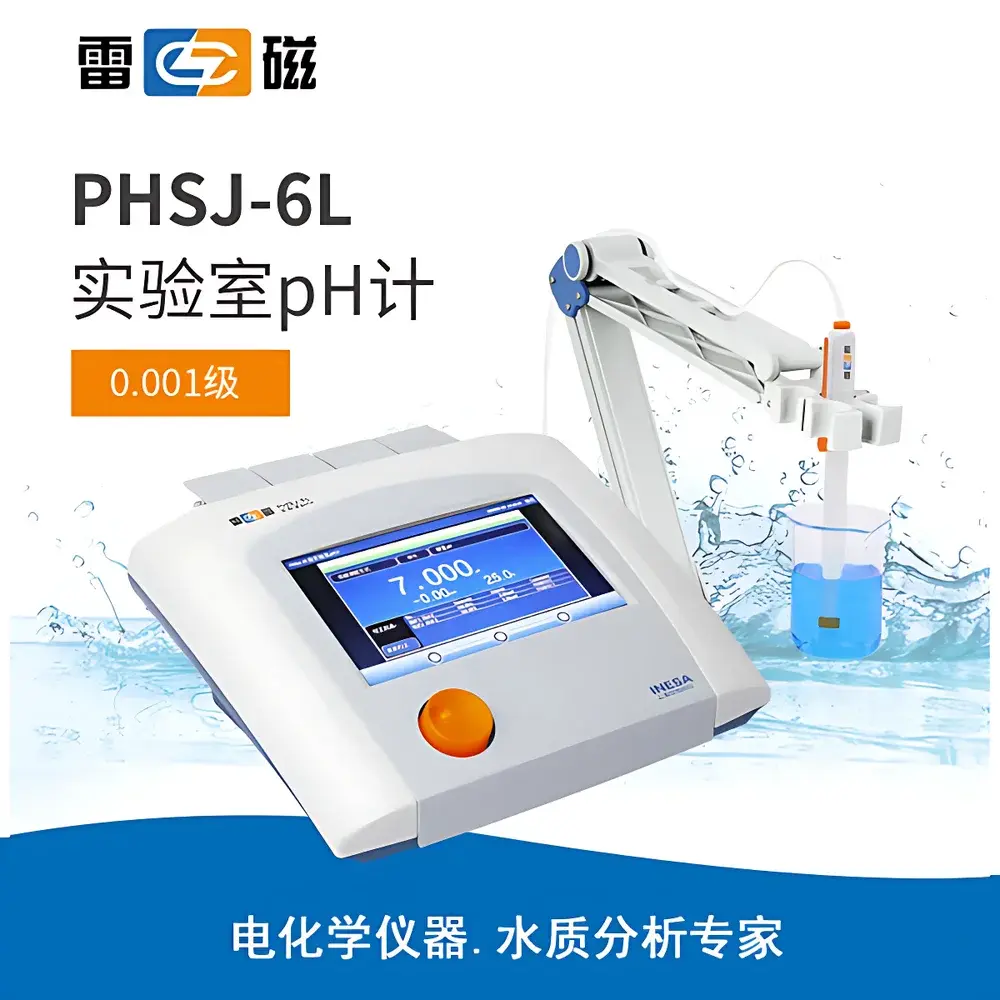
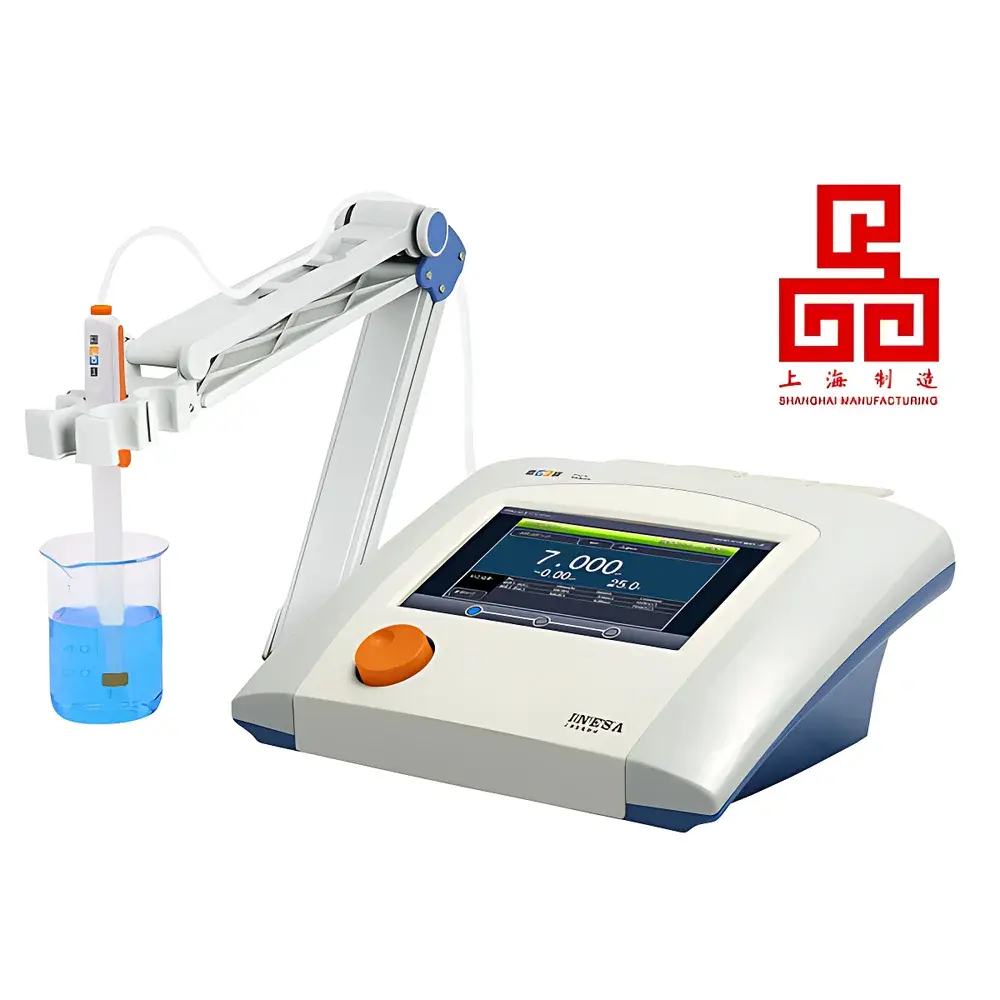
Leici PHSJ-6L Benchtop pH/ORP/Temperature Meter
| Brand | Leici |
|---|---|
| Origin | Shanghai, China |
| Model | PHSJ-6L |
| Instrument Type | Benchtop |
| Parameter Types | pH, mV (ORP), Temperature |
| Measurement Accuracy | ±0.002 pH |
| Measurement Range | −2.000–20.000 pH |
| Resolution | 0.001 pH |
| Calibration Standards Supported | GB, DIN, NIST, and 22 additional certified buffer sets |
| Auto-Calibration Points | 1–6 points |
| Temperature Compensation | Automatic (ATC) with integrated sensor or manual entry |
| Data Storage Capacity | 1000 measurement records with metadata (timestamp, electrode ID, calibration status, operator ID) |
| Compliance | GLP-compliant audit trail, 21 CFR Part 11-ready configuration options |
| Connectivity | USB port for PC communication and USB flash drive data export |
| Power Supply | 24 V DC adapter (100–240 V AC input) |
| Dimensions (W×D×H) | 280 × 280 × 130 mm |
| Weight | 2.5 kg |
Overview
The Leici PHSJ-6L is a high-precision benchtop pH/ORP/temperature meter engineered for routine and regulated laboratory applications in quality control, environmental testing, pharmaceutical manufacturing, and academic research. It operates on the fundamental principle of potentiometric measurement: the potential difference between a pH-sensitive glass electrode and a stable reference electrode is converted into a quantitative pH value using the Nernst equation. The instrument simultaneously measures millivolt (mV) output for oxidation-reduction potential (ORP) analysis and integrates a high-stability temperature sensor to enable real-time automatic temperature compensation (ATC), critical for accurate pH determination across variable sample conditions. Designed to meet stringent metrological requirements, the PHSJ-6L conforms to Chinese national standard JJG 119–2018 (Calibration Regulations for pH Meters) and supports international traceability through built-in recognition of NIST, DIN, and GB-certified buffer solutions—ensuring consistency with ISO/IEC 17025-accredited calibration practices.
Key Features
- Triple-parameter measurement: simultaneous, synchronized acquisition of pH, ORP (mV), and temperature with independent resolution settings (0.001 pH, 0.01 mV, 0.1 °C).
- Intelligent endpoint detection: configurable reading modes including auto-read (with stability threshold), timed read, interval read, and manual capture—reducing operator variability and improving throughput.
- Multi-point calibration management: supports 1–6 point pH calibration with dynamic slope and offset validation; automatic electrode diagnostics flag aging or contamination based on response time and asymmetry potential.
- Comprehensive buffer library: recognizes 25 pre-programmed standard buffers (including NIST-traceable TRIS, BORAX, and phosphate series), plus user-defined buffer groups with customizable pH values and temperature coefficients.
- GLP-compliant data governance: each stored record includes timestamp, operator ID, electrode serial number, calibration history, ambient temperature, and measurement mode—enabling full analytical traceability.
- Modular connectivity: USB interface supports bidirectional communication with Windows-based LecSoft™ desktop software for method deployment, report generation, and electronic signature workflows compliant with FDA 21 CFR Part 11 when configured with role-based access control.
Sample Compatibility & Compliance
The PHSJ-6L is compatible with all standard combination pH electrodes featuring BNC connectors and integrated temperature sensors (e.g., ATC or NTCS thermistors). It accommodates aqueous, low-ionic-strength, viscous, and mildly corrosive samples typical in wastewater analysis, fermentation monitoring, and formulation QA/QC. Its extended pH range (−2.000 to 20.000) permits reliable measurement in strongly acidic or alkaline media such as caustic cleaning solutions or battery electrolytes. The instrument’s hardware architecture and firmware design align with IEC 61010-1 safety standards for electrical equipment used in laboratories. While not inherently 21 CFR Part 11 certified out-of-the-box, its audit trail functionality—including immutable timestamps, user authentication logs, and calibration event tracking—provides the foundational infrastructure required for GxP environments under GLP and GMP frameworks.
Software & Data Management
Data handling is implemented via an embedded 1000-record non-volatile memory system with structured metadata fields. Records can be reviewed, filtered by date/operator/electrode, statistically analyzed (mean, SD, min/max), exported in CSV or PDF format, and printed directly via USB-connected thermal or laser printers. The optional LecSoft™ Suite enables centralized method templates, remote firmware updates, and batch report generation with customizable headers, footers, and regulatory footnotes. When paired with networked PCs and domain-authenticated user accounts, the system supports electronic signatures, change control logs, and versioned method archiving—fulfilling core ALCOA+ (Attributable, Legible, Contemporaneous, Original, Accurate, Complete, Consistent, Enduring, Available) data integrity criteria.
Applications
- Pharmaceutical water system monitoring (PW, WFI) per USP and .
- Environmental compliance testing of surface water, effluent, and soil leachates (EPA Method 9040C, ISO 10523).
- Food and beverage pH verification during HACCP-critical process steps (e.g., acidification, fermentation, thermal processing).
- Chemical manufacturing QC for raw material acceptance, in-process titration endpoints, and final product release.
- Academic teaching labs requiring robust, repeatable instrumentation with pedagogical calibration diagnostics and student account management.
FAQ
Does the PHSJ-6L support automatic electrode identification?
No—it does not feature RFID or digital electrode recognition. However, it allows manual assignment of electrode IDs during calibration and stores those identifiers with each measurement record for traceability.
Can the instrument perform direct mV measurements without pH calibration?
Yes. The mV (ORP) channel operates independently; no pH calibration is required for redox potential quantification.
Is temperature compensation mandatory for pH measurement?
Automatic temperature compensation is enabled by default but can be disabled for specialized applications requiring manual correction or fixed-temperature reporting.
What file formats are supported for data export?
CSV (for spreadsheet analysis) and PDF (for auditable reports with embedded metadata and digital signatures via LecSoft™).
How often should the internal calibration be verified?
Leici recommends annual verification against traceable reference standards in accordance with ISO/IEC 17025 or internal quality assurance protocols; factory recalibration is available through authorized service centers.
Related Products






