
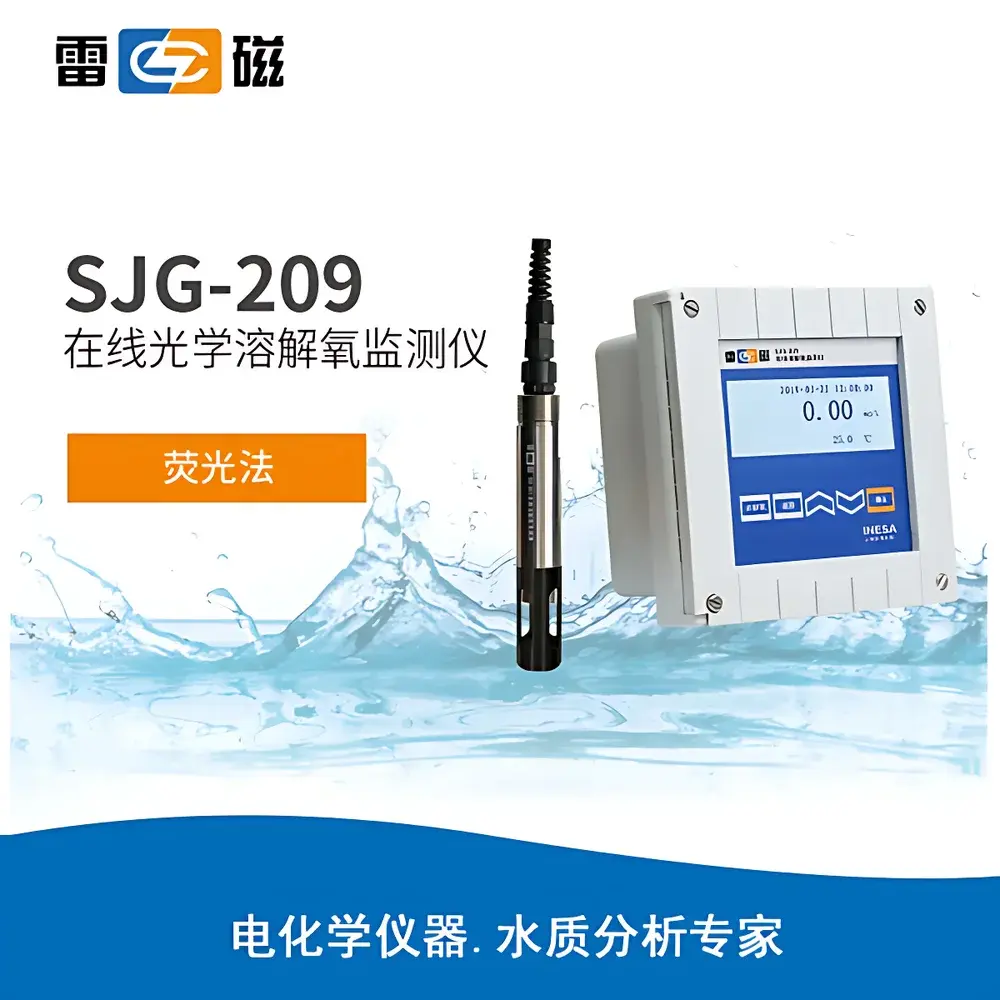
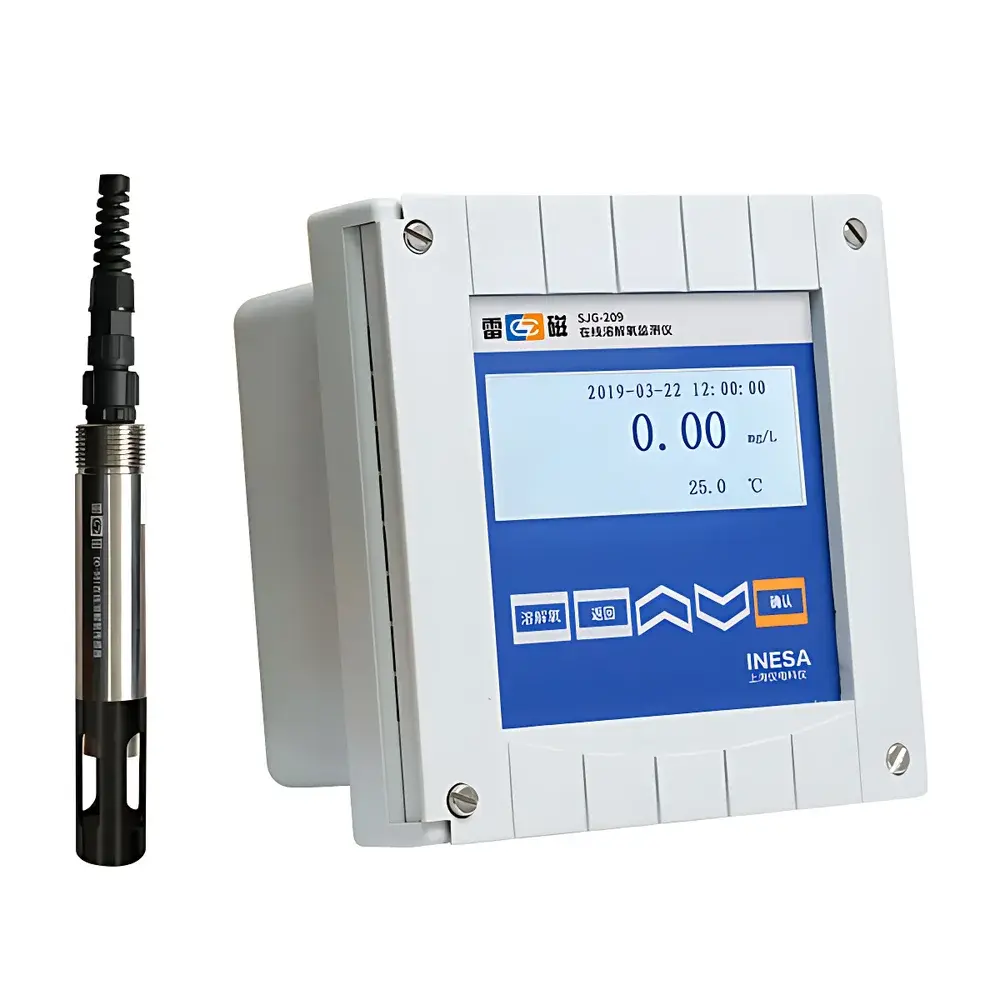
Leici SJG-209 Online Optical Dissolved Oxygen Monitor
| Brand | Leici |
|---|---|
| Origin | Shanghai, China |
| Model | SJG-209 |
| Instrument Type | Online |
| Measurement Range | (0.0–20.0) mg/L DO |
| Repeatability | ≤ 0.20 mg/L |
| Resolution | 0.01 mg/L (DO), 0.1% (saturation), 0.1°C (temperature) |
| Basic Accuracy | ±0.30 mg/L (DO), ±10.0% (saturation), ±0.2°C (temperature) |
| Stability | ±0.20 mg/L / 24 h |
| Output | Isolated 4–20 mA DC (max. load 600 Ω), RS-485 digital interface |
| Alarm & Control | Dual limit relays (220 V AC, 2.5 A), one programmable cleaning relay |
| Data Storage | 2000 records with timestamp |
| Enclosure Rating | IP65 |
| Dimensions | 166 × 166 × 110 mm |
| Weight | 2.5 kg |
Overview
The Leici SJG-209 Online Optical Dissolved Oxygen Monitor is an industrial-grade, optical-based sensor system engineered for continuous, real-time measurement of dissolved oxygen (DO) concentration in aqueous environments. Unlike electrochemical Clark-type sensors, the SJG-209 employs luminescence quenching technology—where molecular oxygen modulates the lifetime and intensity of a fluorescent dye excited by blue LED light. This principle delivers inherent advantages including zero oxygen consumption during measurement, no electrolyte depletion, minimal drift, and immunity to flow rate variations or hydrogen sulfide interference. Designed specifically for unattended operation in demanding water infrastructure applications, the SJG-209 integrates a rugged optical probe with a dedicated transmitter unit capable of simultaneous output of DO concentration (mg/L), percent saturation (%), and temperature (°C). Its robust architecture supports long-term deployment in wastewater treatment plants, drinking water distribution systems, aquaculture facilities, and surface water monitoring stations where regulatory compliance, data continuity, and operational reliability are mission-critical.
Key Features
- Optical luminescence-based DO sensing—no membrane replacement, no electrolyte refills, no polarization time required
- Simultaneous measurement and display of dissolved oxygen (mg/L), saturation (%), and temperature (°C)
- Automatic temperature compensation using integrated Pt1000 RTD sensor; configurable barometric pressure compensation for altitude correction
- Three-point calibration support: zero-oxygen (sodium sulfite solution), air-saturation (100% O2 at ambient conditions), and pressure-adjusted full-scale calibration
- Isolated 4–20 mA analog output with fully adjustable span and zero points for both DO concentration and saturation modes
- RS-485 Modbus RTU digital interface for integration into SCADA, DCS, or PLC-based control systems
- Dual programmable alarm relays (NO/NC) with user-defined high/low thresholds and hysteresis settings
- Dedicated cleaning control relay with configurable on/off timing—enables automated mechanical or chemical probe cleaning cycles
- Onboard non-volatile memory stores up to 2000 timestamped measurement records (DO, saturation, temperature, and system status)
- IP65-rated NEMA 4X enclosure—suitable for panel-mount or wall-mount installation in humid, splash-prone environments
Sample Compatibility & Compliance
The SJG-209 is validated for use in freshwater, seawater (with optional salinity compensation), municipal wastewater, activated sludge, and potable water matrices. It meets general requirements for continuous emission monitoring systems (CEMS) under national environmental standards (e.g., HJ 506-2009 for water quality—determination of dissolved oxygen—electrochemical probe method, adapted for optical equivalence). While not certified to ISO 5814 or ASTM D888 for laboratory-grade validation, its performance characteristics—including repeatability ≤ 0.20 mg/L and stability ±0.20 mg/L over 24 hours—align with field-deployable instrumentation expectations for Class II and III water quality monitoring per Chinese Ministry of Ecology and Environment (MEE) guidelines. The device supports audit-ready data logging and does not implement FDA 21 CFR Part 11 electronic signature functionality; however, raw output signals (4–20 mA, Modbus registers) are compatible with third-party LIMS or historian systems configured for ALCOA+ data integrity principles.
Software & Data Management
The SJG-209 operates as a standalone transmitter without proprietary PC software. Configuration, calibration, and diagnostic functions are executed via intuitive front-panel keypad navigation with LCD menu structure. All critical parameters—including calibration coefficients, alarm setpoints, relay timing, output scaling, and date/time—are stored in EEPROM and retained during power loss. The 2000-entry internal log includes measurement values, timestamps (year/month/day/hour/minute), and event flags (e.g., calibration performed, alarm triggered, cleaning cycle initiated). Data export requires external acquisition via RS-485 Modbus polling (function codes 03/04); register mapping follows standard Leici protocol documentation. For enterprise-level integration, the 4–20 mA output may be connected to analog input modules compliant with IEC 61000-4-5 surge immunity and IEC 61326-1 EMC requirements.
Applications
- Wastewater treatment: Real-time DO feedback control in aerobic bioreactors and aeration basins to optimize energy consumption and nitrification efficiency
- Drinking water reservoirs and intake points: Early detection of hypoxic events or algal bloom-related oxygen depletion
- Aquaculture operations: Closed-loop monitoring of dissolved oxygen levels in recirculating aquaculture systems (RAS) to prevent fish stress or mortality
- Industrial cooling water circuits: Detection of corrosion risk associated with low DO or oxygen pitting in condenser tubes
- Environmental monitoring networks: Fixed-station deployment for long-term trend analysis of riverine or estuarine oxygen dynamics
FAQ
Does the SJG-209 require routine membrane replacement or electrolyte refilling?
No—this is an optical sensor system utilizing solid-state luminescent chemistry. There are no consumable membranes or liquid electrolytes.
Can the instrument compensate for salinity effects on DO readings?
The base model does not include automatic salinity compensation; however, manual correction factors can be applied during calibration setup based on known conductivity or chloride concentration.
What is the maximum cable length between the optical probe and transmitter?
Standard configuration supports up to 10 meters using shielded twisted-pair cable; extended reach (up to 50 m) is achievable with low-capacitance cable and proper grounding per IEC 61000-6-2.
Is the device suitable for submersible probe installation in open-channel flow?
Yes—the optical probe (sold separately, e.g., Leici DO-209 series) is rated IP68 and designed for permanent submersion in flowing or static water bodies.
How often should calibration be performed in continuous operation?
Field validation recommends zero and span calibration every 7–14 days depending on fouling potential; stable installations with low organic loading may extend intervals to 30 days with documented verification.
Related Products







