
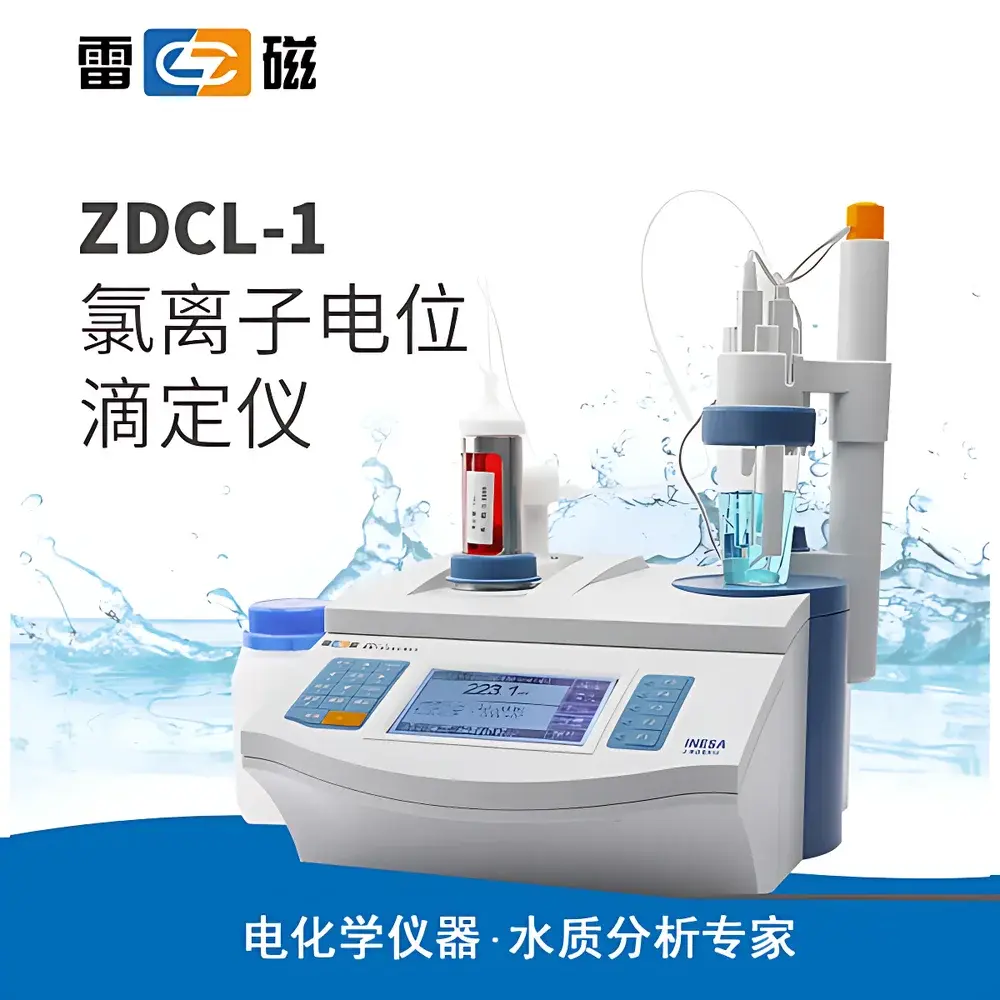
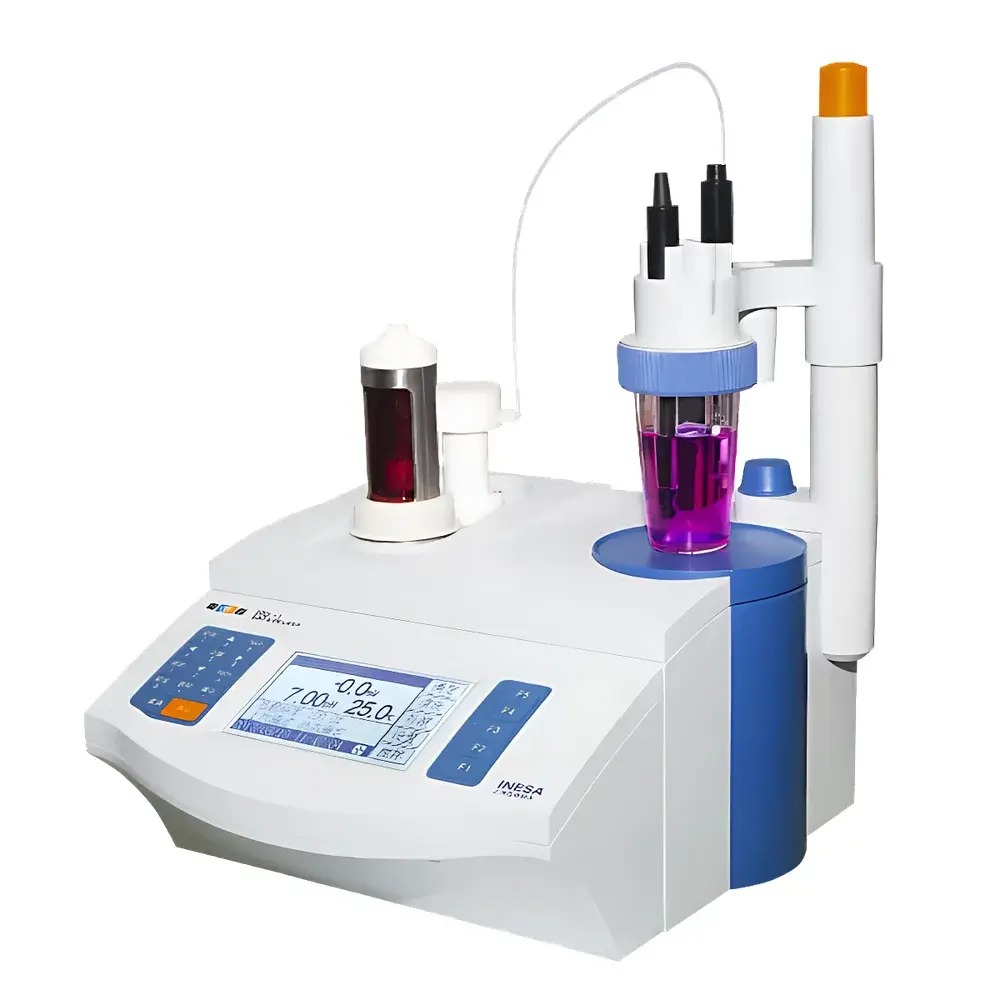
Leici ZDCL-1 Chloride Ion Automatic Potentiometric Titrator
| Brand | Leici |
|---|---|
| Origin | Shanghai, China |
| Model | ZDCL-1 |
| Instrument Type | General-purpose Potentiometric Titrator |
| Application Scope | Dedicated for Chloride Ion Determination |
| Measurement Range | (−1800.0 to +1800.0) mV |
| Potentiometer Accuracy | ±0.20% of full scale |
| Potentiometer Resolution | 0.1 mV |
| Titration Accuracy | (±0.3 mV ±1 digit) over 3 h |
| Titration Resolution | 1/10000 |
| Burette Capacity | 10 mL |
| Burette Error | ±0.025 mL |
| Burette Delivery Time | (55 ± 10) s (at full scale) |
| Temperature Compensation Range | (−5.0 to 105.0) °C |
| Temperature Resolution | 0.1 °C |
| Temperature Accuracy | ±0.3 °C |
Overview
The Leici ZDCL-1 Chloride Ion Automatic Potentiometric Titrator is a dedicated electrochemical analytical instrument engineered for precise, trace-level quantification of chloride ions (Cl⁻) in solid and liquid matrices—particularly cement, concrete admixtures, construction materials, and aqueous environmental or industrial samples. It operates on the principle of potentiometric titration using a silver nitrate (AgNO₃) standard solution and a selective silver/silver chloride (Ag/AgCl) indicator electrode, where the endpoint is determined by an inflection point in the potential–volume curve. The system complies with internationally referenced standard methods including GB/T 176–2017 *Chemical Analysis of Cement* and GB/T 8077–2012 *Uniformity Tests for Concrete Admixtures*, both of which specify potentiometric titration as the reference procedure for chloride determination in high-ionic-strength, heterogeneous samples. Designed for routine QC/QA laboratories, the ZDCL-1 integrates a stable electrometric measurement circuit, high-resolution burette drive mechanism, and temperature-compensated electrode interface to ensure reproducibility under variable ambient conditions.
Key Features
- High-fidelity potentiometric measurement module with ±0.20% full-scale accuracy and 0.1 mV resolution across a wide dynamic range (−1800.0 to +1800.0 mV), enabling reliable detection of subtle potential shifts during endpoint recognition.
- Dedicated chloride analysis firmware supporting three operational modes: (1) sample chloride content determination, (2) standardization of AgNO₃ titrant concentration, and (3) blank volume correction—each with method-specific calibration logic and endpoint algorithm selection.
- 10 mL precision burette with certified volumetric error ≤ ±0.025 mL and 1/10000 volumetric resolution, delivering consistent reagent dosing even at sub-microliter increments near the equivalence point.
- Integrated temperature compensation (−5.0 to 105.0 °C, 0.1 °C resolution, ±0.3 °C accuracy) to correct for thermal drift in electrode potential and solution conductivity—critical for non-isothermal titrations in cement slurry or heated digestates.
- Dot-matrix LCD display with real-time graphical rendering of titration curves (E vs. V), stepwise protocol guidance, and concurrent display of current method parameters, cumulative volume, and calculated results.
Sample Compatibility & Compliance
The ZDCL-1 is optimized for chloride analysis in complex, high-salt, particulate-laden matrices typical of construction chemistry—including Portland cement clinker, blended cements, concrete admixtures, fly ash, slag, and hardened mortar extracts. Its robust electrode interface accommodates conventional double-junction Ag/AgCl reference electrodes and solid-state chloride-selective sensors. Method validation aligns with Chinese national standards GB/T 176–2017 and GB/T 8077–2012, which are harmonized with ISO 9597 (determination of chloride in hydraulic cements) and ASTM C114 (standard test methods for chemical analysis of hydraulic cement). While not pre-certified for FDA 21 CFR Part 11, the instrument’s GLP-compliant data structure—including timestamped method files, operator ID fields, and immutable result logs—supports audit-ready documentation for regulated QA environments.
Software & Data Management
The ZDCL-1 communicates via RS-232 serial interface with proprietary titration software running on Windows-based PCs. This software enables remote method configuration, live curve visualization, automated endpoint calculation (first derivative, second derivative, or fixed-potential threshold), and export of raw E–V datasets in CSV format. Internal memory stores up to 200 complete titration reports—including sample ID, titrant concentration, blank correction value, final Cl⁻ concentration (mg/kg or %), statistical deviation, and full titration curve coordinates—each tagged with date, time, operator code, and instrument serial number. All stored records conform to GLP traceability requirements: no data overwriting is permitted; deletion requires dual authorization; and printed reports include embedded digital signatures and revision-controlled method version stamps.
Applications
- Quality control of cement raw materials and finished products per GB/T 176–2017, ensuring chloride content remains below critical thresholds (<0.10% for prestressed concrete applications) to prevent steel reinforcement corrosion.
- Verification of chloride impurity limits in concrete admixtures (e.g., water reducers, retarders, accelerators) as mandated by GB/T 8077–2012 and EN 934–2.
- Environmental monitoring of leachates from construction waste or contaminated soils using standardized extraction protocols followed by potentiometric titration.
- Routine analysis in university and government research labs studying chloride ingress mechanisms in cementitious systems, alkali–silica reaction mitigation, or durability modeling.
- Batch release testing in precast concrete manufacturing facilities requiring rapid, operator-independent chloride verification prior to shipment.
FAQ
What electrode types are compatible with the ZDCL-1 for chloride titration?
The instrument supports standard Ag/AgCl double-junction reference electrodes and silver indicator electrodes; compatibility with solid-state chloride-selective electrodes (e.g., PVC membrane-based) is confirmed for non-aqueous or low-ionic-strength samples.
Does the ZDCL-1 support multi-point calibration of the AgNO₃ titrant?
Yes—the built-in standardization mode allows sequential titration of ≥3 potassium chloride (KCl) reference solutions to compute mean titrant concentration and assess inter-run precision (RSD ≤ 0.20%).
Can titration curves be exported for third-party statistical analysis?
Yes—raw potential (mV) and volume (mL) data pairs are exportable in comma-separated values (CSV) format via the PC software, retaining full resolution and timestamps for regression or uncertainty propagation studies.
Is temperature compensation mandatory during chloride titration?
While not strictly mandatory, it is strongly recommended: electrode potential exhibits measurable thermal dependence (≈0.5–1.2 mV/°C), and uncorrected drift may introduce systematic bias >0.5% in high-precision cement assays.
How does the ZDCL-1 handle sample turbidity or suspended solids?
The method relies on potentiometric endpoint detection—not optical clarity—so filtered or centrifuged extracts (per GB/T 176 Annex A) are analyzed directly; no UV/vis interference or photometric limitations apply.
Related Products






