
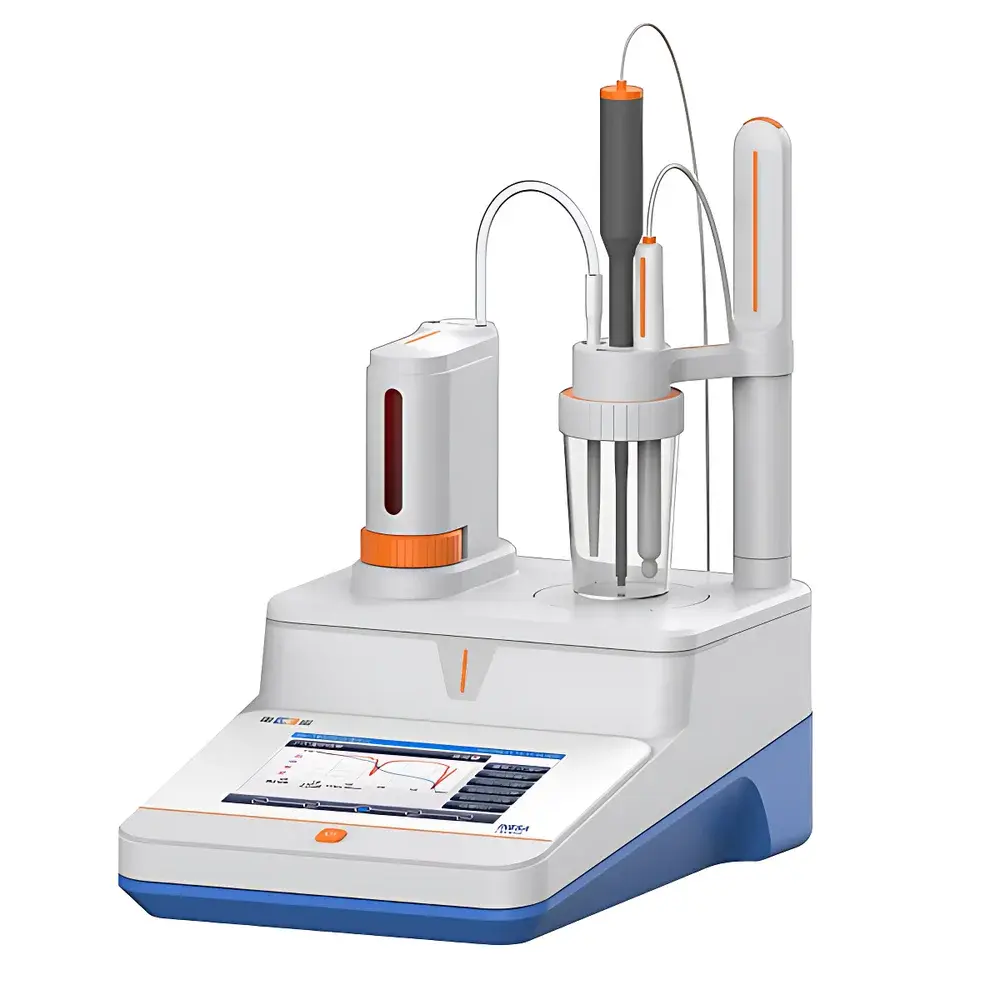
Leici ZDJ-4D Automatic Potentiometric Titrator
| Brand | Leici |
|---|---|
| Origin | Shanghai, China |
| Model | ZDJ-4D |
| Instrument Type | General-purpose Potentiometric Titrator |
| Application Scope | Universal |
| mV Measurement Range | −2000.0 to +2000.0 mV |
| pH Measurement Range | −5.000 to 20.000 pH |
| mV Resolution | 0.01 mV |
| pH Resolution | 0.001 pH |
| Temperature Compensation Range | −10.0 to 135.0 °C |
| Temperature Resolution | 0.1 °C |
| Titration Resolution | 1/20000 |
| Titration Modes | Dynamic, Fixed-volume, Pre-set Endpoint, Manual |
| Endpoint Detection Methods | Pre-set Potential, First Derivative (dE/dV), Second Derivative (d²E/dV²) |
| Display | 8-inch color touchscreen |
| Interface | USB, RS232 (bidirectional) |
| Software Compliance | Supports GMP-compliant operation via PC software with audit trail and user permission levels |
Overview
The Leici ZDJ-4D Automatic Potentiometric Titrator is a precision-engineered electrochemical analytical instrument designed for high-reproducibility volumetric analysis based on potentiometric endpoint detection. It operates on the fundamental principle of monitoring potential changes (in mV or pH) across a redox, acid–base, precipitation, or complexometric titration reaction using a reference electrode and an indicator electrode—typically a glass electrode for pH or a platinum/silver/silver chloride electrode for redox systems. The instrument continuously records electrode potential versus delivered titrant volume, enabling robust endpoint identification through real-time derivative analysis. Engineered for laboratory environments requiring regulatory compliance and method traceability, the ZDJ-4D integrates hardware-level measurement stability with software-supported data integrity controls.
Key Features
- High-resolution potentiometric measurement: ±0.01 mV resolution and ±0.001 pH resolution ensure precise detection of subtle potential inflections during titration.
- Wide operational range: Supports pH measurements from −5.000 to 20.000 and mV readings from −2000.0 to +2000.0 mV—accommodating aggressive non-aqueous, highly alkaline, or strongly acidic matrices.
- Intelligent titration control: Four programmable titration modes—including dynamic (adaptive addition rate based on slope), fixed-volume, pre-set endpoint, and manual override—allow optimization for diverse reaction kinetics.
- Advanced endpoint recognition: Implements three algorithmic methods—predefined potential threshold, first derivative (dE/dV), and second derivative (d²E/dV²)—to minimize subjectivity and enhance inter-operator reproducibility.
- Integrated temperature compensation: Built-in temperature sensor with 0.1 °C resolution and compensation range from −10.0 to 135.0 °C enables accurate activity correction in thermally variable samples (e.g., hot-process streams or cryogenic solvents).
- Regulatory-ready architecture: Features triple-tier user authentication (Operator, Supervisor, Administrator), electronic signature support, and full audit trail logging when used with optional PC-based software compliant with FDA 21 CFR Part 11 and GLP/GMP requirements.
Sample Compatibility & Compliance
The ZDJ-4D is compatible with standard ASTM E2087, ISO 8655-6, and USP protocols for titrimetric analysis. Its universal electrode interface supports interchangeable pH, redox, ion-selective, and conductometric sensors, enabling analysis of aqueous, alcoholic, acetonitrile-based, and mixed-solvent systems. The instrument meets IEC 61010-1 safety standards for laboratory electrical equipment and incorporates electromagnetic compatibility (EMC) shielding per EN 61326-1. All firmware and calibration routines are traceable to NIST-traceable reference standards; certificate of conformance is supplied with each unit.
Software & Data Management
The ZDJ-4D communicates bidirectionally via USB and RS232 interfaces, enabling seamless integration with Windows-based Leici TitrSoft™ software (v3.x or later). This platform provides method creation, sequence programming, real-time curve overlay, automated report generation (PDF/CSV), and long-term data archiving. Audit trail functionality logs all user actions—including method edits, calibration events, result modifications, and login/logout timestamps—with immutable timestamps and operator IDs. Data export complies with LIMS interoperability standards (ASTM E1578, HL7) and supports secure transfer via encrypted FTP or network share. Electronic signatures adhere to ALCOA+ principles (Attributable, Legible, Contemporaneous, Original, Accurate, Complete, Consistent, Enduring, Available).
Applications
The ZDJ-4D delivers validated performance across pharmaceutical QC (e.g., assay of active ingredients, residual chloride in APIs), environmental testing (COD, alkalinity, cyanide), food & beverage analysis (acidity, salt content, SO₂), petrochemical QA (TAN/TBN), and academic research in coordination chemistry and reaction mechanism studies. Its broad pH/mV range supports non-aqueous titrations (e.g., perchloric acid in glacial acetic acid), while high-resolution endpoint detection ensures accuracy in low-concentration determinations such as trace halides or weak acids (pKa > 7). Method validation documentation—including precision (RSD < 0.3%), linearity (r² ≥ 0.999), and robustness data—is available upon request.
FAQ
Does the ZDJ-4D support GLP-compliant data handling?
Yes—when operated with certified TitrSoft™ software, it provides full audit trail, electronic signatures, role-based access control, and 21 CFR Part 11–compliant data integrity features.
Can the instrument be calibrated with external reference standards?
Yes—it accepts user-defined calibration points for both pH and mV channels, supporting multi-point calibration against NIST-traceable buffers and redox standards.
Is remote operation possible?
Remote control and real-time monitoring are supported via Ethernet-to-serial adapters or direct USB connection to a networked PC running TitrSoft™.
What electrode types are compatible?
Standard BNC and mini-DIN connectors accommodate glass pH electrodes, platinum redox electrodes, Ag/AgCl reference electrodes, and specialized ion-selective electrodes (e.g., fluoride, calcium).
How is method validation documented?
Each method file includes embedded metadata: operator ID, date/time stamp, electrode serial number, calibration history, and raw titration curve data—exportable for inclusion in regulatory submissions.
Related Products



