
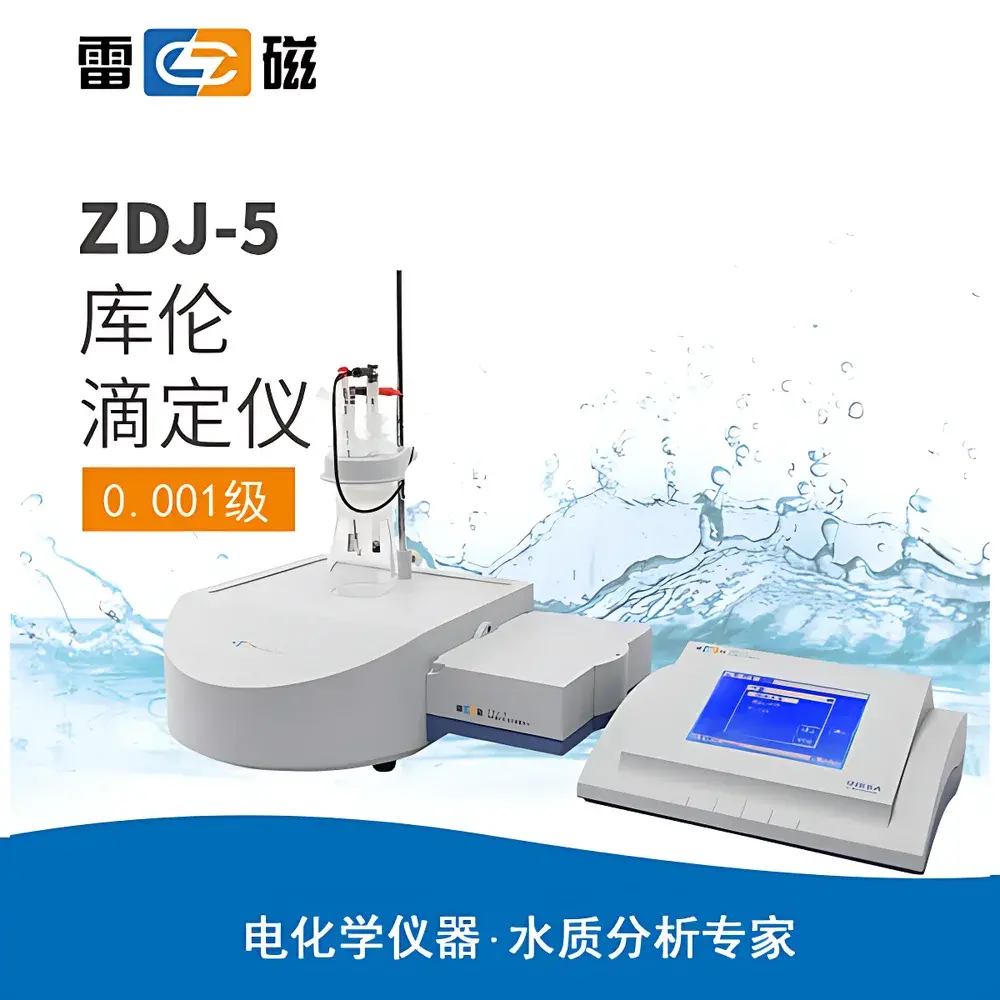
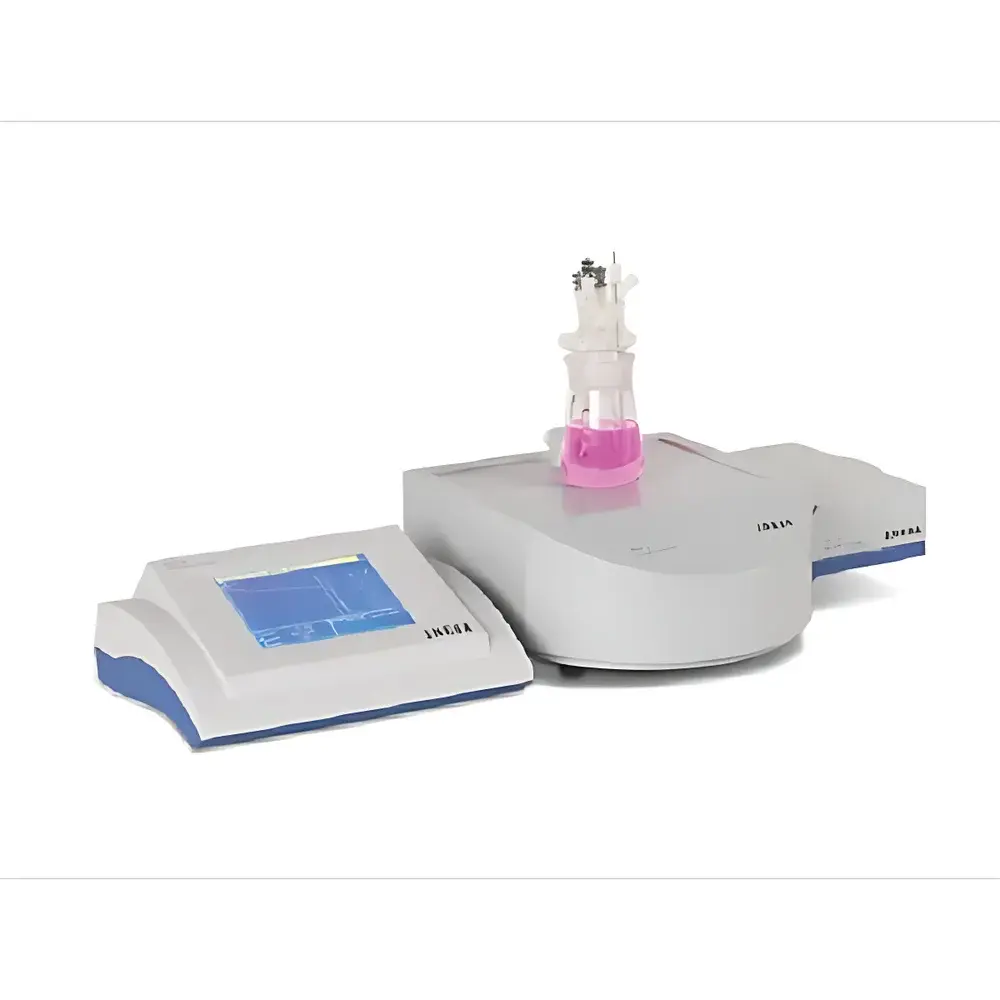
Leici ZDJ-5 Coulometric Titrator
| Brand | Leici |
|---|---|
| Origin | Shanghai, China |
| Model | ZDJ-5 |
| Measurement Range | (−1999.9 to +1999.9) mV |
| Electrolysis Current Options | 1 mA, 10 mA, 50 mA |
| Electrolysis Current Accuracy | ±0.25% of reading (max. load: 500 Ω) |
| Titration Repeatability | ≤0.5% (minimum integration time: 3 s) |
| Power Supply | AC (220 ± 22) V, (50 ± 1) Hz |
| Dimensions | 360 × 300 × 300 mm |
| Weight | 10 kg |
| Interface | RS-232 (bidirectional), USB support for data export and firmware update |
| Software | ZDJ-5专用滴定分析软件 (ZDJ-5 Titrator Control & Analysis Suite) |
| Stirring System | PWM-controlled magnetic stirrer with software-adjustable speed |
| Printer Compatibility | TP-16, TP-24, or TP-40 serial printers |
Overview
The Leici ZDJ-5 Coulometric Titrator is a precision electrochemical instrumentation platform engineered for quantitative coulometric titrations based on Faraday’s law of electrolysis. Unlike conventional volumetric titrators, the ZDJ-5 generates titrant electrochemically at the working electrode—eliminating the need for standardized reagent solutions and minimizing volumetric errors associated with burette calibration, temperature-induced expansion, or reagent instability. The instrument operates by applying a controlled current across an electrolytic cell and measuring the resulting potential shift (mV) between indicator and reference electrodes. Its core measurement circuit delivers high-resolution potential monitoring within ±1999.9 mV, enabling accurate endpoint detection in redox, precipitation, complexometric, and acid-base coulometric assays. Designed for laboratory environments requiring trace-level quantification and method reproducibility—especially in quality control labs, environmental testing facilities, and academic electrochemistry research—the ZDJ-5 integrates modular hardware architecture with rigorous signal conditioning to ensure stability under variable ionic strength and low-conductivity sample conditions.
Key Features
- 5.7-inch capacitive touch LCD interface with intuitive Chinese-language UI; supports direct operation without external PC
- Modular three-unit architecture: independent Coulometric Generator Unit, Control Unit, and Measurement Unit (pH/mV), allowing flexible configuration and serviceability
- Multi-mode titration capability: dynamic titration (with real-time derivative calculation), preset-endpoint titration, constant-current manual titration, and user-defined custom protocols
- Real-time graphical display of E-t (potential vs. time) curves, first-derivative (dE/dt), and second-derivative (d²E/dt²) plots directly on screen or via PC synchronization
- PWM-driven magnetic stirring system with software-adjustable speed (0–1200 rpm), optimized for low acoustic noise and consistent mass transport during electrolysis
- Bidirectional RS-232 interface compliant with standard SCPI command syntax; supports remote control, script-based method execution, and audit-trail logging
- USB port for firmware updates, U-disk data export (CSV, TXT), and optional integration with automated sample handling peripherals
Sample Compatibility & Compliance
The ZDJ-5 accommodates aqueous and mixed-solvent samples compatible with standard Ag/AgCl, SCE, or Pt indicator/reference electrode configurations. It meets fundamental performance criteria outlined in ISO 8655-6 (volumetric and coulometric titrators), ASTM D4308 (coulometric Karl Fischer titration), and general requirements for GLP-compliant electrochemical analysis. While not pre-certified for FDA 21 CFR Part 11, its software architecture supports operator authentication, electronic signature fields, and timestamped method/data logs—enabling laboratories to configure validation packages per internal SOPs or regulatory audits. All electrical components conform to IEC 61010-1 safety standards for laboratory equipment.
Software & Data Management
The proprietary ZDJ-5 Titrator Control & Analysis Suite runs on Windows OS (7/10/11, 64-bit) and provides a virtual front panel mirroring hardware functionality. Users may create, edit, and archive titration methods—including current selection, integration time windows, endpoint algorithms (inflection point, fixed potential, or derivative threshold), and post-run calculation formulas (e.g., mg/L Cl⁻, µmol/g antioxidant capacity). Raw E-t data and derivative curves are stored in structured binary format with metadata (operator ID, date/time, method name, sample ID). Export options include CSV for LIMS integration, PDF reports with embedded graphs, and database-ready XML exports. Audit trails record all parameter changes, start/stop events, and result approvals—supporting traceability requirements under ISO/IEC 17025 and pharmaceutical QC workflows.
Applications
- Determination of trace halides (Cl⁻, Br⁻, I⁻) in pharmaceutical excipients using silver coulometry
- Quantification of sulfur compounds in petrochemical feedstocks via iodine coulometric titration
- Water content analysis in solvents and polymers (adapted Karl Fischer principle)
- Redox titrations of Fe²⁺/Ce⁴⁺, As(III)/I₂, or hydrazine derivatives in environmental water matrices
- Stability-indicating assays for oxidizable APIs where reagent shelf-life limits volumetric approaches
- Educational use in undergraduate electrochemistry labs for validating Faraday efficiency and charge-transfer kinetics
FAQ
What types of electrodes are compatible with the ZDJ-5?
The instrument accepts standard BNC-connected reference and indicator electrodes, including double-junction Ag/AgCl, saturated calomel (SCE), and platinum microelectrodes. Electrode compatibility is verified per ISO 6411 specifications.
Can the ZDJ-5 perform both coulometric and potentiometric titrations?
It is primarily designed for coulometric titration; however, the integrated pH/mV measurement unit allows standalone potentiometric monitoring and endpoint detection when used with external titrant dispensers (not included).
Is method validation documentation available?
Leici provides a basic Instrument Qualification (IQ/OQ) checklist. Full PQ protocols must be developed in-house per application-specific matrix and regulatory context.
Does the system support automatic sample changers?
Yes—via RS-232 TTL-level handshake signals. Third-party auto-samplers (e.g., Metrohm 815, Hanna HI902C-compatible units) can be integrated using custom command mapping.
What is the minimum detectable charge resolution?
Based on 50 mA full-scale current and 16-bit DAC control, the theoretical charge resolution is 0.3125 µC per step under 3 s integration—subject to cell resistance and electrode kinetics.
Related Products






